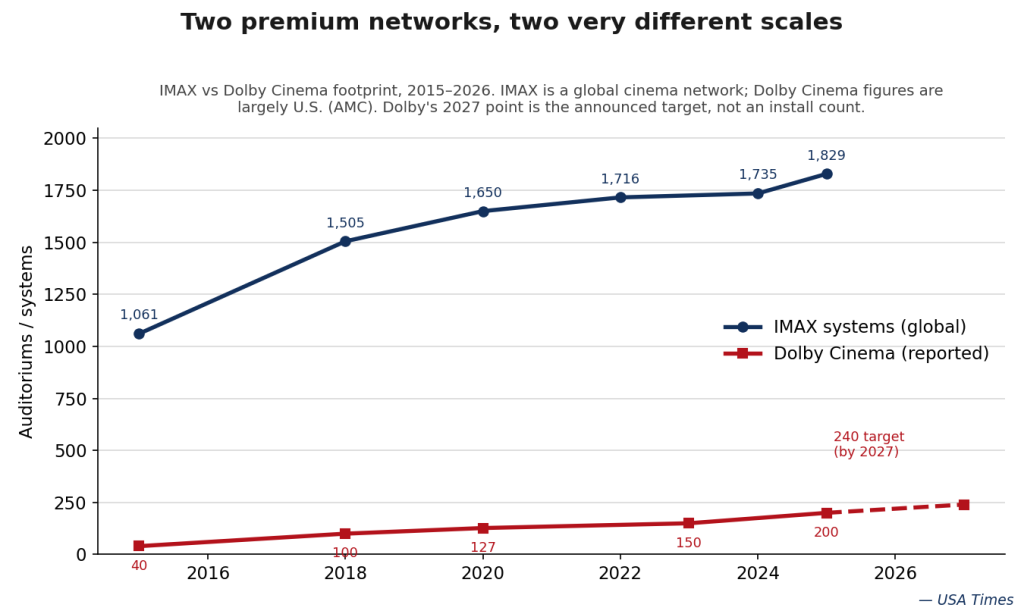
When exhibitors and studios talk about “premium large format” as the thing keeping theatrical alive, they usually name two brands in the same breath: IMAX and Dolby Cinema. It is a fair pairing on prestige — both are the screens filmmakers ask for and audiences will pay extra to sit in. It is a wildly unequal pairing on size. Trace the two networks across the last decade and you find one global build-out measured in the thousands and one boutique premium tier measured in the low hundreds, growing on entirely different logic.
USA Times pulled the reported screen counts year by year to see the shape of the race. The headline, visible at a glance in the chart above, is that IMAX ended the period roughly nine times larger than Dolby Cinema. But the more interesting story is in the slopes — because in percentage terms, the smaller network has been growing faster.
IMAX: a mature global network, still climbing
IMAX entered 2016 with 1,061 systems worldwide as of December 31, 2015. From there the network expanded steadily: about 1,505 systems by the end of 2018, roughly 1,650 by the end of 2020 despite the pandemic, 1,716 at the close of 2022, and 1,735 at year-end 2024. By September 30, 2025, IMAX reported 1,829 systems operating across 89 countries and territories, along with a backlog of hundreds more signed but not yet installed.
Batmandir · Founders A numbered seat at the table. S3 · The Founders Club — 161 seats per location. By invitation. Explore membership →That is roughly 770 net new systems in a decade — real growth, but growth off a very large base, which is why the curve flattens as it rises. IMAX is not trying to blanket the market; it is a scarcity brand that adds screens deliberately, often converting or upgrading existing premium auditoriums and increasingly pushing its laser projection into the network. The 2020 dip that never came is itself notable: unlike much of exhibition, IMAX’s installed base barely paused through the pandemic, because systems already in the ground stayed in the ground even when they went dark.
One structural point matters for reading these numbers: “IMAX systems” is an umbrella. It counts institutional and museum screens, commercial multiplex screens, digital xenon, digital laser and the tiny sliver of true 15/70mm film houses together. The network’s growth over the decade has overwhelmingly been digital, and more recently laser — not new film projectors, which remain a rounding error at around 41 screens globally.
Dolby Cinema: a younger, steeper, mostly American curve
Dolby Cinema is a decade newer as a mass-market proposition. The format launched with AMC in the United States in late 2014, so 2015 finds it in the low dozens of auditoriums — we peg it near 40 as an early-rollout estimate. From there it climbed past 100 sites around 2018, reached roughly 127 by 2020, and — after the pandemic slowed new builds — sat around 150 by 2023. By the March 2025 expansion announcement, Dolby and AMC put the U.S. total at “over 200,” and committed to 40 more by the end of 2027, which would bring the domestic network to roughly 240.
Run the math and the contrast with IMAX sharpens. Dolby Cinema roughly quintupled from around 40 to over 200 in a decade — a far steeper percentage climb than IMAX’s growth over the same span, even though the absolute number of screens added is a fraction of IMAX’s. That is exactly what you would expect from a younger network filling in a single large partner’s circuit rather than expanding a mature global footprint.
The other defining trait of Dolby Cinema is concentration. Where IMAX spreads across 89 countries and dozens of exhibitor partners, Dolby Cinema’s growth has been tightly coupled to AMC in the United States, with a smaller set of international sites through partners such as Pathe in Europe. When the AMC relationship expands, Dolby Cinema expands; the network’s fortunes ride largely on one exhibitor’s capital-spending appetite. That is a very different risk profile from IMAX’s diversified, licensing-driven model.
Why the two curves look nothing alike
The divergence is not an accident of timing. It reflects two different business models. IMAX sells and licenses a branded system to exhibitors all over the world and takes a cut of the box office; its incentive is broad global reach, and its screen count reflects thirty-plus years of that strategy. Dolby licenses a design-and-technology package — Dolby Vision projection plus Dolby Atmos sound in a room built to spec — primarily through deep partnerships with a few large chains. IMAX optimized for ubiquity early; Dolby optimized for a premium, controlled experience and is still scaling it.
For moviegoers, the practical upshot of the chart is availability. In most of the world outside the United States, “premium large format” in practice means IMAX, because Dolby Cinema barely exists there. Inside the United States, and especially at AMC, the two are real alternatives in the same building — which is exactly the situation where knowing the difference between them pays off.
The laser transition hiding inside IMAX’s number
There is a second growth story folded inside IMAX’s flat-looking top line, and it does not show up in a simple systems count. Over this decade IMAX has been steadily replacing its older digital xenon projectors with laser projection — first the premium dual-laser “GT” system reserved for its largest screens, then a single-projector commercial laser system built to roll out across the wider network. So even in years when the total systems number barely moves, the composition of the network is changing underneath it: an aging xenon base is being upgraded to laser, which improves brightness, contrast and, on the biggest screens, the ability to open up to the tall 1.43:1 frame.
This matters for anyone comparing IMAX to Dolby on quality rather than quantity. Dolby Cinema was laser from the start; every one of its roughly 200 auditoriums is a dual-4K Dolby Vision laser room. IMAX’s network is a mix, and the “IMAX” on your ticket could still be an older xenon system in some locations. The upgrade cycle means the gap in average picture quality between the two networks has been narrowing even where the gap in screen count has not. It also means IMAX’s real investment over the decade is understated by the headline count: a converted laser screen is a major capital upgrade that leaves the systems total unchanged.
Dolby’s growth, by contrast, is almost entirely additive rather than conversion-driven — new rooms built to a fixed spec, with little legacy hardware to replace. That is another reason the two curves behave differently: IMAX spends part of its capital deepening the network it already has, while Dolby spends nearly all of its on widening a younger one.
What the next two years likely hold
Both networks are still adding screens, and both have said so on the record. IMAX carries a signed backlog in the hundreds and continues to convert its base toward laser. Dolby has a concrete, dated commitment: 40 new U.S. auditoriums by the end of 2027. If both hit plan, the gap in raw screens stays enormous while Dolby keeps closing ground in percentage terms. What will not change on this timeline is the basic geometry the chart shows — IMAX the sprawling global network, Dolby the fast-growing premium enclave. They are rivals in prestige and, increasingly, in the same lobbies; they are not rivals in scale.
What we did
We assembled IMAX’s year-end and quarterly system counts from the company’s SEC filings and investor releases: 1,061 systems at year-end 2015, ~1,505 at year-end 2018, ~1,650 at year-end 2020, 1,716 at year-end 2022, 1,735 at year-end 2024, and 1,829 as of September 30, 2025. Dolby Cinema figures are compiled from Dolby and AMC announcements and contemporaneous trade reporting: an early-rollout estimate near 40 in 2015, over 100 by 2018, roughly 127 by 2020, about 150 by 2023, “over 200” in the March 2025 expansion release, and a stated target of roughly 240 U.S. auditoriums by the end of 2027. A note on comparability: IMAX’s count is a global, multi-format systems total, while Dolby Cinema’s is largely a U.S. auditorium count — so the chart compares two networks of different geographic scope, and the Dolby series carries more estimation, especially in its earliest years. The 2027 Dolby point is an announced target, not an installed count, and is drawn as such. Chart by USA Times.
- IMAX Corporation — Q4 and Full-Year 2024 results (year-end 2024 systems)
- IMAX Corporation — Form 10-K FY2022 (network count)
- IMAX Corporation — Full-Year 2015 results (1,061 systems)
- Dolby & AMC — Dolby Cinema expansion, over 200 auditoriums plus 40 by 2027
- Forbes — Dolby/AMC deal to expand Dolby Cinema (context)
- USA Times — the premium-ticket trap: how IMAX and PLF pricing props up the box office
- USA Times — Box Office Coverage Index
Sources
- Dolby — Dolby Cinema technology overview
- National Association of Theatre Owners — industry data
- USA Times — Star Index methodology (how our tiers and box-office share are computed)