Read in: English · Español · Русский · 中文 · Português
Walk up to the box office of a big-city multiplex on opening weekend and you can be asked to pay a premium four or five different ways. There is an IMAX door, a Dolby Cinema door, sometimes a ScreenX auditorium down the hall and a 4DX room where the seats move. Each one carries a surcharge, each one is marketed as “the way the film was meant to be seen,” and each one is a genuinely different piece of engineering. The marketing blurs them together on purpose. The numbers pull them back apart.
USA Times has covered the premium-large-format beat closely, and the single most useful thing we can tell a moviegoer is this: the upcharge you pay does not map cleanly onto the experience you get. A “premium” ticket can mean a 96-foot screen showing real 70mm film, or a motion chair that sprays water at you in front of an ordinary digital picture. Below, we put all five of the formats you are most likely to encounter side by side on the metrics that actually vary — footprint, image, sound, motion and cost — so you can decide which premium is worth it for a given movie.
Batmandir · The Circle Full access to theatres, museums & exhibitions. S2 · ongoing membership, without a Founder’s seat. Explore membership →The five contenders, in one sentence each
- IMAX with film (15/70mm): The original. Real film running horizontally through a projector, up to a 1.43:1 image that fills the whole screen, top to bottom. Rare and expensive to run.
- IMAX with Laser: IMAX’s digital flagship. Dual 4K laser projectors (in the premium “GT” configuration) or a single-projector commercial version, driving the same big screens without the film logistics.
- Dolby Cinema: Dolby’s package of dual-4K Dolby Vision laser projection plus Dolby Atmos sound in a purpose-built black auditorium. Standard widescreen shape, but the brightest and highest-contrast digital picture on this list.
- ScreenX: A CJ 4DPlex format that extends the picture onto the left and right side walls for a roughly 270-degree image during select scenes.
- 4DX: Also CJ 4DPlex. A conventional screen paired with motion seats and environmental effects — wind, water, scent, strobe, fog.
Footprint: how many of each actually exist
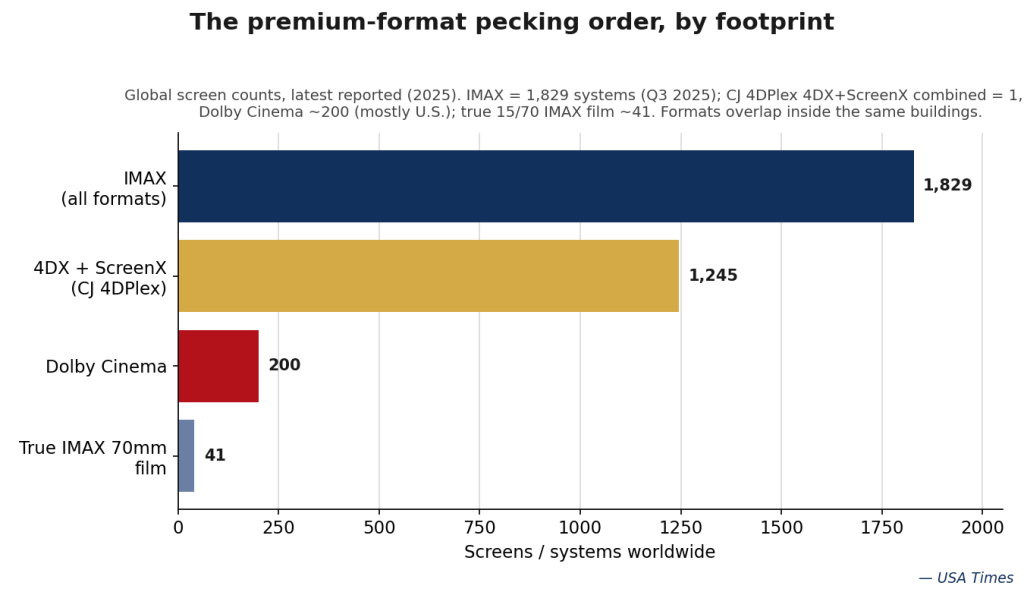
Scarcity is the first thing that separates these formats, and it is bigger than most people assume. IMAX reported 1,829 systems operating in 89 countries as of September 30, 2025 — by far the largest premium network on earth. But that number lumps together every flavor of IMAX, and the overwhelming majority are digital. The rarest tier, true 15/70mm film projection, sits at roughly 41 screens worldwide as of Christopher Nolan’s The Odyssey in July 2026, with about 25 of those in the United States. That is the format that can show a movie in the full 1.43:1 frame on film; almost nobody lives near one.
Dolby Cinema is a much smaller, largely American network. Dolby and AMC said in March 2025 that they would add 40 U.S. auditoriums by the end of 2027, “bringing the total number to over 200” — meaning the current U.S. base is roughly 200 screens after a decade of the partnership. CJ 4DPlex, which owns both 4DX and ScreenX, reported a combined global footprint of about 1,245 locations in 2025, having signed 198 new sites that year with partners including AMC, Cinepolis and Cinemark. In other words: if you count raw screens, IMAX and CJ 4DPlex operate at industrial scale, Dolby is a boutique premium tier, and true IMAX film is a collector’s item.
One caveat worth keeping in mind as you read the chart above: these formats overlap inside the same buildings. A single AMC can house an IMAX with Laser screen, a Dolby Cinema, a ScreenX and a 4DX room simultaneously. Footprint tells you availability, not exclusivity.
Picture: the numbers behind “sharper” and “bigger”
Here the formats split into two philosophies. IMAX and Dolby compete on image quality and scale; ScreenX and 4DX compete on sensation and largely inherit whatever a standard digital projector gives them.
IMAX’s calling card is aspect ratio and height. A true film IMAX screen can display the 1.43:1 frame, which is nearly square and dramatically taller than the 2.39:1 letterbox most movies live in. IMAX with Laser in its premium configuration can also open up to 1.43:1 on the biggest screens, while the more common commercial IMAX tops out around 1.90:1 — taller than a normal screen, but not the full frame. We have written a full explainer on why the number on your ticket rarely tells you which of these you are getting; the short version is that “IMAX” is a brand, not a guarantee of a specific picture shape.
Dolby Cinema does not chase the tall frame at all. It keeps the standard widescreen shape and instead pushes brightness and contrast. Dolby Vision projection in these rooms targets peak highlights several times brighter than a conventional cinema projector and advertises a contrast ratio Dolby describes as up to a million to one, with dual 4K laser projectors and reference-grade black levels in a room painted to swallow stray light. If your priority is a digital picture with punchy HDR color and inky shadows rather than sheer size, Dolby is the technical leader on this list.
ScreenX is the outlier: it does not improve the central image so much as multiply it. During sequences a filmmaker has prepared for the format, the picture wraps onto the side walls for a panoramic, roughly 270-degree effect. Outside those scenes you are watching a normal screen, and the side-wall image is lower resolution and geometrically distorted by design. 4DX, meanwhile, makes no claim on the picture at all — you are watching a standard 2D or 3D presentation, with the novelty happening in your chair.
Sound and motion
On audio, IMAX and Dolby again lead but in different registers. IMAX uses a proprietary sound system tuned to the room with up to 12 discrete channels in its laser theaters, engineered for uncompressed dynamic range and physical low end. Dolby Cinema runs Dolby Atmos, an object-based system that can address dozens of individually powered speakers, including overhead arrays, to place sounds precisely in three-dimensional space. Both are excellent; Atmos is the more flexible mixing format, while IMAX’s system is tuned as a fixed, calibrated whole.
4DX is the only format on this list that engages your body. Its seats pitch, roll and heave in sync with the action, and the auditorium adds wind, water spray, fog, strobe lightning and scent. It is genuinely different and, for the right movie — a rollercoaster blockbuster, a racing film — genuinely fun. It is also the format least concerned with fidelity to what the director shot: the effects are programmed by CJ 4DPlex’s team, not the filmmaker, and the motion can actively distract from a dialogue-driven or visually composed film. This is a sensation product, and it should be judged as one.
Price: what the premium costs
None of these formats has a single national price, because exhibitors — not the format owners — set what you pay. As a rule of thumb from 2026 U.S. pricing, IMAX and Dolby Cinema carry roughly a $5 to $8 surcharge over a standard adult evening ticket, ScreenX lands in a similar band, and 4DX is usually the most expensive add-on at around $8 to $12 because of the mechanical seats. Our own reporting found the average IMAX ticket running near $17.80 nationally and clearing $22 in New York and Los Angeles — well over the roughly $10.75 blended national average ticket. We break the surcharges down format by format in a companion piece.
So which one should you buy?
Match the format to the movie. For a film shot with IMAX cameras — a Nolan picture, a big space or nature spectacle — seek out true IMAX film or premium IMAX with Laser, because you are paying for image height and scale you literally cannot see elsewhere. For a visually rich, HDR-heavy movie where color and contrast carry the mood, Dolby Cinema is the strongest digital picture and the best all-around sound. For a theme-park style action movie you want to feel more than study, 4DX earns its upcharge. ScreenX is the most situational: worth it only for the handful of titles with substantial footage built for the wraparound.
The mistake is treating them as interchangeable tiers of “better.” They are not a ladder. They are five different bets on what a night at the movies is for.
What we did
We compiled the footprint figures from primary corporate sources: IMAX Corporation’s Q3 2025 systems disclosure (1,829 systems), IMAX and Cinemark’s October 2025 70mm/laser expansion announcement, Dolby and AMC’s March 2025 partnership release (over 200 U.S. Dolby Cinema auditoriums, plus 40 more by 2027), and CJ 4DPlex’s 2025 performance release (approximately 1,245 combined 4DX and ScreenX locations). The count of true 15/70mm IMAX film screens (~41 worldwide) is drawn from cross-referenced trade coverage of The Odyssey‘s July 2026 release. Picture, sound and motion specifications reflect each company’s published technical descriptions; where a spec is a manufacturer claim (for example Dolby’s million-to-one contrast), we say so. Pricing reflects reported 2026 U.S. surcharge ranges and our own prior ticket-price reporting. Format capabilities vary by individual auditorium; confirm what a specific theater offers before you buy. Chart by USA Times.
- IMAX Corporation — IMAX and Cinemark agreement, IMAX with Laser and 70mm film (Oct. 2025)
- Dolby & AMC — expansion of Dolby Cinema, over 200 auditoriums (Mar. 2025)
- Boxoffice Pro — CJ 4DPlex 2025 results (4DX + ScreenX footprint)
- Wanderu — mapped list of true 70mm IMAX film theaters
- USA Times — IMAX aspect ratios explained: 1.43:1 vs 1.90:1
- USA Times — the IMAX ticket-price premium, national average and NYC/LA
- USA Times — Box Office Coverage Index
Sources
- Dolby — Dolby Cinema technology overview
- Box Office Mojo — weekly and weekend box office grosses
- USA Times — Star Index methodology (how our tiers and box-office share are computed)