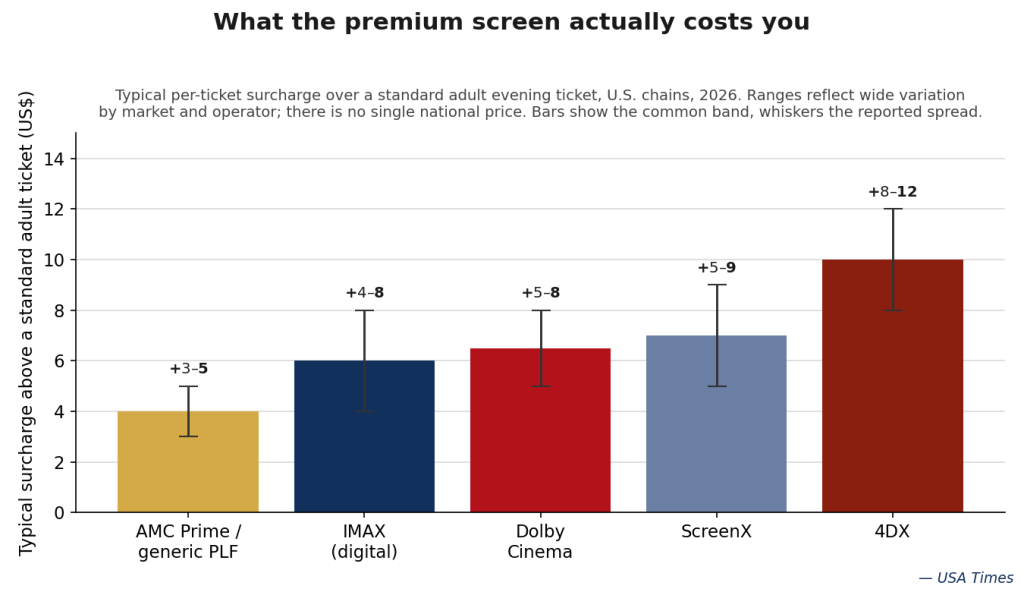
The premium screen is the box office’s best pricing tool. As overall attendance has fallen, exhibitors have leaned hard on the surcharge — the few extra dollars you hand over to sit in an IMAX, a Dolby Cinema, a 4DX or a ScreenX auditorium instead of a standard one. Those few dollars add up: premium formats now drive a wildly disproportionate share of opening-weekend grosses. But if you are the one paying, the obvious question is rarely answered clearly: how much extra, exactly, and for which format?
The honest answer is that there is no single national price, and that is not a dodge — it is the central fact of premium-format pricing. Format owners like IMAX and Dolby do not set the retail ticket price; exhibitors do. So the surcharge for the exact same format on the exact same movie can differ by several dollars between two cities, two chains, or even a matinee and an evening show. What we can do is give you the reliable bands for 2026, format by format, and explain what moves you within them.
The baseline: what “standard” even means
A surcharge only makes sense against a base. The National Association of Theatre Owners’ most recent blended national average ticket — every format, market and discount tier averaged together — works out to roughly $10.75. That figure is a national blend; a standard adult evening ticket in a major metro is often $14 to $17 before any premium is added. When we quote a “+$6 IMAX surcharge,” we mean six dollars on top of whatever that theater charges for a standard adult seat at the same showtime — so the all-in price in an expensive market climbs fast.
Batmandir · Founders A numbered seat at the table. S3 · The Founders Club — 161 seats per location. By invitation. Explore membership →IMAX and Dolby Cinema: roughly +$5 to +$8
The two prestige image formats sit in a similar band. Across U.S. chains in 2026, IMAX digital typically adds about $5 to $8 over a standard adult ticket, and Dolby Cinema usually matches or slightly exceeds IMAX at the same location. Our own earlier reporting put the average IMAX ticket near $17.80 nationally, and routinely over $22 in New York and Los Angeles — which, against the roughly $10.75 national blended average, means IMAX pricing running from about 65 percent above the blend to more than double it, depending on the market.
Note the width of that band. Reported IMAX surcharges over a base ticket have ranged from as little as $1.50 to as much as $6 or more depending on the chain, the market, and whether you are using a subscription or loyalty program. Dolby Cinema behaves similarly. The takeaway: for the two formats people most associate with “premium,” the extra you pay is real but moderate per ticket — and it is the base price in your city, not the surcharge itself, that determines whether you end up at $17 or $27.
ScreenX: roughly +$5 to +$9
ScreenX, the panoramic three-wall format from CJ 4DPlex, generally lands in the same neighborhood as IMAX and Dolby or a touch higher, commonly about $5 to $9 above standard. It is the hardest format to value on price, because the wraparound effect is only active during scenes specifically prepared for it — often a minority of a film’s runtime. You are paying an IMAX-adjacent surcharge for an experience that is transformative in bursts and ordinary the rest of the time. For a title with substantial ScreenX-native footage it can be worth it; for one with a token few minutes, you are paying a premium for a standard screen most of the night.
4DX: the most expensive add-on, roughly +$8 to +$12
The motion-seat format is consistently the priciest premium at the U.S. box office, typically adding about $8 to $12 over a standard ticket and sometimes more in top markets. The reason is straightforward: 4DX is the only format on this list with heavy mechanical hardware in every seat and per-show consumables — water, scent, air. You are not paying for a better picture; you are paying for the ride. That makes 4DX the clearest value proposition to reason about: if a moving, spraying, wind-blown chair is what you came for, the upcharge is honest. If you want to actually watch the movie, it is the least defensible premium of the group.
The generic PLF middle tier: roughly +$3 to +$5
Below the branded formats sits a quieter category: the chains’ own “premium large format” and enhanced-seating rooms — AMC Prime and similar house brands — with bigger screens and upgraded sound but none of the licensing of IMAX or Dolby. These typically carry the smallest surcharge, around $3 to $5. They are frequently the best value on the board: a meaningfully better presentation than a standard auditorium for the lowest premium, without the top-tier price of the marquee brands.
What actually moves your price
Four levers explain almost all the variation you will see:
- Market. The single biggest factor. A New York or Los Angeles base ticket is far higher than a mid-market one before any surcharge, so the all-in premium price swings hardest by geography.
- Chain and policy. AMC, Regal and Cinemark each set their own surcharge structures; independents vary even more.
- Showtime. Matinee and off-peak pricing can shrink or reshape the premium; opening-night evening shows are the most expensive.
- Membership. Subscription programs (AMC A-List, Regal Unlimited) and loyalty tiers can waive or discount format surcharges entirely, which is often the cheapest route into a premium screen for a frequent moviegoer.
The practical advice that falls out of all this: do not shop on the format name alone. Check the base ticket price at your specific theater and showtime, add the surcharge band above, and ask whether the thing that format does — image height for IMAX, HDR and sound for Dolby, motion for 4DX, wraparound for ScreenX — is something this particular movie will actually use. A premium screen is worth paying for when the movie was built to exploit it. The rest of the time, the standard auditorium down the hall is showing the same film for less.
A worked example: the same movie, four ways
Bands are abstract, so make it concrete. Picture one blockbuster on one Friday night, and assume a mid-market standard adult evening ticket of $15. Add a generic PLF room at +$4 and you are at $19. Step up to IMAX digital at +$6 and you are at $21. Dolby Cinema at +$7 puts you at $22. ScreenX at +$7 is another $22. And 4DX at +$10 lands at $25 — a full $10, or two-thirds, over the standard seat for the same film. Now move that theater to Manhattan, where the standard base might be $19 instead of $15, and every one of those numbers climbs by four dollars before the surcharge is even applied: the IMAX seat is now $25, the 4DX seat $29. Nothing about the movie changed; only the base did.
That worked example is the whole argument in miniature. The format surcharge is the part everyone talks about, but the base ticket in your market is usually the bigger driver of what you actually pay. It is why a moviegoer in one city can see IMAX for less than another pays for a standard ticket, and why comparing “IMAX prices” across the country without anchoring to the local base is close to meaningless.
Why the surcharge keeps climbing
The premium surcharge is not holding steady; it has been trending up, and the reason is structural. Domestic attendance remains well below its pre-pandemic peak, so exhibitors are extracting more revenue per admission rather than counting on more admissions. Premium formats are the sharpest instrument for that, because audiences have shown they will pay disproportionately for the biggest titles on the best screens — and studios, in turn, court the formats because a single IMAX or Dolby run can account for an outsized slice of an opening weekend. The result is a feedback loop: premium screens carry the box office, so exhibitors build and price for them, so more of the marquee experience migrates behind a surcharge. Understanding the bands above is, increasingly, just understanding the modern price of going to the movies at all.
What we did
We built the surcharge bands from 2026 U.S. pricing reporting across the major national chains, expressed as the extra amount charged over a standard adult evening ticket at the same location and showtime: roughly +$3 to +$5 for generic PLF and enhanced-seating rooms, +$4 to +$8 for IMAX digital, +$5 to +$8 for Dolby Cinema, +$5 to +$9 for ScreenX, and +$8 to +$12 for 4DX. Because format owners do not set retail prices, these are bands, not fixed figures; individual theaters routinely fall outside them, and subscription and loyalty programs can eliminate the surcharge altogether. The base-ticket context — a roughly $10.75 blended national average, an average IMAX ticket near $17.80, and NYC/LA IMAX pricing over $22 — comes from our prior reporting and cited pricing trackers. Always confirm the price for your specific theater, format, showtime and membership before buying. Chart by USA Times.
- USA Times — the IMAX ticket-price premium: national average, NYC and LA
- USA Times — the premium-ticket trap
- AMC Theatres — premium offerings (formats and enhanced seating)
- Boxoffice Pro — CJ 4DPlex (4DX and ScreenX) 2025 performance
- MoviePass — 2025-26 movie ticket cost guide (format premiums)
- USA Times — Box Office Coverage Index
Sources
- Box Office Mojo — weekly and weekend box office grosses
- Dolby — Dolby Cinema technology overview
- USA Times — Star Index methodology (how our tiers and box-office share are computed)