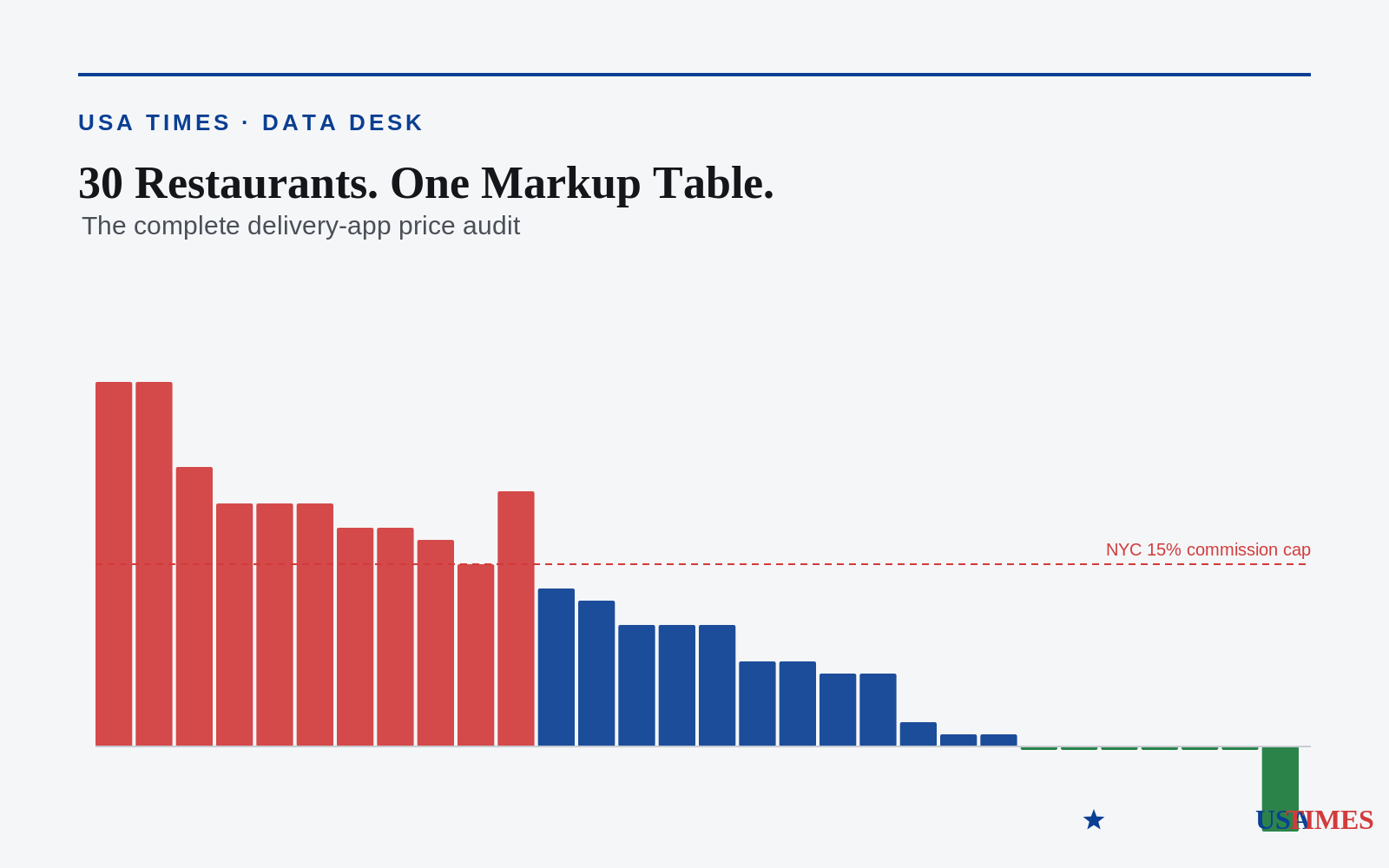
Over five weeks, USA Times compared menu prices at 30 New York City-area restaurants — on their own ordering site or at the register — against the same items on their Uber Eats or DoorDash storefronts. This is the complete dataset: every restaurant, every platform, every markup, sortable below.
The finding, in one number: across the 30 restaurants, the average delivery markup was 10.3%, with a median of 10%. Seven restaurants charged delivery customers exactly what they charge at the counter — and one, on DoorDash, actually charged less. Eleven marked their delivery menu up by 15% or more, at or above the commission rate New York City caps delivery platforms from charging restaurants. In our small DoorDash sample (6 restaurants), markups ran noticeably lower on average than the Uber Eats sample (24 restaurants) — worth watching as this dataset grows, not yet a firm platform-wide conclusion.
None of this shows up as a line item at checkout. Both apps present delivery and service fees separately, in plain view. The markup baked into the menu price itself is invisible unless you already know the restaurant’s own price to compare it against — which is what this series has spent five weeks doing, one restaurant at a time.
Batmandir · Guest Passes Step inside for a day. Guest passes from $161/day — brought in by a member. See guest passes →Why menu prices move at all
New York City caps the commission a delivery platform can charge a restaurant at 15% of the order — a rule the City Council made permanent in 2021. Outside New York, where no such cap exists, commissions commonly run 25–30%. Neither Uber Eats nor DoorDash sets a restaurant’s menu prices; the restaurant does. But when a platform takes a quarter or more of every order, many restaurants raise their in-app prices to recover some of that cut — and the customer, not the platform, ends up paying it, invisibly, in the price of the food itself.
That single dynamic explains nearly every pattern in the table below: restaurants that mark up at or near 15% are pricing to the New York cap; restaurants at 0% are either absorbing the commission themselves or running their own delivery rather than using a platform courier at all.
The full dataset
Click any column header to sort. “Markup” is the average difference between the restaurant’s own price and its delivery-app price across every item we could match by exact name and portion.
| Restaurant | Neighborhood | Platform | Avg. Markup | Range | Items Matched | Note |
|---|---|---|---|---|---|---|
| Junzi Kitchen | Morningside Heights | Uber Eats | +30% | flat | 43 | — |
| Swad Indian Restaurant | Polanco, Mexico City | Uber Eats | +30% | 0% to 66% | 64 | priced in pesos |
| Ojo de Agua | Polanco, Mexico City | Uber Eats | +23% | 19% to 27% | 13 | priced in pesos |
| Mighty Quinn’s BBQ | Gowanus, Brooklyn | Uber Eats | +20% | 0% to 51% | 45 | restaurant nets more per order |
| Sweetgreen | Union Square | Uber Eats | +20% | 16% to 27% | 48 | — |
| Roll-N-Roaster | Sheepshead Bay, Brooklyn | Uber Eats | +20% | 10% to 38% | 34 | — |
| Joe & The Juice | Midtown East | Uber Eats | +18% | 11% to 26% | 15 | — |
| Halal Guys | 14th Street | Uber Eats | +18% | 7% to 33% | 15 | — |
| Maman | Flatiron | Uber Eats | +17% | 6% to 31% | 36 | flat $1 surcharge per item |
| Sweet Chick | Lower East Side | Uber Eats | +15% | flat | 40 | delivery only; pickup = counter price |
| Mamoun’s Falafel | Upper East Side | Uber Eats | +21% | flat | 32 | — |
| Sophie’s Cuban Cuisine | Financial District | Uber Eats | +12% | flat | 43 | — |
| Song ‘E Napule | West Village | Uber Eats | +13% | ‑2% to 39% | 31 | — |
| Williamsburg Pizza | Lower East Side | Uber Eats | +10% | 10% to 11% | 36 | — |
| Denino’s Pizzeria & Tavern | Port Richmond, Staten Island | Uber Eats | +10% | flat | 38 | — |
| L&B Spumoni Gardens | Bensonhurst, Brooklyn | Uber Eats | +10% | 0% to 27% | 62 | — |
| Screamer’s Pizzeria | Crown Heights, Brooklyn | Uber Eats | +7% | 0% to 13% | 25 | — |
| BCD Tofu House | Koreatown | Uber Eats | +7% | 3% to 11% | 20 | — |
| Han Dynasty | East Village | Uber Eats | +6% | ‑10% to 20% | 48 | restaurant nets less per order |
| Katz’s Delicatessen | Lower East Side | Uber Eats | +6% | 3% to 7% | 8 | — |
| Ops | Bushwick, Brooklyn | DoorDash | +2% | ‑6% to 20% | 16 | — |
| Prince Street Pizza | Nolita | Uber Eats | +1% | 0% to 13% | 18 | — |
| Sac’s Place | Astoria, Queens | Uber Eats | ~+1% | near par | 52 | — |
| Lombardi’s Pizza | Nolita | Uber Eats | 0% | flat | 22 | — |
| Roberta’s | Bushwick, Brooklyn | Uber Eats | 0% | flat | 18 | — |
| Motorino Pizza | East Village | Uber Eats | 0% | flat | 49 | self-delivery; smaller platform fee |
| Di Fara Pizza | Midwood, Brooklyn | DoorDash | 0% | flat | 12 | — |
| F&F Pizzeria | Carroll Gardens, Brooklyn | DoorDash | 0% | flat | 10 | — |
| Rubirosa Ristorante | Nolita | DoorDash | 0% | flat | 35 | — |
| Louie & Ernie’s Pizza | Throggs Neck, The Bronx | DoorDash | −7% | ‑17% to +4% | 16 | priced below counter |
One grocery example: Target
This audit is restaurant-focused, but one grocery comparison is worth flagging separately since the economics differ. Five everyday items at a Chelsea Target — a 12-pack of Coca-Cola, a soda bottle, a bag of Lay’s, a box of Cheerios and a pint of Ben & Jerry’s — cost $23.75 at the shelf. The identical basket through DoorDash came to $46.51 at checkout — nearly double. Item markups alone averaged +17% (up to +35% on the Ben & Jerry’s), with the rest of the gap coming from delivery, service and regulatory fees stacked on top. We’ll expand this into its own dataset as we audit more grocery retailers.
Two restaurants at opposite extremes
Mighty Quinn’s BBQ in Gowanus marks its Uber Eats menu up by roughly 20% on average — more than New York’s 15% commission cap. The result is unusual for this series: after the platform takes its cut, Mighty Quinn’s clears slightly more per order on delivery than it does on a walk-in sale, by our calculation about 15 cents a dish. Han Dynasty in the East Village sits at the other end. Its average markup is only 6.1% — nowhere near enough to offset the 15% commission — so the kitchen nets roughly $1.60 less per dish on every delivery order than it would selling the same food at the register.
Motorino Pizza, Roberta’s, and three of our DoorDash restaurants — Di Fara Pizza, F&F Pizzeria, and Rubirosa Ristorante — all charge delivery customers the exact same price as their own counter. Louie & Ernie’s Pizza in the Bronx went further: several items actually cost less on DoorDash than at the counter. In each case, the restaurant — not the diner — absorbs the platform’s commission rather than passing it on.
The regulatory backdrop
This audit measures menu prices, not tips — but a separate, government-sourced finding adds the other half of the picture. A New York City report found that Uber Eats and DoorDash redesigned their tipping interfaces in ways that made tipping harder to complete, costing delivery workers more than half a billion dollars in tips citywide. Combined with what this series found on the menu side, the same platforms are shown moving money away from both diners and workers, in ways neither can easily see at checkout.
For the mechanics of why a “commission” and a “service fee” both exist, and who each one actually charges, see our explainer on Uber Eats’ fee structure.
Methodology
For each restaurant, USA Times compared prices on the restaurant’s own ordering channel (in-store menu, register, or first-party online-ordering site) against the same restaurant’s Uber Eats or DoorDash storefront, matching items by exact name and portion. Prices were captured on the same day for both channels wherever possible. “Markup” reflects only the difference in listed menu/item price — it does not include either platform’s separate delivery fee, service fee, regulatory fee, or any tip, all of which are added on top and disclosed separately at checkout. Where a restaurant’s menu is priced in a foreign currency (Swad Indian Restaurant and Ojo de Agua, both in Mexico City), figures are converted to U.S. dollars at the exchange rate noted at time of capture. New York City’s 15% commission cap applies to the 28 New York City restaurants in this dataset; it does not apply to the two Mexico City restaurants. This dataset will be updated as USA Times audits additional restaurants and grocery retailers; merchants named here are welcome to provide context or corrections, which we will include.