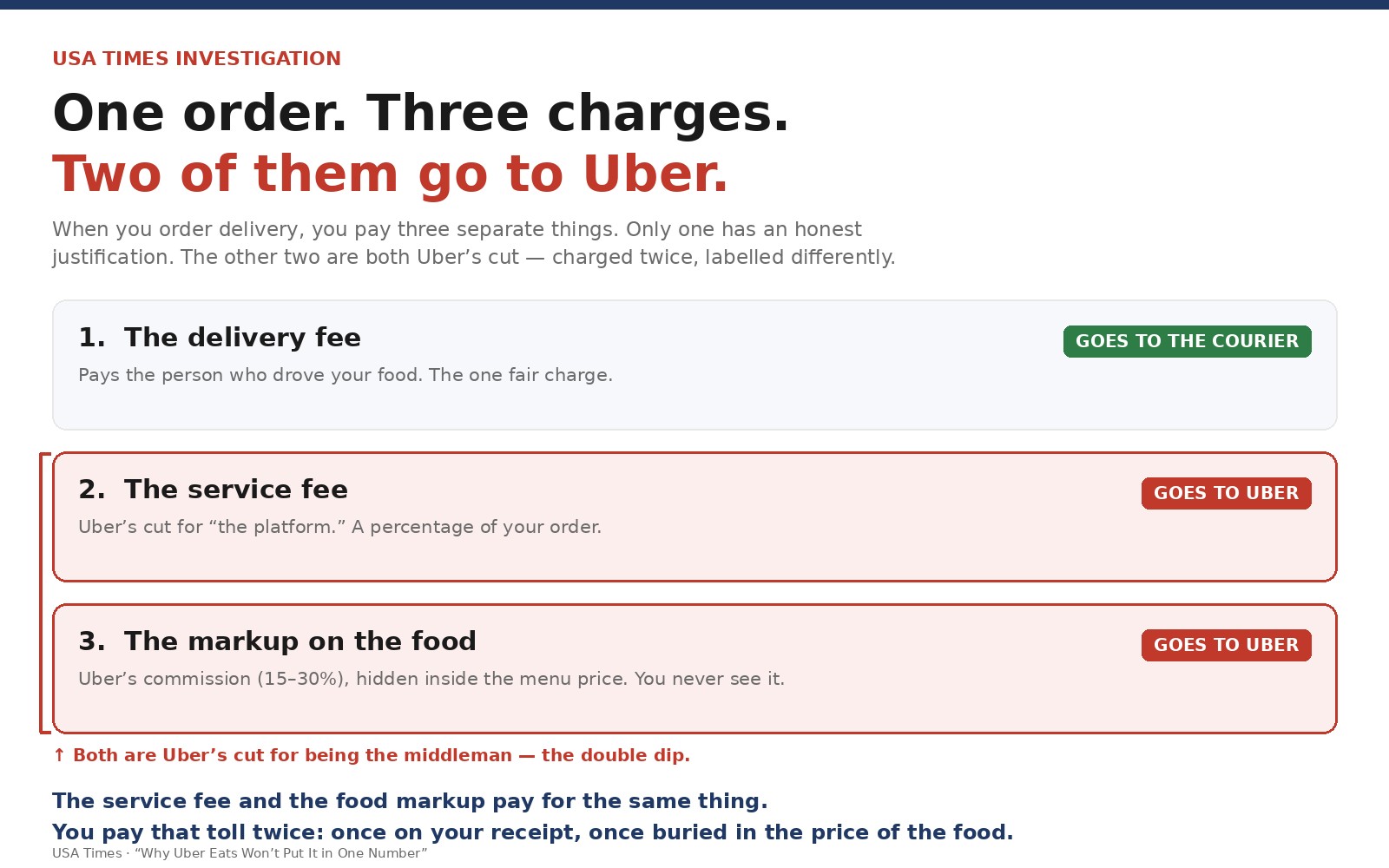
The commission is Uber’s fee for being the middleman. The service fee is also Uber’s fee for being the middleman. There is only one middleman.
| Charge | What it claims to pay for | Who really pays | Legit? |
|---|---|---|---|
| Delivery fee | The courier’s drive | You | ✅ Yes — a real, separate service |
| Commission (hidden in the food) | Uber being the platform | You, via the restaurant | ⚠️ Once is fair |
| Service fee | Uber being the platform | You, directly | ❌ The same thing, charged again |
This is why the word “transparently” sits in the middle of our mission: to have fun, deliver excellence transparently, and create wealth. We are asking Uber to do the one thing we hold ourselves to — show the customer, in one honest number, what they are actually paying.
Every time you order delivery on Uber Eats, you pay three separate charges. One of them — the delivery fee — is fair. The other two are the same charge wearing two costumes. This is the story of why Uber won’t just put it in one honest number.
Batmandir · The Circle Full access to theatres, museums & exhibitions. S2 · ongoing membership, without a Founder’s seat. Explore membership →Over the past week USA Times has audited restaurants in New York and Mexico City, comparing what each charges at its own counter against what it charges on Uber Eats for the exact same food at the exact same address. The markups ranged from under 6 percent at Katz’s Delicatessen to a flat 21 percent at a Mamoun’s Falafel. Every one was undisclosed. And in every single case, the customer paid the higher price and a delivery fee and a service fee on top.
Readers kept asking the same sharp question: if the food is already marked up, why is there a delivery fee and a service fee at all? It is exactly the right question. Here is the answer.
The three charges
The delivery fee pays the courier who drove your food. It is the one charge with an honest justification: a person did physical work, and this pays them.
The service fee is Uber’s cut “for the platform” — the app, the payment processing, the support. It is typically a percentage of your order, and it goes to Uber.
The markup on the food is the one you can’t see. Uber charges the restaurant a commission on every order — roughly 15 to 30 percent — and the restaurant raises its in-app prices to recover it. That commission is real, it is large, and you pay it, embedded invisibly in the price of the dish. It goes to Uber.
Look at the second and third charges together. Both are Uber’s payment for the same thing: being the middleman between you and the restaurant. Uber collects that toll twice — once as a visible service fee on your receipt, and once as an invisible markup inside the food. That is the double dip.
So why not just charge one honest fee?
If Uber wanted to be transparent, it could show the true food price and add a single line: “Uber’s fee: $X.” It does not. There are four reasons, and none of them are accidental.
1. Splitting the charge hides its size. A low-looking food price plus a few small-sounding fees feels cheaper than one big number. If your receipt read “Uber’s total cut: $12 on a $25 order,” you would flinch. Three fragments never look as alarming as the sum.
2. Burying the commission preserves Uber’s favorite defense. Because the largest charge is hidden inside the food price and billed to the restaurant, Uber can say — accurately — “we don’t set menu prices; restaurants do.” Move that money into a visible “Uber fee” and the defense collapses: now it is plainly Uber’s markup, and Uber owns it.
3. Fragmentation enables ‘free delivery’ marketing. Splitting the toll into three levers lets Uber wave one — “$0 delivery fee with Uber One!” — while quietly keeping the other two. You cannot advertise “free” on a charge you’ve folded into one honest total.
4. Opacity stays ahead of regulators. New York City capped the delivery commission at 15 percent. By keeping that charge buried in the menu price instead of shown as an Uber fee, Uber keeps it outside what the cap can easily see or measure. A single transparent fee would be far simpler for a regulator to cap. We documented this directly: at a Manhattan restaurant, the menu markup was 21 percent — larger than the entire capped commission, sitting in plain sight, regulated by nothing.
The conclusion is uncomfortable but simple. The three-part split is not sloppy billing. It is the design. Opacity is the product.
What the numbers look like
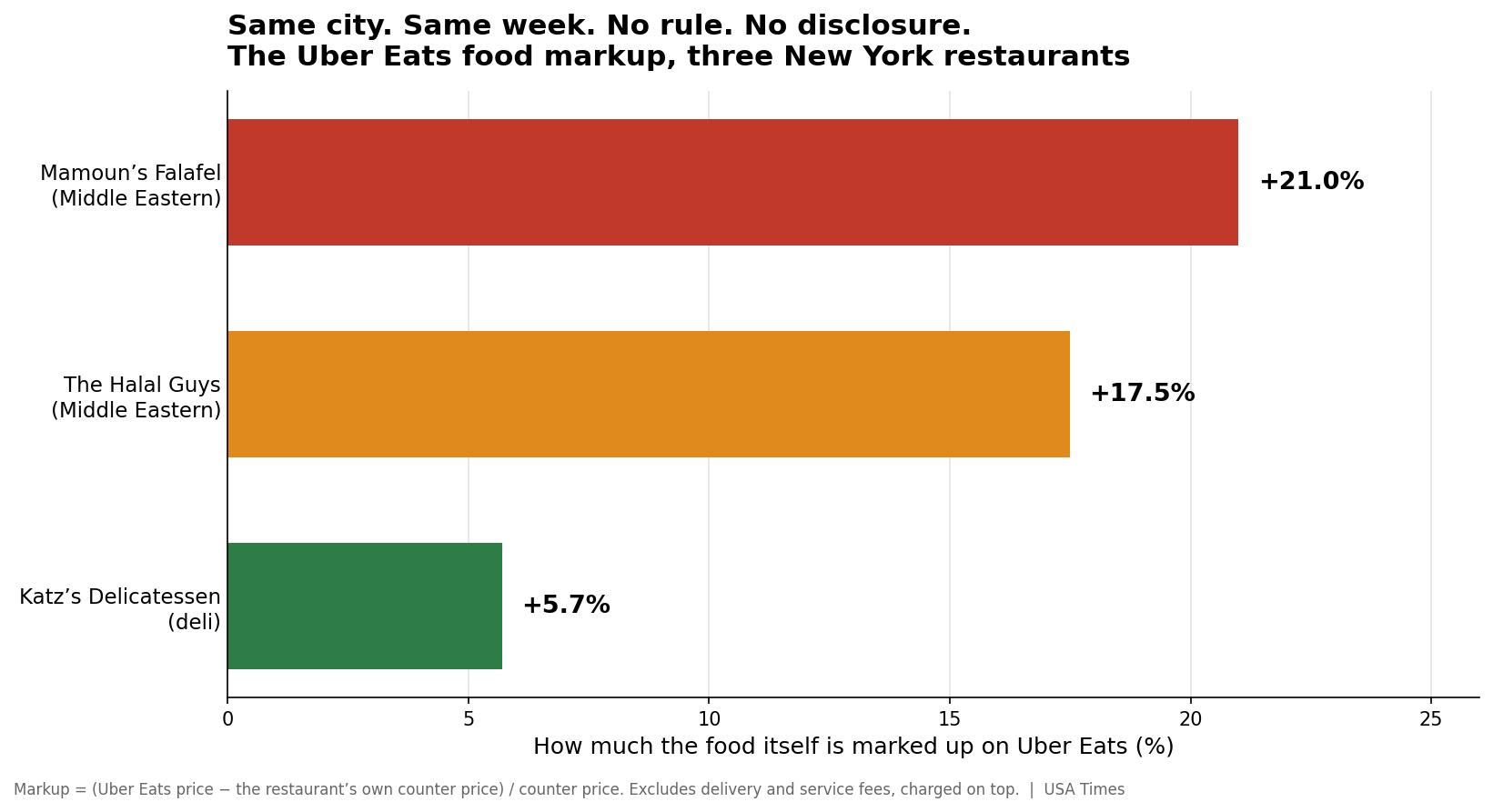
Uber knows every one of these numbers. It maintains a merchant metric it calls “Menu Markup” that measures the exact gap between a restaurant’s in-store and in-app prices. It shows that number to the restaurant. It does not show it to you.
Our standard, and our ask
USA Times’ mission is to deliver excellence transparently. That is the whole point of this series: we publish our method, name our sources, date our evidence, show every restaurant its own numbers, and put the data in front of you so you can check the math yourself. We are asking Uber for the one thing we hold ourselves to — transparency: show the customer, at checkout, the true price of the food and the total Uber is charging, in one honest number.
Uber has been contacted for comment. This explainer anchors an ongoing USA Times investigation into food-delivery pricing; each restaurant case study links back here.
The markup isn’t about delivery at all
Here is the fact that collapses the platforms’ entire defense. We switched DoorDash from delivery to pickup — you walk to the restaurant and carry the food home yourself, no driver, no delivery cost of any kind. The price did not change. Katz’s pastrami was $30.95 on pickup, the same as delivery, and still two dollars above the $28.95 counter price. The platform still takes its commission on an order it does nothing to deliver. Whatever the markup is paying for, it is not delivery.
This report is part of a USA Times series auditing food-delivery pricing. Prices were collected by USA Times on the dates noted, compared item by item against each restaurant’s own current menu, and reviewed by an editor before publication.