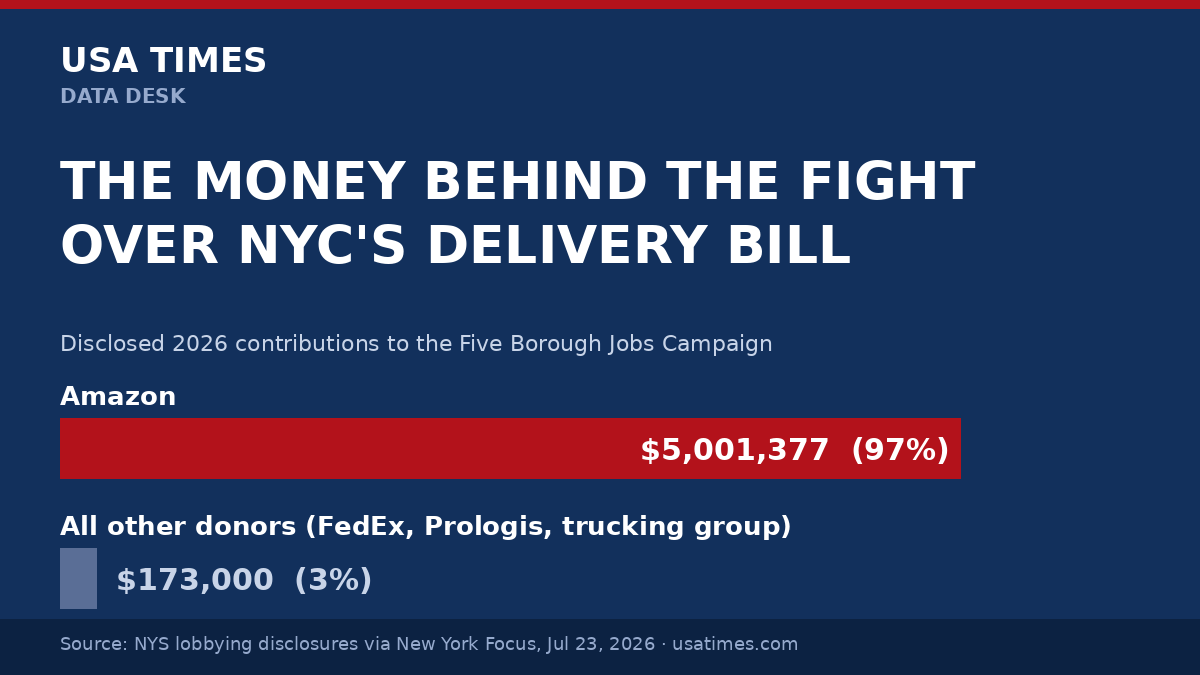
The group leading the fight against New York City’s Delivery Protection Act presents itself as a coalition of small businesses, workers, and national carriers. State lobbying disclosures tell a simpler story: it is overwhelmingly funded by one company. Between February and mid-May of this year, Amazon made five payments totaling $5,001,377 to the Five Borough Jobs Campaign, the business group bankrolling the opposition — the largest sum Amazon has ever reported putting behind a lobbying effort in New York State, according to disclosure reporting by New York Focus.
Every other disclosed donor to the group this year — FedEx, the warehouse landlord Prologis, and the Trucking Association of New York — contributed about $173,000 combined. Do the arithmetic and roughly 97 cents of every disclosed dollar behind the campaign came from Amazon.
What the bill would actually do
The Delivery Protection Act (Int. 518), sponsored by Queens Council Member Tiffany Cabán, would make New York the first city in the country to license “last-mile” delivery facilities — the smaller warehouses where packages are staged for the final run to your door. Operators would need a license from the Department of Consumer and Worker Protection, would face new safety and training standards, and — the provision Amazon objects to most — would have to directly employ the drivers and core warehouse workers who move their packages.
Batmandir · The Circle Full access to theatres, museums & exhibitions. S2 · ongoing membership, without a Founder’s seat. Explore membership →That last requirement strikes at the structure of Amazon’s delivery network. Amazon does not employ the more than 200,000 drivers nationwide who wear its uniforms and drive its branded vans. They work for third-party contractors called Delivery Service Partners, or DSPs. Critics — including the City Comptroller’s office — say the model lets Amazon set the pace of work while avoiding legal responsibility for crashes, injuries, and labor violations. Amazon says the model has built more than 40 locally owned businesses in the city employing roughly 5,000 people, and that the bill would prohibit those arrangements outright.
On August 10, Mayor Zohran Mamdani formally backed the bill, saying the City would “crack down on the subcontracting model that allows corporations like Amazon to evade responsibility for dangerous working conditions and unsafe streets.” As of late July, 31 of the Council’s 51 members had signed on as sponsors — enough to pass it if Speaker Julie Menin brings it to a vote. She has not yet scheduled one.
The money, itemized
The Five Borough Jobs Campaign is not new — it is a long-standing pro-business coalition affiliated with the Real Estate Board of New York. What is new is its budget. The group ended 2024 with $121,405 in assets and raised $161,800 in all of last year. Then, starting in February, Amazon’s five payments arrived, and between March and June the group reported spending $4.7 million under the banner of a campaign called “New York Delivers,” plus about $316,000 more outside it.
New York Delivers describes itself as a coalition of “small businesses, workers, and national carriers,” and its public face has been local delivery-company owners. As recently as May 19 — by which point the Amazon-funded group had already channeled at least $1.9 million to the effort — the coalition’s website did not list Amazon as a member, according to archived copies of the site. It has since been updated to include the company.
The campaign’s most-cited number — that the bill would cost the average New York household $664 a year in higher delivery fees — comes from a study by the consulting firm AKRF. Lobbying disclosures show the Five Borough Jobs Campaign paid AKRF $52,500 this year. The figure has appeared in social ads viewed more than a million times and in sponsored placements in political newsletters.
The data the fight is about
Behind the ad war sits a body of city data assembled by the Comptroller’s office in a November 2025 report, Fast Shipping. Slow Justice, released under then-Comptroller Brad Lander. Daily package deliveries in New York City grew from 1.8 million before the pandemic to 2.5 million in 2024 — roughly one in three New Yorkers now receives a package every day.
- Worker injuries: Between 2022 and 2024, 38 of the 50 last-mile facilities identified by the Department of City Planning reported injuries to OSHA — more than 2,000 in total, an average of 678 a year. The injury rate at last-mile facilities was 8.3 per 100 employees, more than triple the 2.4 national average for all private employers.
- Amazon’s DSP network specifically: In 2023 and 2024, the DSP program recorded an injury rate of 9.2 per 100 employees and a DART rate (days away, restricted, or transferred) of 8.1 — higher than the last-mile and courier industries overall.
- Street safety: After last-mile facilities opened, 78% of nearby areas saw more injury-causing crashes; injuries within a half-mile rose an average of 16%, truck-related crashes rose 146%, and truck-injury crashes rose 137%.
- Who lives next door: 68% of the city’s last-mile warehouses sit in officially designated Environmental Justice areas such as Red Hook, East New York, Maspeth, and Hunts Point, where 65.8% of residents are Black or Latino, versus 49.2% citywide.
Those numbers are the empirical core of the case for licensing. The Comptroller’s report attributes the pattern to a regulatory gap: last-mile warehouses can open “as-of-right” with no public review, and the subcontracting model diffuses legal responsibility for what happens on the road and the warehouse floor.
Amazon’s counter-case
Amazon testified against the bill at an April Council hearing and has not disputed its opposition — only, critics say, its visibility. The company argues the act would threaten the existence of its more than 40 city DSPs and the 5,000 jobs they support, since nothing in the bill guarantees Amazon would rehire those workers directly. It has said it would consider moving delivery facilities out of the city if the bill passes. “We’re proud to stand with our partners and oppose legislation that would hurt New York consumers, small businesses, and their employees,” Amazon spokesperson Steve Kelly said in a statement to New York Focus.
Bill sponsor Cabán is skeptical of the relocation threat: “Their entire business model is predicated on being as close to the consumer as possible,” she told New York Focus.
What to watch
The bill has the votes on paper and the mayor’s signature waiting, which leaves the Speaker’s calendar as the chokepoint. The Teamsters — who have organized two Amazon facilities in Queens and rallied hundreds at City Hall this month — are pressing for a vote this fall. Amazon’s five payments ran only through mid-May; the next round of state lobbying disclosures will show whether the $5 million was an opening bid or the whole war chest.
Sources and methodology: Funding figures come from New York State lobbying disclosures as reported by New York Focus (July 23, 2026); the 97% share is USA Times’ calculation from the disclosed totals ($5,001,377 of $5,174,377). Injury, crash, and demographic data come from the NYC Comptroller’s November 17, 2025 report “Fast Shipping. Slow Justice.” Bill provisions and the mayor’s position come from the Aug. 10, 2026 Mayor’s Office release and the text of Int. 518 of 2026. Amazon’s jobs figures come from its April 2026 Council testimony. The $664 household-cost figure is from an AKRF study commissioned by the Five Borough Jobs Campaign and has not been independently verified.