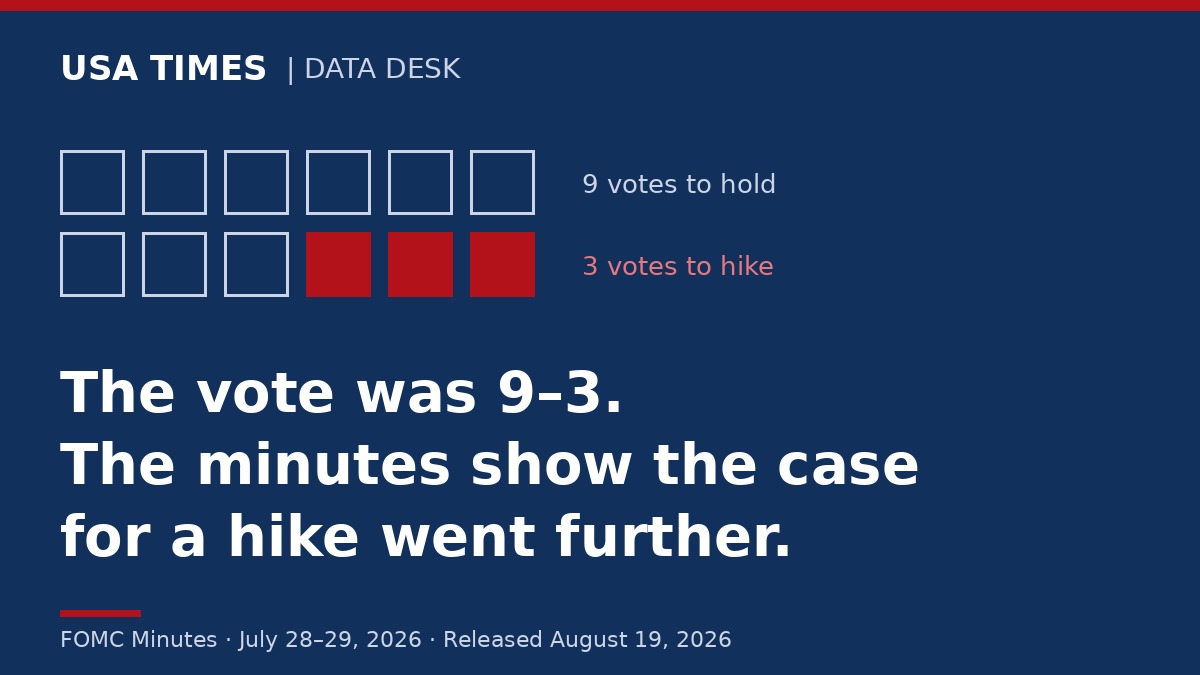
The Federal Reserve’s July decision looked, on the surface, like a familiar kind of split: a 9–3 vote to leave the federal funds rate at 3.5 to 3.75 percent, with three regional bank presidents dissenting in favor of a quarter-point increase. But the meeting minutes, released Wednesday afternoon, show the argument for raising rates reached well beyond the three officials who formally voted for it — and that much of the committee has already sketched out the conditions under which it would hike.
The sentence that matters most in the 12-page document is this one: “Many participants assessed that policy tightening would likely be necessary if inflation did not decline.” In the Fed’s carefully calibrated vocabulary — where “a couple” is fewer than “a few,” which is fewer than “some,” “several,” and “many” — that is a strong signal. It means the hawkish position was not a three-person protest. It was a widely shared view that the committee simply chose not to act on yet.
Three dissents on the record, more support off it
The formal dissents came from Cleveland Fed President Beth M. Hammack, Minneapolis Fed President Neel Kashkari, and Dallas Fed President Lorie K. Logan, each of whom “preferred to raise the target range for the federal funds rate by 1/4 percentage point at this meeting,” according to the minutes. That much was known on decision day, July 29, and it was already notable: three dissents in the same direction is the kind of division the Fed rarely displays.
Batmandir · Guest Passes Step inside for a day. Guest passes from $161/day — brought in by a member. See guest passes →What the minutes add is breadth. “Several participants favored an increase of 25 basis points in the target range at this meeting,” the document says — and “participants” is a larger group than the twelve officials who actually vote. All 19 attendees of a Federal Open Market Committee meeting, voters and non-voters alike, count as participants. The minutes also record that “some participants commented that financial conditions might not currently be sufficiently restrictive” to bring inflation back to the Fed’s 2 percent target — an argument that current policy, far from being tight, may not be tight enough.
The inflation numbers behind the argument
The committee was looking at inflation that remains well above target. Total PCE inflation — the Fed’s preferred gauge — ran at 4.1 percent over the 12 months through May, with core PCE (which strips out energy and much of food) at 3.4 percent. Staff estimated that the June readings “stepped down” to 3.7 percent and 3.3 percent respectively, but attributed much of the improvement to “a deceleration in consumer energy prices” — the same caveat that applied to June’s headline CPI decline, which we covered earlier this month.
Participants were not reassured by the direction of travel. “Several participants noted that price increases over the past year were broad based, spanning various categories of goods and services,” the minutes say, and several observed that “successive supply shocks have repeatedly delayed the expected return of inflation to 2 percent in recent years.” Many participants flagged the re-escalation of the conflict in the Middle East as a development that “significantly clouded the inflation outlook,” warning a protracted conflict could prolong supply chain problems and add price pressure.
The case for holding rested on different readings of the same data. Several participants assessed that the pass-through of past tariff increases “was now largely complete,” with recently announced tariffs likely to have only modest effects on measured inflation. Wage growth offered the doves support too: average hourly earnings rose 3.5 percent over the 12 months through June, 0.4 percentage point slower than a year earlier — a pace some participants called “moderate and consistent with inflation moving toward 2 percent.”
The AI economy runs through the whole document
One striking feature of the July minutes is how thoroughly the artificial intelligence buildout has worked its way into the Fed’s deliberations — on both sides of the inflation ledger.
On prices, some participants observed that data center materials “such as chips and steel, had registered large price increases,” with consumer items like smartphones, computer equipment, software and electricity “also subject to price pressures.” On wages, several participants reported “strong demand for skilled workers — including electricians, machinists, and engineers” in AI-connected sectors, “leading to notable increases in their wages.” Several participants suggested AI investment would eventually lift productivity and potential output — which would ease inflation — but conceded “considerable uncertainty” about both the timing and the size of those gains.
The committee also spent time on how the buildout is being financed. Some participants pointed to “vulnerabilities associated with the financing of the rapid buildout of AI-related infrastructure,” noting that high equity valuations of AI-linked firms rest on favorable long-term earnings assumptions, and a few highlighted “the increased degree to which capital spending in the AI sector was being financed by borrowing,” including credit from nonbank investors and regional banks. Fears of AI-driven mass layoffs, several participants noted, “had not materialized to date.”
Both halves of the mandate are now flashing
Perhaps the most uncomfortable detail in the minutes is the staff’s risk assessment: risks to the employment and GDP growth forecasts “were seen as skewed to the downside,” while risks to the inflation forecast “were seen as skewed to the upside.” That is the Fed’s dual mandate pulling in opposite directions — a weakening-growth risk that argues against hikes, and a sticky-inflation risk that argues for them, at the same time.
The strain is not evenly distributed. Some participants noted that “low- and moderate-income households were under increasing strains, with inflation eroding their real disposable income,” even as consumer spending overall strengthened and stock market gains supported wealthier households’ consumption.
The committee next meets September 15–16. Between now and then it will see one more jobs report, one more CPI release and one more PCE inflation reading — the data that, by the minutes’ own account, will determine whether the “many participants” who conditioned tightening on inflation failing to decline conclude that their condition has been met.
Sources and methodology: All quotations and figures are drawn from the minutes of the Federal Open Market Committee meeting of July 28–29, 2026, released by the Federal Reserve Board on August 19, 2026 (federalreserve.gov), and cross-checked against the Fed’s July 29 policy statement and contemporaneous reporting. PCE and earnings figures are as cited in the minutes’ staff review of the economic situation.