New York Mayor Zohran Mamdani said July 22 that his administration had concluded the city cannot enforce the International Criminal Court’s arrest warrant against Israeli Prime Minister Benjamin Netanyahu, reversing a pledge he had made repeatedly since his 2025 mayoral campaign. This report lays out what was said, by whom, and the legal and historical record surrounding it, drawing on U.S., Israeli, Palestinian, and international sources.
Editor’s note: This is a factual news report. Characterizations of Netanyahu’s conduct — including the phrase “war criminal” — are attributed to the specific officials, courts, or organizations that made them, and should not be read as conclusions reached by this publication. The ICC has issued an arrest warrant, which under the court’s own rules reflects “reasonable grounds to believe,” a preliminary evidentiary standard; it is not a conviction, and no trial has taken place.
Background: who is Zohran Mamdani
Zohran Mamdani, 34, is a member of the Democratic Socialists of America who represented a Queens district in the New York State Assembly before launching his mayoral campaign in October 2024. He defeated former Governor Andrew Cuomo in the June 2025 Democratic primary, then defeated Cuomo again in the November 2025 general election, after Cuomo entered as an independent, becoming the first Muslim mayor in New York City’s history. His campaign centered on affordability proposals, including a rent freeze, free city buses, and city-run grocery stores. Mamdani has also been a vocal critic of Israel’s military campaign in Gaza since before he entered electoral politics, a position that drew both support and opposition during the campaign.
Background: the Gaza war and the ICC warrant
The Gaza war began after Hamas’s October 7, 2023 attack on Israel, which Israeli officials say killed approximately 1,200 people, with hundreds more taken hostage. Gaza health officials, whose figures are cited by the United Nations and independent monitors, have reported a Palestinian death toll exceeding 40,000 over the course of the ensuing Israeli military campaign. Casualty figures, responsibility, and characterization of the conflict remain contested between the Israeli government, Palestinian officials, and international organizations.
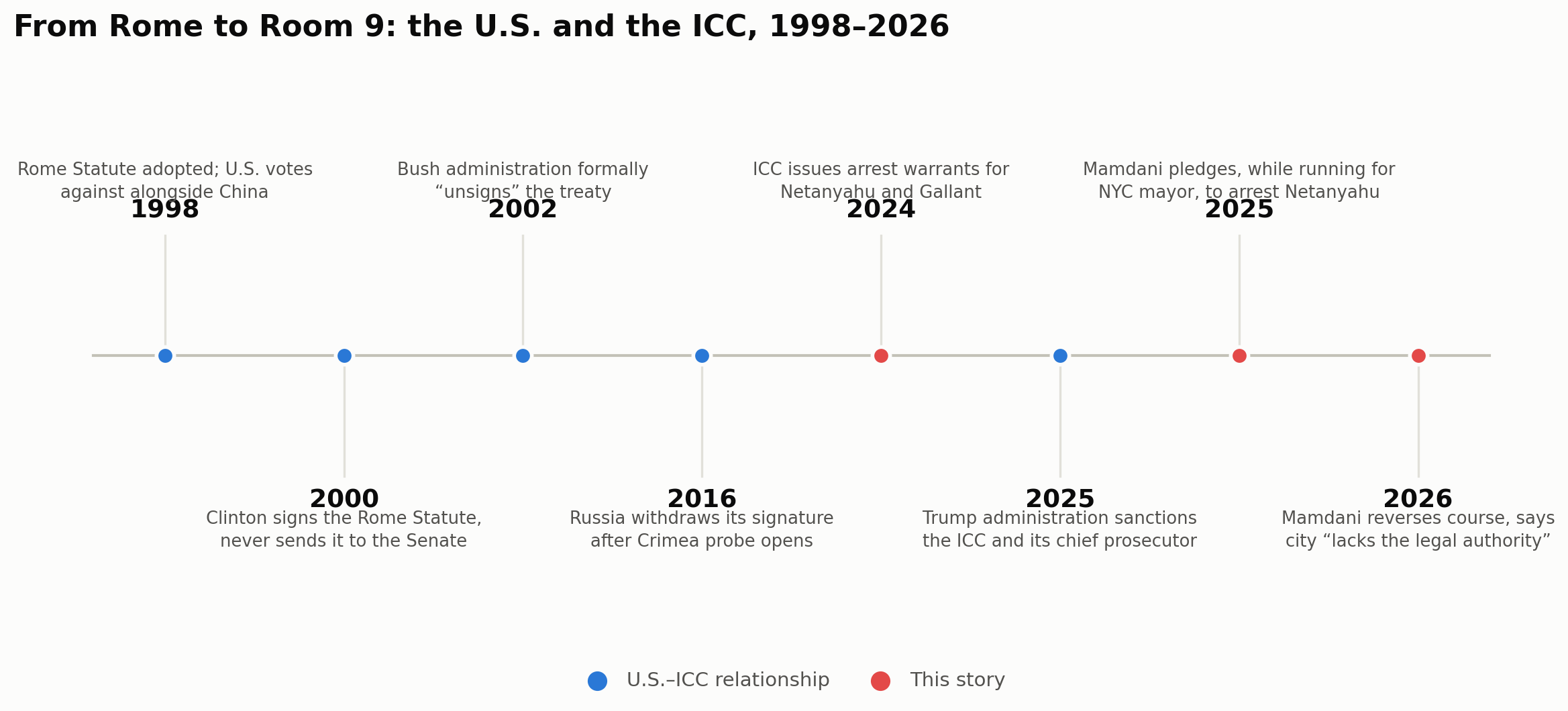
On November 21, 2024, an ICC Pre-Trial Chamber rejected a challenge from Israel to the court’s jurisdiction and issued arrest warrants for Netanyahu and then-Defense Minister Yoav Gallant. A third warrant, for Hamas commander Ibrahim Al-Masri (also known as Mohammed Deif), was later rendered moot after Israel confirmed his death. The chamber’s decision states there are reasonable grounds to believe Netanyahu and Gallant bear criminal responsibility, as co-perpetrators, for the war crime of “starvation as a method of warfare” and for crimes against humanity including “murder, persecution, and other inhumane acts,” covering the period from October 8, 2023 through at least May 20, 2024.
The court’s asserted jurisdiction rests on Palestine’s 2015 accession to the Rome Statute; the ICC’s Office of the Prosecutor has said this gives the court territorial jurisdiction over alleged crimes committed on Palestinian territory, even though Israel itself has never joined the court. Israel disputes that the court has jurisdiction over its nationals at all.
Palestinian human rights organizations, including Al-Haq, welcomed the warrants at the time, calling the decision “a major step toward accountability” after what they described as decades of impunity, while noting in their statement that “the criminal conduct concerns a mere fraction of the overall criminality” they allege Israel has committed against Palestinians. Israel’s government rejected the warrants as illegitimate. Then-candidate Mamdani, then a New York State Assembly member, was among the elected officials in the U.S. who publicly supported the ICC’s action.
The pledge, and how it evolved
During his 2025 mayoral campaign, Mamdani said repeatedly that if Netanyahu visited New York City, local authorities should and would enforce the ICC warrant against him. As mayor-elect and in the early months of his term, he continued to affirm the position, telling reporters the city would “follow all applicable local laws” — language his office and allies described as consistent with the original pledge. Legal specialists raised doubts about the pledge’s enforceability from early on; the Times of Israel reported that legal experts characterized it as an “empty threat” given the jurisdictional realities involved.
In mid-July 2026, with a possible Netanyahu visit to New York for the UN General Assembly under discussion, Mamdani told reporters he was in “active conversation with our legal department” about the question. On July 22, he released a video statement saying: “My administration has reviewed every avenue available under applicable law” and concluding, “It is clear that we do not have the independent legal authority to enforce this warrant.” He called on the federal government to join the ICC and said it should act to arrest Netanyahu. He maintained his characterization of Netanyahu, saying he “is a war criminal” who “belongs before a court of law,” while acknowledging the city could not itself take that action.
Reactions
Reactions to both the original pledge and the reversal came from multiple directions:
- President Donald Trump said Netanyahu “will not be arrested, in any way, shape, or form, while in the United States of America,” citing Israel’s cooperation with the U.S. on matters including the conflict with Iran.
- New York Governor Kathy Hochul, a fellow Democrat, said publicly that arresting a foreign head of state falls outside the New York Police Department’s authority, a position that put her at odds with Mamdani’s earlier framing.
- Netanyahu responded to the original threat by telling reporters: “I’m not concerned about that. There’s enough craziness in the world, but I guess it never ends. This is folly and it’s silly in many ways,” adding, “I’m going to come there with President Trump and we’ll see.”
- Al-Haq and allied Palestinian human rights organizations have continued to call for ICC member states to arrest and transfer Netanyahu and Gallant to The Hague, and for expanded international measures against Israel, positions they reiterated after the ICC warrants were issued in 2024.
- Coverage of the reversal by Al Jazeera noted that neither Israel nor the U.S. is an ICC member and that the Trump administration has taken active steps to sanction the court, while continuing to describe Netanyahu as facing ICC war-crimes charges.
- U.S. outlets across the political spectrum, including Fox News, the Washington Post, CBS News, NPR, and Time, covered Mamdani’s reversal, generally framing it as an acknowledgment of a jurisdictional limit his office had newly confirmed through formal review.
Why New York City could not enforce the warrant: the U.S.-ICC relationship
The United States is not a member of the International Criminal Court. That status dates to the court’s founding and has held under both Republican and Democratic administrations since.
The Rome Statute, the treaty establishing the ICC, was adopted in 1998; the United States was among a small number of countries that voted against it, along with China. President Bill Clinton signed the treaty on December 31, 2000, near the end of his presidency, but sent it to the Senate with a recommendation not to proceed toward ratification until concerns about the court’s jurisdiction over U.S. personnel were addressed. The Senate never ratified it.
In May 2002, the Bush administration formally notified the United Nations Secretary-General that the United States did not intend to ratify the treaty and did not consider itself bound by Clinton’s signature, an action commonly referred to as “unsigning” the treaty. The Rome Statute entered into force in July 2002, establishing the court without U.S. participation. The Bush administration subsequently sought bilateral agreements with other governments to shield U.S. personnel from surrender to the court. U.S. policy shifted somewhat in following years — Washington did not veto a 2005 UN Security Council referral of the situation in Darfur, Sudan, to the ICC, and supported a 2011 referral concerning Libya — but the U.S. never became a member state. A resolution introduced in the current Congress, H.Res. 9, restates that “the United States is not a party to the Rome Statute and does not recognize the jurisdiction of the International Criminal Court.”
In February 2025, the Trump administration issued an executive order imposing sanctions on the ICC itself, stating the court’s actions against Netanyahu and Gallant were “illegitimate and baseless” and that the court “has no jurisdiction over the United States or Israel, as neither country is party to the Rome Statute.” The order blocked the U.S. assets of ICC Chief Prosecutor Karim Khan and barred ICC officials, employees, and their immediate families from entering the United States. The administration said the warrants exposed American and Israeli personnel to “harassment, abuse, and possible arrest” over conduct it described as lawful.
Because the U.S. is not a party to the Rome Statute, it has no domestic statute obligating any level of government — federal, state, or municipal — to execute an ICC arrest warrant. That structural fact predates Mamdani’s mayoralty and applies regardless of any city official’s stated intentions.
Other major countries outside ICC jurisdiction
The United States’ non-member status is not unique among large or powerful states:
| Country | Rome Statute status | Key date(s) |
|---|---|---|
| United States | Signed 2000, never ratified | Signed Dec. 2000; “unsigned” May 2002 |
| Russia | Signed 2000, later withdrew signature | Withdrew Nov. 2016 |
| Israel | Signed 2000, never ratified | Disputes ICC jurisdiction over its nationals |
| India | Never signed | Not a signatory |
| China | Voted against adoption in 1998 | Never signed |
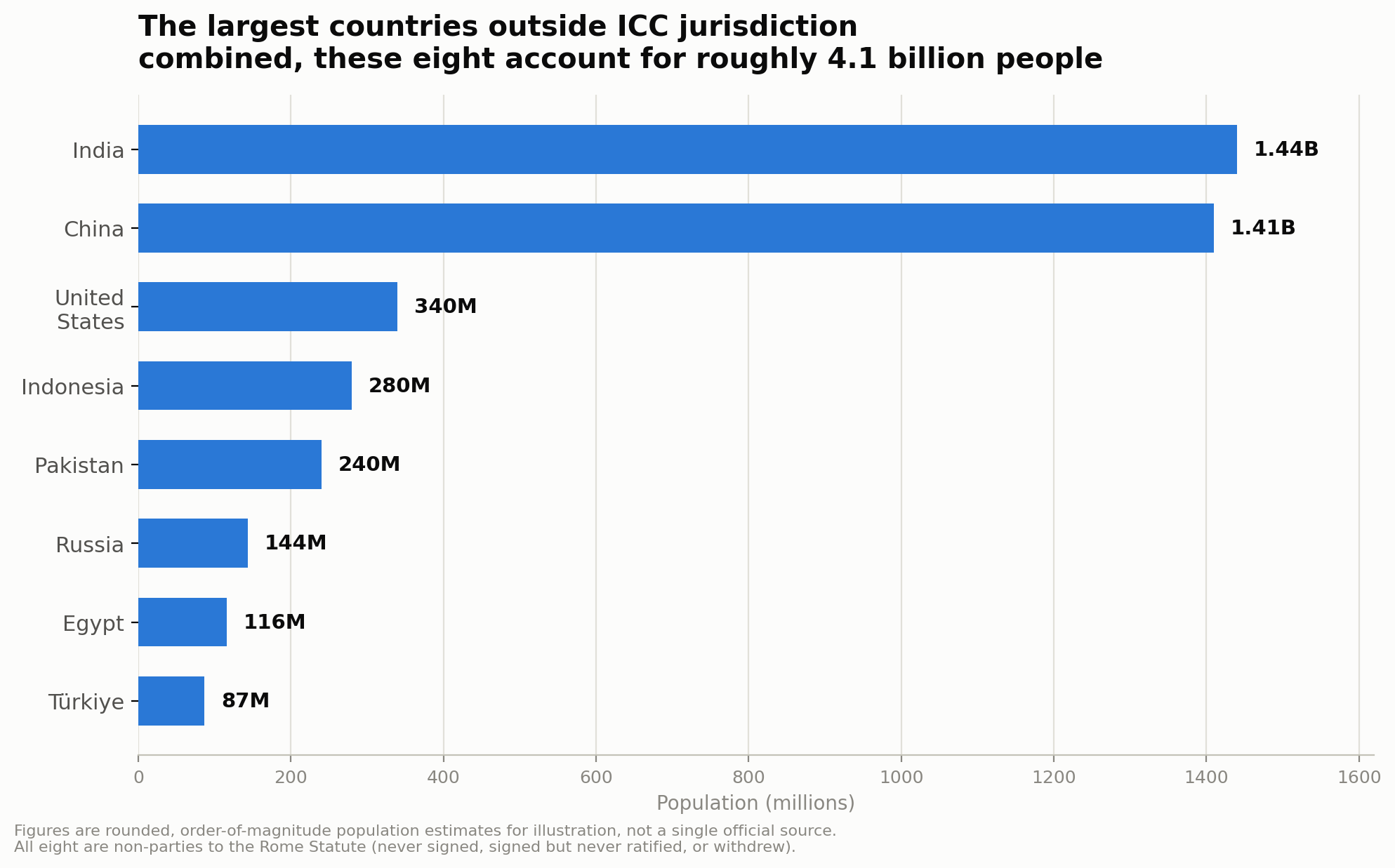
| Indonesia, Pakistan, Türkiye, Egypt | Non-parties (never ratified, or signed without ratifying) | — |
As of 2026, the ICC has 124 states parties, with Ukraine’s accession set to bring the total to 125 — a majority of the roughly 193 UN member states by country count. Population is distributed differently: several of the largest non-member states account for a substantial share of the world’s population.
Three of the five permanent members of the UN Security Council — the United States, Russia, and China — are not ICC members. Israel, the country whose former and current officials are named in this particular warrant, is also not a member.
Cost and process
Mamdani’s July 22 statement said his administration had “reviewed every avenue available under applicable law.” News coverage of the reversal reviewed for this report does not specify which office or attorneys conducted that review, whether outside counsel was retained, or what the review cost. City Hall has not published that information as of this writing. This report was unable to independently verify the cost or staffing of the review; readers should treat any specific claim about its cost as unconfirmed unless and until the city discloses it.
Perspectives on the reversal
Supporters of Mamdani’s original position have characterized the arrest pledge as a statement of political and moral position rather than an operational commitment, arguing that elected officials routinely make public statements about foreign leaders’ conduct without an expectation of personally carrying out an arrest, and that the pledge served to highlight what they view as inconsistency in U.S. and Israeli non-membership in the ICC relative to the court’s pursuit of other cases.
Critics of the original pledge, including some legal commentators cited in this report’s sources, have said the specific language Mamdani used — that the city “would enforce” the warrant or “follow all applicable local laws” — described an action rather than an opinion, and that the eventual reversal confirmed what was legally foreseeable before the pledge was first made.
Both characterizations appear in the public record and are presented here as reported positions, not as conclusions of this publication.
What remains unresolved
Mamdani’s reversal addresses the narrow legal question of municipal enforcement authority. It does not resolve, and was not represented by any party as resolving, the broader disputes over the Gaza war’s conduct, the ICC’s jurisdiction over non-member states’ nationals, or U.S. policy toward the court — all of which remain actively contested among the U.S. government, the Israeli government, Palestinian officials and human rights organizations, and the ICC itself.
Sources
- Mamdani says New York City can’t arrest Netanyahu but the federal government should — NPR
- Mamdani says he won’t try to arrest Israel’s Netanyahu, acknowledges NYC doesn’t have legal authority — CBS News
- New York Mayor Mamdani Admits He Can’t Arrest ‘War Criminal’ Netanyahu — TIME
- Opinion | ICC, Mamdani have no power to arrest Israel’s Netanyahu — The Washington Post (opinion)
- Mamdani says New York doesn’t have authority to arrest Netanyahu, urges feds to act — The Washington Post
- NYC Mayor-elect Mamdani doubles down on Netanyahu arrest pledge — Fox News
- Zohran Mamdani says NYC should uphold ICC arrest warrant for Netanyahu if he visits city — Fox News
- Mamdani admits he lacks power to arrest Netanyahu, after repeated pledges to do so — The Times of Israel
- Mamdani hedges on campaign pledge to arrest Netanyahu — Jewish Insider
- Mamdani orders review of whether New York can arrest Netanyahu when he visits this fall — The Forward
- Mamdani doubles down on calls to arrest Netanyahu after Trump pushback — Al Jazeera
- Mamdani: Netanyahu is a war criminal, but New York cannot arrest him — Al Jazeera
- World reacts to ICC arrest warrants for Israel’s Netanyahu, Gallant — Al Jazeera
- Israeli PM Netanyahu shrugs off ‘silly’ Mamdani threat to arrest him — wire report via AOL
- Palestinian Organisations Welcome Landmark Decision of the ICC Pre-Trial Chamber — Al-Haq (Palestinian human rights organization)
- ICC issues arrest warrants for Netanyahu, Gallant and Hamas commander — UN News
- Situation in the State of Palestine: ICC Pre-Trial Chamber I rejects Israel’s challenges to jurisdiction — International Criminal Court
- Israel/OPT: Netanyahu, Gallant and Al-Masri must face justice at the ICC — Amnesty International
- Imposing Sanctions on the International Criminal Court — The White House, Feb. 2025
- Issuance of Executive Order Imposing Sanctions on the ICC — U.S. Treasury, Office of Foreign Assets Control
- Q&A: The International Criminal Court and the United States — Human Rights Watch
- United States | Coalition for the International Criminal Court — Coalition for the ICC
- The Role of the International Criminal Court (ICC) — Council on Foreign Relations
- Text – H.Res.9 – 119th Congress — Congress.gov
- President Clinton on Signing of ICC Treaty (Rome Statute) — U.S. Department of State archive
- Russia withdraws from International Criminal Court treaty — BBC News
- Zohran Mamdani — Encyclopaedia Britannica
Graphics: USA Times. Population figures in the population chart are rounded, order-of-magnitude estimates compiled for illustrative comparison, not drawn from a single official source. This report will be corrected if any factual error is identified; readers may contact the editorial desk.