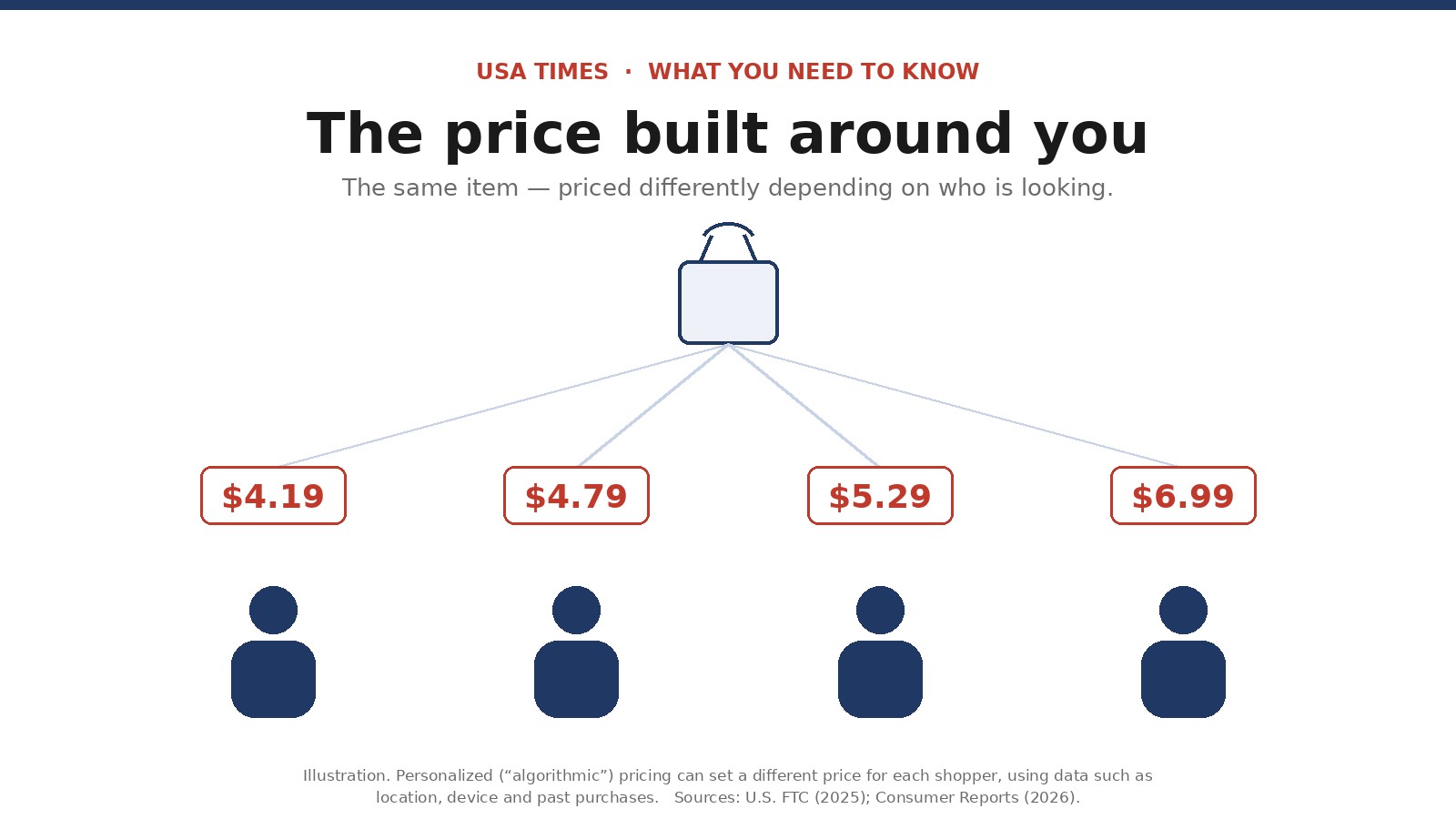
For as long as there have been stores, there has been a price tag — one number, in the window, the same for whoever walked in. That simple idea is quietly being replaced. Increasingly, the price you are shown online can be assembled just for you, in the instant you look, using what a company knows about you: where you are, what device you are holding, what you have bought before, even what you left sitting in a shopping cart. This report explains what that practice is, what independent studies and regulators have documented about it, and the one place in America where the law now forces companies to admit when they are doing it.
What “surveillance pricing” actually means
The plain definition: instead of posting a single price for everyone, a business uses software to set an individualized price based on personal information about the shopper. The industry prefers the term “personalized pricing.” Critics call it “surveillance pricing,” because the personalization runs on data collected about you. Both terms describe the same mechanism — a price shaped by your data rather than a price shared by all.
It is worth being precise about what this is not. It is not ordinary supply-and-demand pricing, where a flight or a hotel room costs more at busy times for everyone. It is not a coupon you chose to clip. Surveillance pricing is different because the number is tuned to the individual, and because, in most cases, you have no way of knowing the price was tuned at all.
Batmandir · The Circle Full access to theatres, museums & exhibitions. S2 · ongoing membership, without a Founder’s seat. Explore membership →What the federal government has found
In January 2025, the U.S. Federal Trade Commission released preliminary staff findings from a study of surveillance pricing. Using its authority to compel documents from companies, the FTC examined the intermediaries that help retailers set individualized prices. Its staff reported that details such as a person’s precise location and browsing history can be used to target individual consumers with different prices for the same goods, and that behaviors as granular as mouse movements on a page, or items left unpurchased in an online cart, can be tracked and fed into pricing (FTC, Jan. 2025; see also the FTC’s issue spotlight). The FTC has stressed that these are preliminary staff observations rather than a final report, and two commissioners objected to their release (Forbes). The subject has since drawn a congressional inquiry.
What an independent test of ride-hailing found
The most concrete public test to date comes from Consumer Reports. In an investigation conducted in March and April 2026, using 174 volunteers who ran more than 40 routes across 18 states, Consumer Reports found that Uber and Lyft charged different riders different prices for the same route ordered within about six minutes of one another. The median difference between the highest and lowest price clusters on a route was about 50 percent; on one Austin, Texas route, fares ranged from $25 to $65 for the same trip. The organization also reported that a share of the “discounts” shown to riders appeared to be measured against inflated original prices (Consumer Reports; summary of findings; NBC News).
The companies dispute the interpretation. Uber has said it does not engage in surveillance pricing and does not personalize fares for individual customers; both Uber and Lyft have said that customer data can be used to determine discounts. USA Times notes these as the companies’ stated positions. What the Consumer Reports data shows is variation in the price different people were quoted for the same ride at nearly the same moment; the cause of that variation is precisely what remains contested and under regulatory scrutiny.
The New York law, explained
Most of the time, surveillance pricing is invisible: there is no second price tag to compare against. New York has become the first state to change that. Its Algorithmic Pricing Disclosure Act took effect on November 10, 2025 (N.Y. Attorney General; bill text, A6765A). Here is what it actually requires, in plain terms:
- The trigger. The law applies when a business doing business in New York sets a price using an algorithm that relies on a consumer’s personal data.
- The required words. In that case, the business must place a “clear and conspicuous” disclosure next to the price stating: “THIS PRICE WAS SET BY AN ALGORITHM USING YOUR PERSONAL DATA.” The wording is prescribed by the statute.
- What counts as personal data. The law defines it broadly — data that identifies or could reasonably be linked to a specific consumer or device (Skadden analysis; Jones Day analysis).
- A key carve-out. The statute excludes location data used by ride-hailing and similar transportation services. In practice, that means the on-screen disclosure is more likely to appear on things like delivery and retail apps than on an Uber or Lyft ride fare — a distinction worth understanding.
- Enforcement. The New York Attorney General enforces the law, which carries civil penalties of up to $1,000 per violation, along with the power to seek cease-and-desist orders and injunctions. Attorney General Letitia James publicly warned New Yorkers about algorithmic pricing as the law took effect.
USA Times has already seen the law in operation. In reporting a separate story on food-delivery costs, our Data Desk reached the DoorDash checkout for a New York City address on July 15, 2026, and the app displayed the exact disclosure the statute requires — that the price shown was set by an algorithm using the customer’s personal data — alongside a “NYC Regulatory Response Fee.” We captured it as it appeared.
Why it is debated
Supporters of personalized pricing argue it can, in some cases, lower prices for shoppers who would not otherwise buy, and that businesses have always adjusted prices. Critics, including consumer-privacy groups, argue that pricing built on surveillance is opaque and can quietly charge people more based on characteristics they cannot see and did not consent to share (EPIC). Both views are part of an active policy debate; New York’s answer, for now, is disclosure rather than prohibition.
What a shopper can do
Because the practice is largely invisible, defenses are limited, but a few steps are grounded in the reporting above. Comparing the same purchase across more than one account, device, or a logged-out session can reveal differences; clearing items you were “saving” in a cart removes one signal companies are documented to use; and in New York, looking for the required disclosure line tells you when an algorithm, not a fixed price, is setting your number.
The bottom line
Surveillance pricing is not a rumor and it is not, by itself, illegal. It is a documented practice that regulators are studying, that at least one independent test has measured in ride-hailing, and that New York now forces some companies to disclose in writing. The single most useful thing for a shopper to understand is the shift itself: the price on your screen may no longer be a fact about the product. It may be a fact about you.
Sources
- Federal Trade Commission, “FTC Surveillance Pricing Study Indicates Wide Range of Personal Data Used to Set Individualized Consumer Prices,” Jan. 2025 — ftc.gov; issue spotlight (PDF) — ftc.gov.
- Forbes, “Your Data Sets Your Price. A Federal Study Showed Exactly How,” June 2026 — forbes.com.
- Consumer Reports, “Different Prices for the Same Ride,” 2026 — consumerreports.org; press release — consumerreports.org.
- NBC News, “On Uber and Lyft, different prices for the same ride” — nbcnews.com.
- New York State Attorney General, warning on algorithmic pricing as the new law takes effect, 2025 — ag.ny.gov.
- New York Algorithmic Pricing Disclosure Act, bill A6765A — nysenate.gov; legal analyses: Skadden, Jones Day.
- Electronic Privacy Information Center (EPIC), Surveillance Pricing — epic.org.
- DoorDash NYC checkout disclosure, captured by USA Times, 15 July 2026.
This report is part of a USA Times series examining how prices are set for consumers. It draws on public studies and primary sources cited above and was reviewed by an editor before publication. It describes documented findings and the stated positions of the companies named; it does not allege that any specific company has broken the law.