Read in: English · Español · Русский · 中文 · Português
The last six weeks of the year are the box office’s crown jewels — and for two decades a very short list of franchises has owned them. Looking at every week from late November through early January, the most dominant holiday weeks in the USA Times Star Index belong almost entirely to three names: Star Wars, Avatar, and one record-smashing Spider-Man.
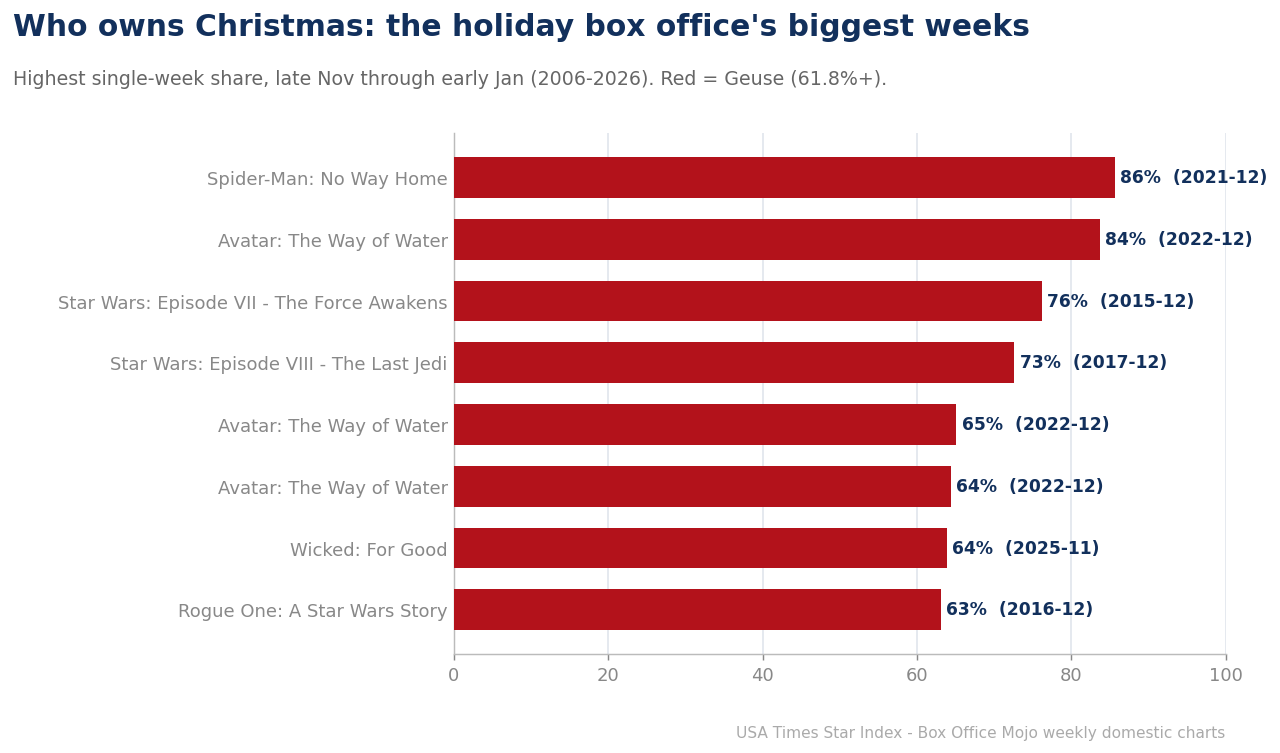
The three kings of December
The single most dominant holiday week in twenty years belongs to Spider-Man: No Way Home, which took an astonishing 86% of the entire U.S. box office in mid-December 2021. Right behind it sits Avatar: The Way of Water at 84% in December 2022 — and, remarkably, Avatar appears three separate times in the top eight, having held above 64% for three consecutive weeks. Then come the Star Wars sequels: The Force Awakens (76%), The Last Jedi (73%), and Rogue One (63%), each detonating in mid-December. The newest entrant is Wicked: For Good, which opened Thanksgiving 2025 at 64%.
Batmandir · Founders A numbered seat at the table. S3 · The Founders Club — 161 seats per location. By invitation. Explore membership →Why the holidays reward giants
The holiday corridor concentrates demand like no other time of year: schools are out, families are together, and studios save their biggest guns for the window. That combination produces the most lopsided weeks on the calendar — when a true event film lands in December, it doesn’t just win, it consumes nearly the whole market. It is the flip side of a pattern we’ve documented elsewhere: the biggest weekends are the least competitive, because one giant clears the room. Nowhere is that truer than at Christmas.
The strategic takeaway for studios is unchanged after twenty years: if you have a genuine phenomenon, the week before Christmas is the most valuable real estate in the business — and if you don’t, it is the worst place to stand.
The Avatar anomaly
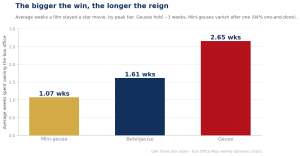
Most holiday giants dominate for one explosive week and then decline. Avatar: The Way of Water did something no other film in the twenty-year record managed: it held above 64% of the entire market for three consecutive holiday weeks in December 2022, appearing three separate times in our top eight. That is the single most sustained act of holiday domination in the Star Index — a reminder that James Cameron’s films operate on a different clock than the rest of the industry, converting the whole holiday window into one long coronation rather than a single opening spike.
Thanksgiving vs. Christmas: two different windows
The holiday corridor is really two events. Thanksgiving rewards broad four-quadrant crowd-pleasers — animated films and musicals like Wicked: For Good, which opened the 2025 corridor at 64% — that can play to extended families over a five-day weekend. Christmas week, by contrast, belongs to the event spectacle: the Star Wars and Avatar and Spider-Man titles that turn the days between December 20 and New Year’s into the highest-grossing stretch of the year. A studio choosing between the two slots is really choosing between reach and altitude.
| Film | Holiday week | Share |
|---|---|---|
| Spider-Man: No Way Home | Dec 2021 | 86% |
| Avatar: The Way of Water | Dec 2022 | 84% |
| Star Wars: The Force Awakens | Dec 2015 | 76% |
| Star Wars: The Last Jedi | Dec 2017 | 73% |
| Wicked: For Good | Nov 2025 | 64% |
The empty half of the calendar
The flip side of all this concentration is how punishing the holiday window is for anything that isn’t a giant. Because a single event film can take 80%+ of the market, every other release in the corridor is fighting over a sliver. That is why counter-programming at Christmas tends to be either prestige awards plays chasing a long slow run into January or nothing at all. The holidays are the clearest illustration of the Star Index’s central finding: the biggest weeks are the least competitive, because one film takes almost everything.
The January cliff
What goes up at Christmas comes down hard in January. The first weeks of the year are among the softest on the calendar — the giants have exhausted their opening crowds, and studios hold their next wave for the spring. That trough is why holiday releases are engineered to bank as much as possible in the compressed December window: the corridor is a spike with a cliff on the far side, not a plateau. A film that fails to detonate before New Year’s rarely gets a second chance in the January lull.
The awards-season exception
There is one kind of film that deliberately ignores holiday domination: the awards play. Prestige dramas often open narrow in late December to qualify for the year’s awards, then expand slowly through January and February on the strength of nominations. These films will never appear on a list of the most dominant holiday weeks — that is not their game. Their strategy is the mirror image of the tentpole’s: not to own a single enormous week, but to accumulate a long, modest run while the giants burn out around them.
Two decades of Christmas kings
Line up the December winners year by year and the concentration is striking: Star Wars titles claimed the crown across the mid-2010s, Avatar bracketed the era at both ends (2009 and 2022), and Marvel’s Spider-Man: No Way Home posted the single most dominant holiday week ever recorded. The through-line is that Christmas has become a slot reserved almost exclusively for the surest bets in the business — established franchises with guaranteed openings. The window is too valuable, and too unforgiving, to gamble on anything else.
The Thanksgiving-to-Christmas handoff
Inside the holiday corridor there is a rhythm. Thanksgiving launches the broad crowd-pleaser — the animated film or musical that plays to the whole family over five days — and that film often holds through early December before the Christmas juggernaut arrives to take the crown for the year’s final, biggest weeks. In strong years the two titles hand off cleanly, keeping a star movie on top for six straight weeks; in weak years the gap between them produces a rare holiday Dark week. The health of a given December can almost be read from whether that handoff is smooth or broken.
The other holiday calendars
It is worth remembering that the U.S. December is not the world’s only blockbuster window. China’s box office peaks around its own Lunar New Year and National Day holidays, and India’s biggest weeks cluster around festival dates that have nothing to do with the Western calendar. A film engineered to dominate an American Christmas may land in an ordinary week elsewhere, and vice versa — one reason global release strategy has become a calendar-matching exercise as much as a marketing one. The USA Times Star Index measures the U.S. market specifically, but the concentration pattern it reveals repeats, on different dates, around the world.
Why the corridor keeps getting more concentrated
If anything, the holiday window has grown more winner-take-all over the twenty years, not less. As the number of true event films per year has shrunk and their individual scale has grown, studios have funneled their surest bets into December — and a single one of those bets can now take a larger share of the corridor than any film did a decade ago. Spider-Man’s 86% and Avatar’s three-week stranglehold are recent records for a reason: the holiday box office is the purest expression of the concentration reshaping the whole industry.
What we did: We isolated every weekly chart falling between November 20 and January 5 and ranked them by the No. 1 film’s share of that week’s total domestic box office. Weekly share is each film’s gross as a percentage of that week’s total U.S. domestic box office, from Box Office Mojo’s weekly charts, 2006–2026. We exclude 2020, whose pandemic-shrunken weeks distort shares below the Star Index qualification floor.
Related from the USA Times Data Desk
Sources
- Box Office Mojo — annual domestic box office by year
- The Numbers — historical domestic box office records
- USA Times — Star Index methodology (how our tiers and box-office share are computed)