Read in: English · Español · Русский · 中文 · Português
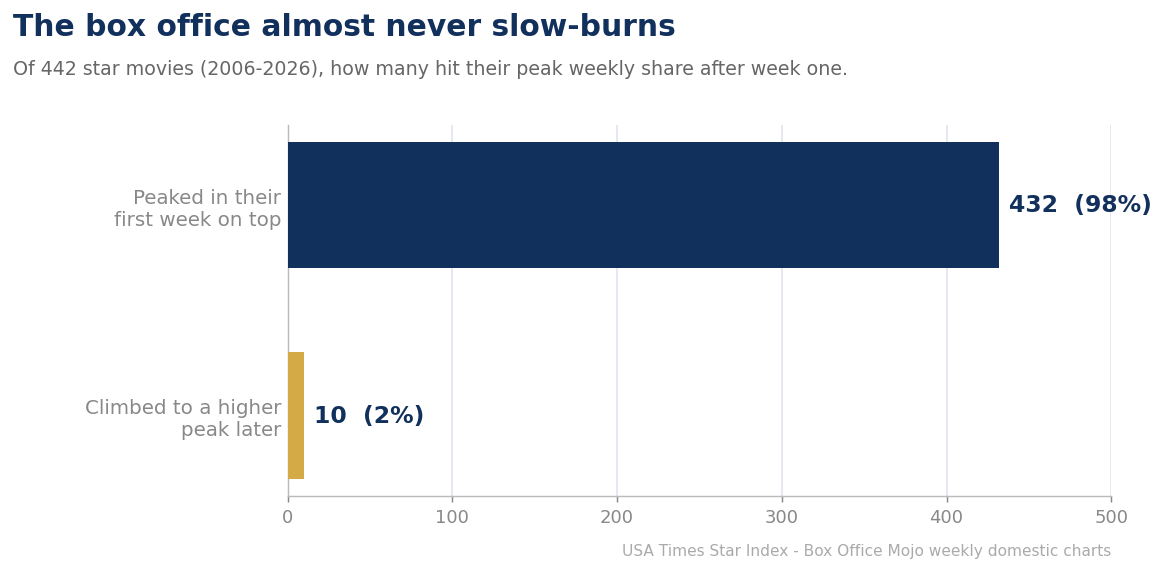
There is a romantic idea about the movies: the sleeper hit that opens quietly, builds on word of mouth, and climbs to the top of the charts weeks later. In the modern U.S. box office, it almost never happens. Across twenty years and 442 star movies in the USA Times Star Index, 432 — 98% — hit their single biggest week of market share the very first week they reached the top. Only ten films ever climbed to a higher peak afterward.
Opening weekend is the whole story
The reason is structural. A film’s widest release, its heaviest marketing, and its most eager audience all land on day one. Share — a film’s slice of the week’s total box office — is therefore almost always highest at launch and erodes from there, as the opening crowd thins and the next blockbuster arrives. The famous “second-weekend cliff” isn’t an exception; it’s the rule. What our data adds is the scale of it: front-loading is nearly universal, across every tier and every year.
Batmandir · The Circle Full access to theatres, museums & exhibitions. S2 · ongoing membership, without a Founder’s seat. Explore membership →The ten films that broke the pattern
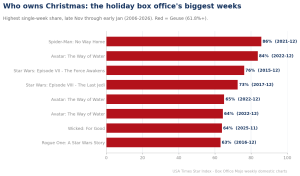
The exceptions are revealing. The handful of films that peaked after their first week on top nearly all share one trait: they debuted into unusual conditions and then surged. Top Gun: Maverick (2022) opened huge over Memorial Day, then took an even larger share of a quieter following week — a genuine word-of-mouth climb to 74% of its peak week. Tenet topped a depressed late-summer market and grew as almost nothing else opened. Animated tentpoles like The Super Mario Bros. Movie, The Croods: A New Age and Godzilla vs. Kong also crept up a week after launch, buoyed by family repeat business and thin competition. In every case, the “slow burn” was really a second-week vacuum, not a months-long build.
For anyone reading release strategy, the lesson is blunt: the number a film posts on opening weekend is, with 98% reliability, the best it will ever do. There is no meaningful path to the crown for a film that opens soft and hopes to grow into it. The box office rewards the loud entrance, not the long game.
What ‘front-loaded’ really costs the industry
A 98% front-loading rate is not a neutral fact; it shapes every decision a studio makes. If a film’s opening is destiny, then the marketing spend that drives that opening is the single highest-leverage dollar in the business — which is exactly why prints-and-advertising budgets for tentpoles now routinely rival or exceed the negative cost of the film itself. The entire modern release calendar, with its jealously guarded four-day windows and its terror of opening against another giant, is a rational response to a market that pays out almost entirely in week one.
It also explains why the theatrical “long tail” has withered. In an earlier era, a film like My Big Fat Greek Wedding or Titanic could sit in theaters for months and climb. Today, the compressed theatrical window and the pull of streaming mean there is little time for a slow build even if audiences wanted one. The films that do leg out — holding a large share of their own gross across several weeks — are almost always the giants that opened huge and simply declined slowly, not small films that grew.
The anatomy of the ten exceptions
Grouping the ten climbers shows two clear archetypes. The first is the quiet-market surge: Tenet and Godzilla vs. Kong opened into pandemic-thinned or competition-free weeks and grew as the surrounding market stayed flat. The second is the family-repeat climb: The Super Mario Bros. Movie, The Croods: A New Age and Frozen all benefited from the one audience that reliably returns for a second and third viewing — kids and the parents who take them. Top Gun: Maverick is the rare true word-of-mouth phenomenon, a film whose second full week actually out-shared its first because adult audiences kept recommending it.
| Climber | Tier | Peak share | Weeks owned |
|---|---|---|---|
| Top Gun: Maverick | Geuse | 74.4% | 3 |
| The Super Mario Bros. Movie | Geuse | 71.1% | 5 |
| Godzilla vs. Kong | Geuse | 69.4% | 4 |
| The Croods: A New Age | Geuse | 67.9% | 5 |
| Tenet | Betelgeuse | 58.6% | 6 |
Even these exceptions prove the rule. Their “climb” was a single step — a peak in week two, not a months-long ascent — and it required either an empty market or the unique repeat economics of animation. For everyone else, the opening number is the ceiling.
The streaming window closed the door
It is worth asking whether the box office was always this front-loaded. The historical record suggests not. In the 1980s and 1990s, when theatrical windows ran four to six months before home video, a modestly-opening film had time to find an audience — the platform release, expanding city by city on the strength of reviews, was a viable strategy that produced genuine slow-burn hits. That world is gone. With theatrical windows now often compressed to 30–45 days before a film hits premium video-on-demand, there is simply no runway for a months-long build. A film either captures the culture on opening weekend or it is gone before word of mouth could ever compound.
This has a knock-on effect on which films even get made. If opening weekend is destiny, studios rationally favor projects that can guarantee a big open — pre-sold IP, franchise entries, recognizable stars — over original stories that would have depended on discovery and legs. The 98% front-loading rate is therefore not just a description of how films perform; it is a quiet explanation of why the multiplex looks the way it does. The economics of the opening weekend select for the kind of movie that can win one.
What exhibitors do with the number
For theater owners, near-universal front-loading is both a blessing and a curse. It makes screen allocation predictable — you give the new giant your biggest auditoriums on Friday and reclaim them within two or three weeks — but it also concentrates risk into a handful of weekends. A single underperforming tentpole open can blow a quarter, because there is no slow-building midlist to cushion the miss. It is why exhibitors lobby so hard for a steady release cadence and dread the “empty” stretches: in a front-loaded market, the calendar’s gaps are pure downside.
The record books lie about front-loaded films
One underappreciated consequence of near-universal front-loading is how it warps the way we rank films. Lifetime-gross leaderboards — the lists that crown the “biggest movies of all time” — reward total accumulation, which favors films with staying power and long runs. But weekly-share dominance rewards the opposite: the concentrated, explosive open. A film can post one of the most dominant weeks in twenty years and finish nowhere near the all-time gross list, simply because it front-loaded so hard that it had little left to accumulate. The two metrics measure different virtues, and conflating them is one of the most common mistakes in box-office coverage.
This is precisely why the Star Index tracks weekly share rather than cumulative gross. Share captures the thing audiences actually experience in the moment — which film owned the culture this week — and it is inflation-proof and release-size-agnostic in a way raw dollars never are. A $100 million opening meant something very different in 2006 than in 2026; a 60% share of the week means the same thing in both. Front-loading is the reason share, not gross, is the honest unit for measuring domination.
A note on the pandemic exception
We exclude 2020 from these counts, and front-loading is part of why. With most theaters shuttered or capacity-limited, the handful of films that did open behaved abnormally — tiny releases held the top for weeks not because they were phenomena but because nothing else existed to unseat them. Those distorted, un-front-loaded reigns are an artifact of a broken market, not a signal about how the box office normally works, which is exactly the kind of noise the Star Index qualification floor is designed to screen out.
What we did: We compared each qualifying star movie’s first week atop the chart with the week of its highest recorded share. Weekly share is each film’s gross as a percentage of that week’s total U.S. domestic box office, from Box Office Mojo’s weekly charts, 2006–2026. We exclude 2020, whose pandemic-shrunken weeks distort shares below the Star Index qualification floor.
Related from the USA Times Data Desk
Sources
- Box Office Mojo — weekly and weekend box office grosses
- The Numbers — historical domestic box office records
- USA Times — Star Index methodology (how our tiers and box-office share are computed)