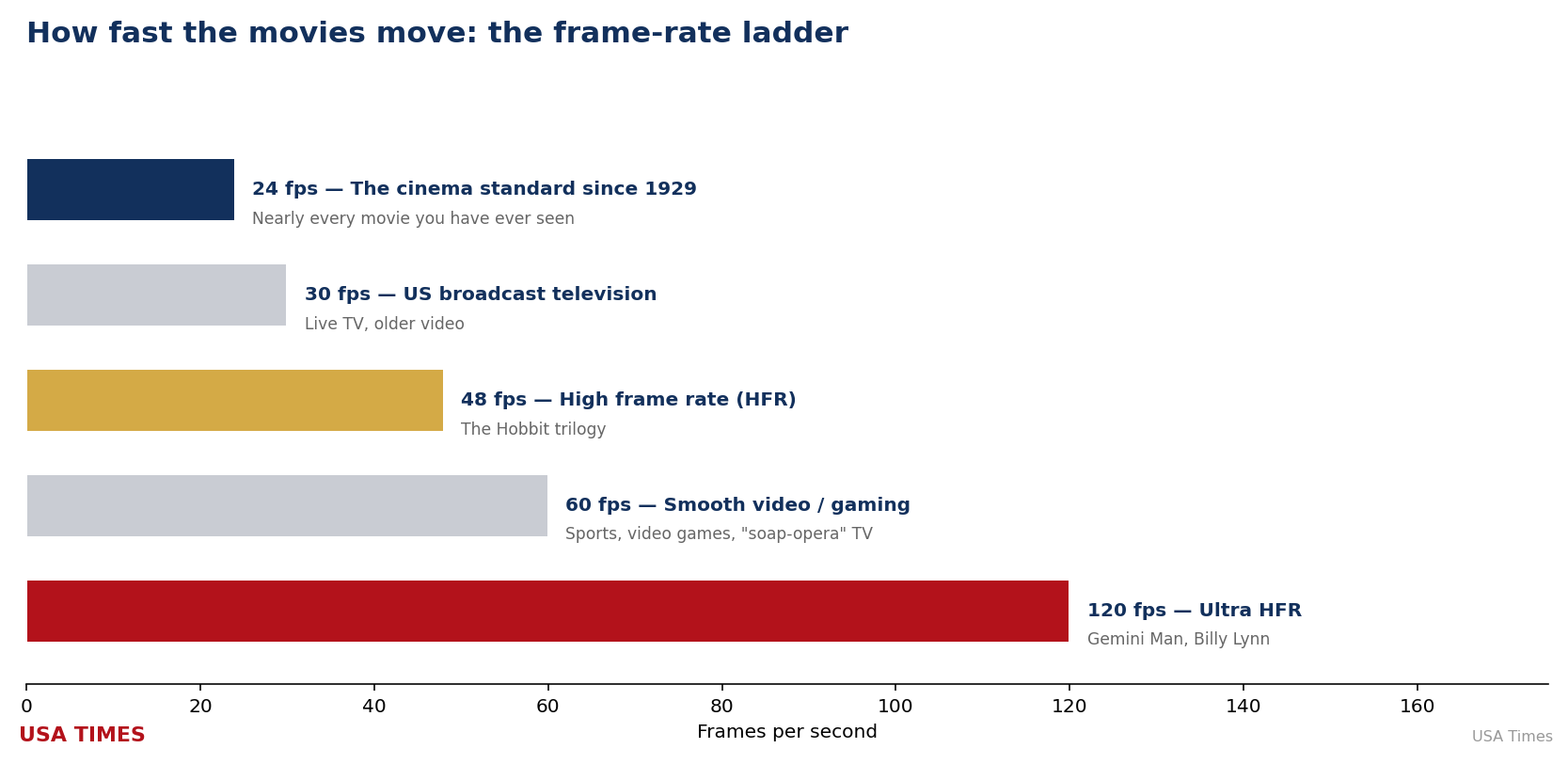
Almost every film you have ever seen — the silent classics, last summer’s blockbuster, the movie playing at your local multiplex tonight — runs at 24 frames per second. Twenty-four still images, flashed past your eyes each second, that your brain stitches into motion. It is one of the most durable technical standards in all of media, older than television, older than color film, older than sound itself was as a mass format. And despite a century of technological upheaval, nobody has managed to replace it. The story of why is a story about economics, biology, and the strange, stubborn thing we call “the look of film.”
An accident of economics
The number 24 was not chosen because it is optimal. It was chosen because it was cheap enough and good enough at the same time. In the silent era, films ran at a range of speeds — often slower, sometimes hand-cranked — because there was no soundtrack to keep in sync and film stock was expensive; projectionists could run a reel at whatever speed filled the show. When synchronized sound arrived at the end of the 1920s, that flexibility vanished. Sound needs a constant, predictable speed to stay in sync and to reproduce audio at acceptable quality, and the industry needed a single standard everyone could build cameras and projectors around. Twenty-four frames a second was the compromise: fast enough that the audio was clean and the motion was smooth enough to read as lifelike, slow enough that studios weren’t burning through vastly more of a costly physical medium than they had to. It was a budget decision that hardened into a law of nature.
Why your eye accepts it
Twenty-four frames a second should not, by rights, look like motion at all — it is a slideshow running fast. It works because of two quirks of human vision. The first is persistence of motion: the brain fills the gaps between frames, interpreting a rapid sequence of stills as continuous movement. The second is motion blur. Because each frame of a film is exposed for a fraction of a second while the subject moves, fast action smears slightly within the frame, and that blur is exactly the cue your visual system uses to read smooth motion. A film at 24fps is not showing you reality; it is showing you 24 blurry snapshots a second that your brain is delighted to accept as reality. The “imperfection” of the low frame rate is doing part of the work.
Batmandir · Founders A numbered seat at the table. S3 · The Founders Club — 161 seats per location. By invitation. Explore membership →The failed revolutions
Every so often, a filmmaker decides 24 is a limitation to overcome rather than a look to preserve. The most famous recent attempt was the Hobbit trilogy, shot and projected at 48 frames a second — “high frame rate,” or HFR — to eliminate the strobing and blur of fast motion on a big screen. Others have gone further: films shot at 60 or even 120 frames a second, chasing a hyper-clear, hyper-smooth image. Technically, they succeed. The motion is glassy and precise. And audiences, by and large, have recoiled. The common complaint is that HFR looks “cheap,” like a daytime soap opera or a live sports broadcast — too clear, too immediate, stripped of the dreamy, slightly-removed quality that makes a film feel like a film rather than a window. The higher frame rate reveals the sets as sets and the makeup as makeup. Reality, it turns out, is not what we go to the movies for.
The look we didn’t know we loved
This is the deep reason 24 refuses to die. Over a century, audiences have not merely tolerated the frame rate — they have come to associate its specific texture with “cinema” itself. The subtle strobing of a fast pan, the way motion blurs and smears, the faint dreamlike distance between the image and raw reality: these are not bugs we endure but the grammar of the medium, learned so thoroughly that we notice only when they’re absent. When a film looks “too real,” it breaks a spell we didn’t know we were under. The 24-frame image is a stylization so universal it became invisible, and any attempt to “improve” it reads instead as a departure from the thing we came to see.
There is a lesson here that reaches beyond projectors. A standard chosen for the dullest of reasons — the price of film stock in 1929 — became, through nothing but a century of habit, an aesthetic that audiences actively defend. The technology to show you more, clearer, smoother images has existed for years, and audiences keep saying no. What they are protecting is not accuracy but feeling: the particular, slightly unreal texture that separates a movie from a livestream. Twenty-four frames a second isn’t the best the technology can do. It is the number the movies taught us to love, and a century of trying to beat it has only proved how attached we are.
Even digital kept the number
The most telling proof of 24’s hold is what happened when the reason for it disappeared. The frame rate was born of physical film — a compromise about how much celluloid to expose. When cinema went digital, that constraint evaporated: a digital camera can shoot at practically any frame rate for the same cost, and there is no film stock to conserve. And yet the industry chose to keep shooting and projecting at 24. Directors who could have had any smoothness they wanted deliberately preserved the old cadence, because the goal was never efficiency — it was the look. Digital cinema could have quietly abandoned 24 and no accountant would have objected. It didn’t, because audiences and filmmakers alike had decided the number was part of the art.
Television, tellingly, went the other way, and the split is instructive. Broadcast and streaming video embraced higher, smoother frame rates for sports and live events — contexts where immediacy and clarity are the whole point, where you want to feel like you are there. Cinema kept 24 precisely because it does not want you to feel like you are there. It wants you to feel like you are watching something composed, heightened, a step removed from the ordinary. The frame rate is where that distinction lives. Smooth motion says “this is real, and happening now.” The gentle judder of 24 says “this is a story.”
So the next time you sit in the dark, remember that the smooth, cinematic motion in front of you is an illusion built on 24 flickering snapshots a second — a compromise struck by accountants and engineers a hundred years ago, preserved not by inertia but by love. The frame rate is the oldest special effect in the movies, and still the one we’d least like to live without.