A movie poster has one job: to stop you in a hallway and make you want to buy a ticket. For a century, the designers who did that job best worked less like illustrators and more like architects — balancing a title, a face, a mood, and a wall of legal small print inside a fixed rectangle. Inevitably, the golden ratio gets invoked to explain their genius. As usual, the truth is part craft, part legend.
The shape you already know
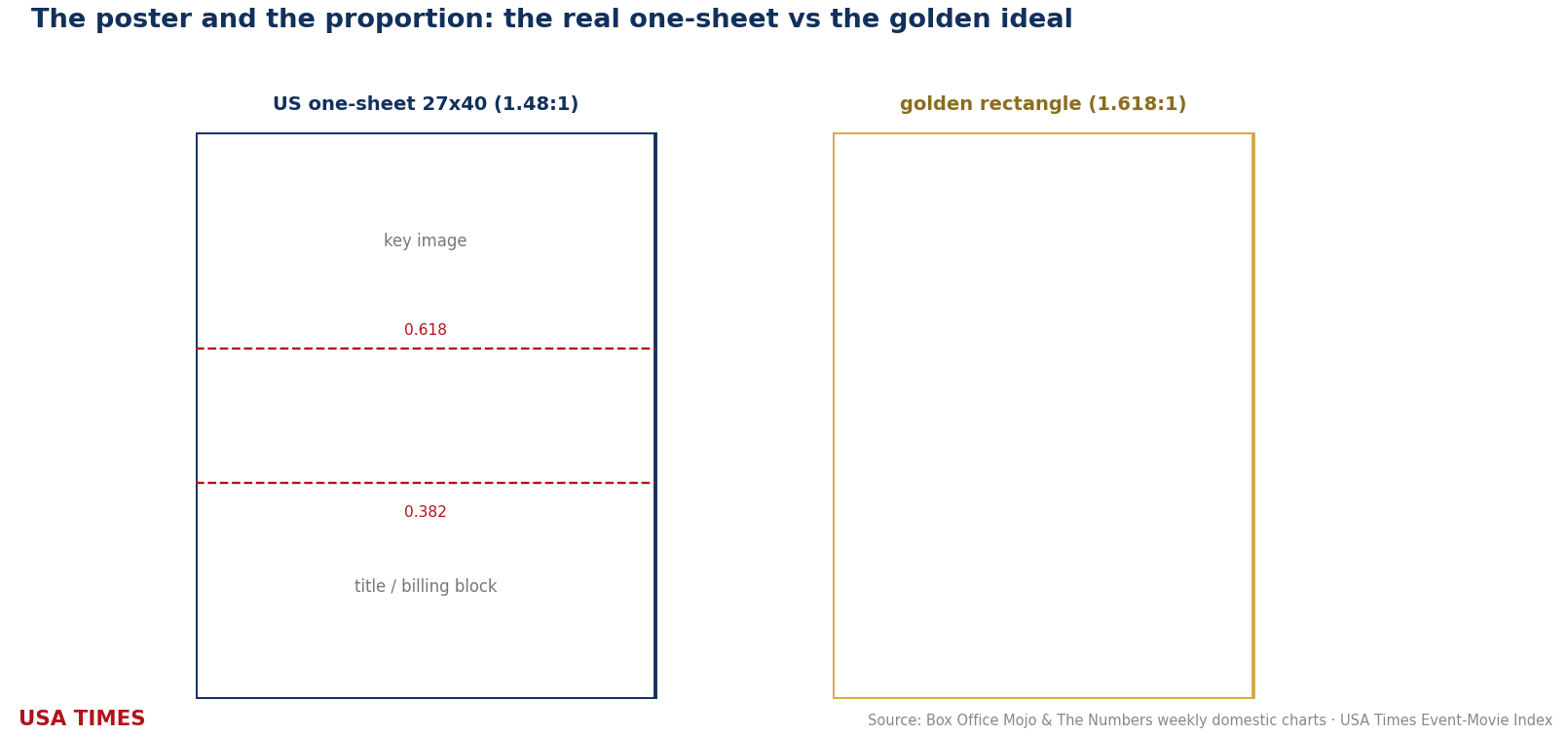
Start with the canvas itself. The standard American “one-sheet” poster is 27 by 40 inches — a ratio of about 1.48 to 1. That is close to the golden rectangle’s 1.618 but noticeably squarer, and it was chosen for mundane reasons: printing standards, frame sizes, and the dimensions of the display cases outside theaters, not any appeal to sacred geometry. The poster’s shape is an industrial spec, and it is not golden.
What designers do inside that rectangle is where the interesting choices live. A huge share of posters divide their height into a large image zone up top and a lower band for the title and the billing block — the dense credits legally required at the bottom. Designers place that division by eye, and it often lands somewhere in the 0.6-to-0.7 range from the bottom — which means the golden section, 0.618, frequently falls near it. Is that intent, or is it just where a title looks balanced against a full-bleed image? Almost always the latter. The eye finds the same pleasing spots the ratio predicts, without anyone doing the arithmetic.
Batmandir · The Circle Full access to theatres, museums & exhibitions. S2 · ongoing membership, without a Founder’s seat. Explore membership →The Saul Bass exception
No conversation about poster design survives without Saul Bass, the mid-century master behind the one-sheets for Vertigo, Anatomy of a Murder, and The Man with the Golden Arm. Bass stripped the poster down to a single bold symbol and a hand-cut typeface, and his work is genuinely rigorous about proportion, balance, and negative space. But Bass’s genius was not that he obeyed the golden ratio — it was that he understood reduction: that one arresting graphic idea, perfectly placed, beats a collage of floating heads. His compositions feel inevitable because of ruthless editing, not because of a spiral you can lay over them afterward.
That distinction matters, because Bass is constantly enlisted as a golden-ratio witness by people who admire his results and want a formula to explain them. The formula flatters us: it suggests great design is a solvable equation. Bass himself talked about symbolism, wit, and emotional shorthand — the meaning of an image — far more than about mathematics. The proportion was a tool in a large kit, not the secret.
What actually makes a poster work
Strip away the numerology and the durable principles are unglamorous but real: a single dominant focal point; a clear hierarchy so the eye knows where to go first, second, third; enough contrast to read at a glance and from across a lobby; and negative space that lets the key image breathe. Golden proportions can help you land those goals, but so can the rule of thirds, a strong diagonal, or simple symmetry. The ratio is one route to balance among many, and the best designers switch tools by instinct.
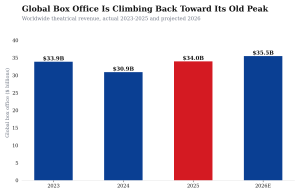
So enjoy the golden-ratio overlays that circulate on design blogs — they are fun, and they often do graze something real about where a well-placed title sits. Just hold them loosely. The proportion is a lens for appreciating good composition after the fact, not the blueprint the designer worked from. And as with every other corner of cinema we have examined, the golden ratio earns its real keep not on the wall but in the ledger, where it measures not how a poster looks, but how big the movie behind it became.