Read in: English · Español
The Federal Trade Commission has opened a nationwide rulemaking aimed squarely at the fees on food- and grocery-delivery apps — the same charges USA Times has spent months documenting, sandwich by sandwich, on New York City menus. Here is what the agency is asking, what our own audit of dozens of restaurants found, and how the economics actually work.
For years, the price you pay to have dinner delivered has been a small mystery. The number on the app is not the number on the restaurant’s menu. A “service fee” appears at checkout. So does a line item most New Yorkers have never heard of. And by the time you tap “Place Order,” a sandwich that costs $28.95 at the counter can cost close to $45.
Batmandir · Guest Passes Step inside for a day. Guest passes from $161/day — brought in by a member. See guest passes →On April 14, 2026, the Federal Trade Commission signaled it wants that to change. The agency announced it is seeking public comment on whether a nationwide rule is needed to stop “unfair or deceptive fee practices” on online food and grocery delivery platforms — a formal Advance Notice of Proposed Rulemaking, or ANPRM. It is the clearest signal yet that federal regulators intend to police how Uber Eats, DoorDash, Instacart and Grubhub present the cost of the food you order.
“Online grocery fees that are unclear, inconsistently disclosed, or revealed only at the last moment before consumers make a purchase distort competition and harm consumers,” said Christopher Mufarrige, director of the FTC’s Bureau of Consumer Protection. “Clear and truthful pricing is essential to competitive markets. The Commission’s enforcement track record suggests that consumers continue to face a suite of fees that prevent them from making informed comparisons.”
A junk-fee campaign reaches the delivery aisle
The food-delivery proposal does not stand alone. It is the latest front in a broader FTC campaign against so-called junk fees — mandatory charges that are hidden until the final step of a purchase. The agency has already turned that campaign into enforcement dollars against delivery platforms specifically. In December 2025, it announced a $60 million settlement with Instacart over allegations the company advertised “free delivery” on customers’ first orders and then charged service fees that were not disclosed until checkout. A year earlier, in December 2024, the FTC and the Illinois Attorney General reached a $25 million settlement with Grubhub over allegations it misled diners about the cost of delivery.
Those cases, the Commission argues, show the problem is recurring rather than one-off — and that case-by-case enforcement has not fixed it. A rule would let the agency seek civil penalties and consumer redress more directly. It would also, the FTC notes, create a single national standard where today there is a patchwork: a number of states have passed their own delivery-fee disclosure laws, but there is no uniform federal rule that applies to every platform in every market.
The nine questions the FTC is asking
The ANPRM asks the public whether platforms clearly and conspicuously disclose nine things. Read as a list, it is essentially a diagram of every complaint diners have about these apps:
- Total price — is the all-in cost shown up front?
- Fees and charges — is the existence, purpose, refundability and recipient of each fee disclosed?
- Variable or contingent fees — are the factors that move a fee up or down explained?
- Material restrictions — is it clear which fees are mandatory versus optional?
- Price differentials — does the platform disclose that item prices differ from the in-store or restaurant price?
- Personalized pricing — does it disclose when the price you see was set differently than for another customer?
- Discounts or promotions — are the limits on a promotion made clear?
- Additional payments — does the platform ever claim you owe money for something you did not agree to buy?
- Unauthorized billing — does it charge without express, informed consent?
Two of those — price differentials and personalized pricing — describe, almost word for word, what our reporting has already found in New York.
What we found across the city
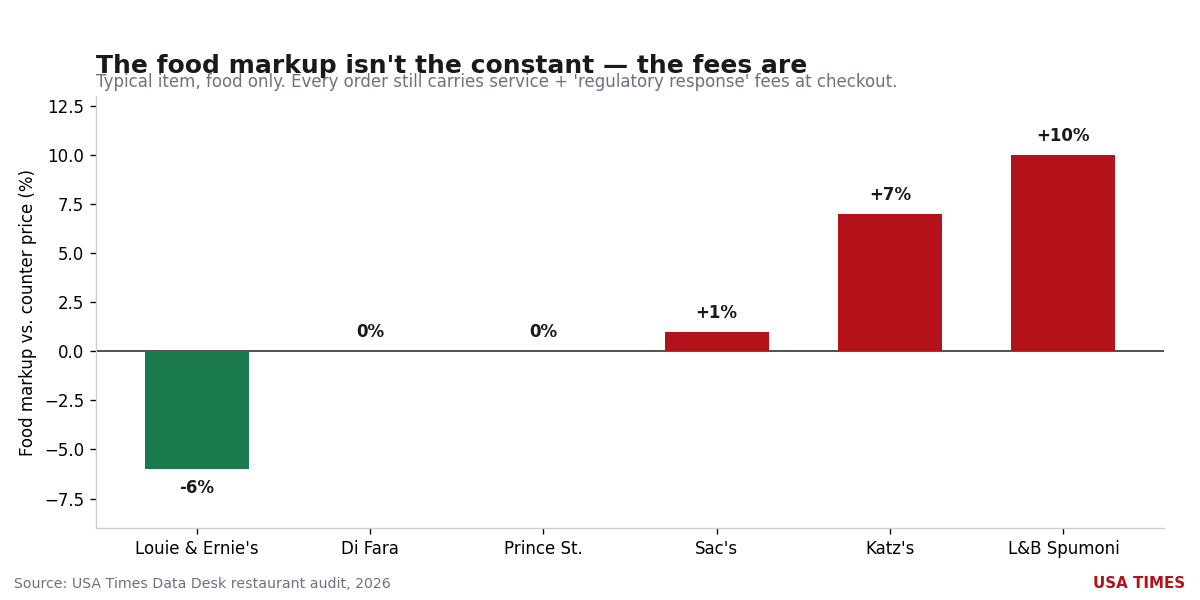
Since mid-2026, the USA Times Data Desk has priced identical menu items three ways for the same restaurant on the same day: the restaurant’s own counter price, the item on Uber Eats, and the item on DoorDash, capturing every fee at checkout for a Manhattan delivery address. The single most important finding is not that the apps always mark up the food. It is that the markup on the food itself varies wildly from restaurant to restaurant, while the fee stack is the constant.
Consider the range:
- At Di Fara, the Midwood landmark, we priced 12 items on DoorDash and found the identical price on every one — a $32 regular pie, a $36 square, a $42 Chaos Pie, a $6 slice — matched to the cent. The food markup was zero. The platform made its money on the fees stacked on top.
- At Prince Street Pizza in Nolita, 16 of 18 whole pies matched the counter price exactly; only one square pie ran about 13% higher.
- At Louie & Ernie’s in the Bronx, the delivery menu actually ran about 6% below the counter — $12 calzones listed at $10 — before the fees.
- At Sac’s Place in Astoria, 52 items ran about 1% above the counter, essentially at par.
- At L&B Spumoni Gardens, by contrast, 58 of 62 items carried a near-flat +10% surcharge — with the famous square pie a notable exception.
| Restaurant | Food markup vs. counter | Where the platform earns |
|---|---|---|
| Di Fara (Midwood) | 0% — matched to the cent | Checkout fees only |
| Prince Street (Nolita) | ~0% — 16 of 18 pies matched | Checkout fees only |
| Louie & Ernie’s (Bronx) | −6% — below counter | Checkout fees |
| Sac’s Place (Astoria) | +1% — at par | Fees + small markup |
| Katz’s (Lower East Side) | +7% — $28.95 → $30.95 | Markup + fees |
| L&B Spumoni (Bensonhurst) | +10% — 58 of 62 items | Markup + fees |
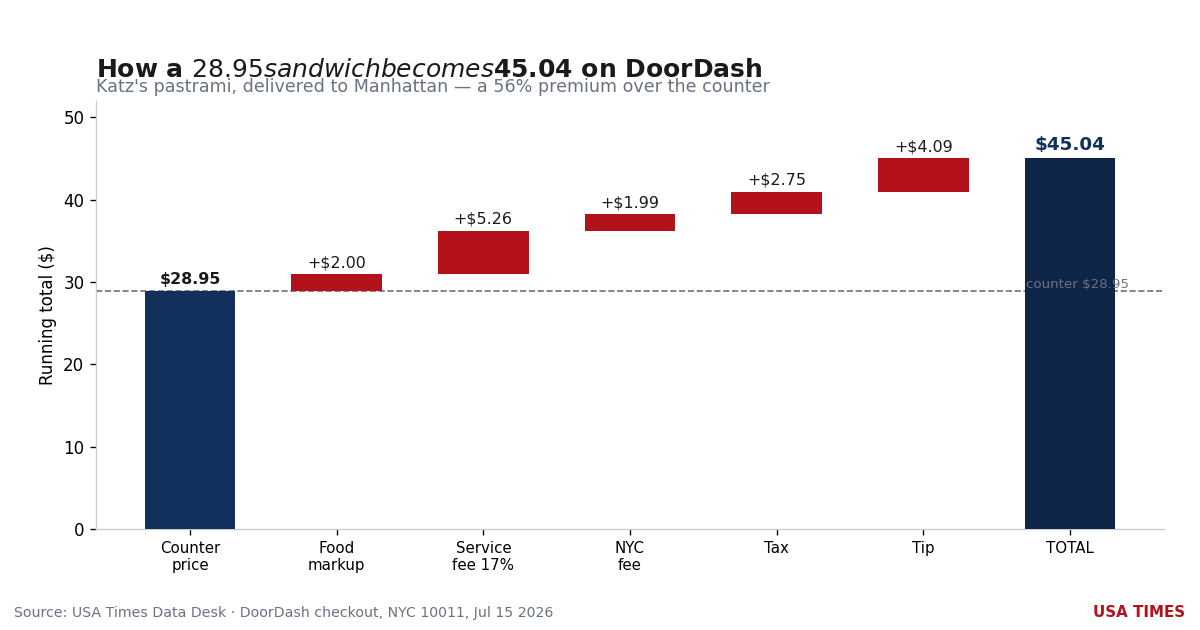
Where the money reliably comes from is the checkout. Here is a single-sandwich DoorDash order from Katz’s Delicatessen to a Chelsea address, captured live on July 15, 2026:
| Katz’s pastrami sandwich | Price |
|---|---|
| Counter price (Katz’s own menu) | $28.95 |
| Marked-up food subtotal on DoorDash | $30.95 |
| Service fee (17%) | $5.26 |
| “NYC Regulatory Response Fee” | $1.99 |
| Estimated tax | $2.75 |
| Tip (10%) | $4.09 |
| Total | $45.04 — a 56% premium over the counter |
The $1.99 fee — and the algorithm
Two line items in that receipt go straight to the FTC’s questions. The first is the $1.99 “NYC Regulatory Response Fee.” In its own on-screen disclosure to New York users, DoorDash explains that “regulations in New York City have increased the cost of facilitating deliveries,” and that it therefore adds the surcharge to NYC orders. In plain terms: New York caps the commission the apps can charge restaurants, and the platforms have responded by charging the difference to the customer instead.
The second is subtler and, arguably, bigger. In the same New York disclosure — required under a state algorithmic-pricing transparency law — DoorDash tells users, verbatim: “This price was set by an algorithm using your personal data.” That is personalized pricing, disclosed by the company itself, and it is precisely the practice the FTC is now asking the public about.
Pickup kills the “delivery cost” defense
The most common justification for delivery-app pricing is that it simply covers the cost of getting food to your door. Our audit undercuts that. We found the same marked-up item prices on pickup orders — where there is no driver and no delivery at all. Whatever the markup is, on those orders it is not paying for a car.
The math also matters for the restaurants everyone assumes are protected. At a 30% platform commission, a menu has to be marked up roughly 42.9% just for the restaurant to net what it earns at the counter. The pizzerias that list at the counter price — Di Fara, Prince Street, Louie & Ernie’s — are, on the delivery order, very likely taking home less than a walk-in customer would pay them, with the platform’s commission making up the gap.
What the companies say
Uber, DoorDash and Instacart have consistently defended their pricing. The companies say fees are disclosed before a customer completes an order; that service fees fund the real costs of running a marketplace — driver pay, insurance, support and payment processing; that tipping remains available; and, in New York specifically, that local rules such as the commission cap and the minimum-pay mandate raised their costs and prompted the surcharges. They also note that restaurants, not the platforms, sometimes choose to set higher menu prices on the apps. USA Times’ Data Desk requested comment from Uber and DoorDash for this series and will update with any response.
Those points deserve weight. A delivery marketplace is genuinely expensive to run, and some of what critics call “junk fees” do fund labor and insurance that did not exist a decade ago. The FTC’s question is narrower than whether the fees are justified: it is whether they are disclosed clearly enough, early enough, for a consumer to comparison-shop honestly.
What a rule would do — and how to weigh in
An ANPRM is the earliest formal step in federal rulemaking; a proposed rule and a final rule, if they come, can take years and could be narrowed or dropped. But the comment record built now shapes what follows. The comment window for this notice (docket FTC-2026-0463) closed May 18, 2026, drawing more than 430 public comments. The FTC is now reviewing that record to decide whether to advance a proposed rule.
USA Times compiled the pricing data behind this series — the counter-versus-app differentials, the fee stack, the pickup finding and the algorithmic-pricing disclosure — into a formal comment, and is publishing the underlying findings here so readers and regulators can weigh them as the rulemaking proceeds.
How we reported this. USA Times’ Data Desk priced identical items at each restaurant’s counter, on Uber Eats and on DoorDash on the same day, from a Manhattan (10011) delivery address, and captured full checkouts including all fees. Where prices differ by platform we note it; where the food price matches the counter, the platform’s revenue comes from fees and commission. Commission rates to specific restaurants are confidential contract terms and are described here as ranges.
Sources: FTC, “FTC Seeks Public Comment on Unfair and Deceptive Fee Practices in Online Food and Grocery Delivery Services” (April 14, 2026); FTC settlements with Instacart (Dec. 2025) and Grubhub (Dec. 2024); USA Times Data Desk pricing audit and published restaurant reports (2026). Comment docket: FTC-2026-0463-0001.