A USA Times price audit of a Mexico City restaurant found its dishes cost about 30% more on Uber Eats than on its own printed menu — before a single fee is added. The markup is almost exactly what Uber is reported to charge restaurants. Then Uber bills the customer again.
Order the butter chicken at Swad Indian Restaurant on Alejandro Dumas 125, in Mexico City’s Polanco district, and the printed menu asks $235 pesos. Order the identical dish through Uber Eats, from a kitchen a courier will visit in person, and it costs $345 — a 47 percent premium. The chicken tikka masala is $245 in the dining room and $365 in the app. A plate of four idli is $145 at the table and $240 on your phone, a 65 percent increase.
None of those figures include Uber’s delivery fee. None include its service fee. Those are added afterward, at checkout, on top of a price that has already been inflated.
Batmandir · Guest Passes Step inside for a day. Guest passes from $161/day — brought in by a member. See guest passes →USA Times compared every dish we could match between Swad’s own menu — published as a PDF on the restaurant’s website — and its Uber Eats storefront, captured on July 14, 2026. Across 64 items, the average markup was 29.8 percent; the median was 28 percent. Twenty-nine dishes were marked up 30 percent or more; fifteen by 40 percent or more. A basket of one of each of the 64 items costs $10,993 in the restaurant and $14,179 on Uber Eats — a 29 percent difference, before any fee at all.
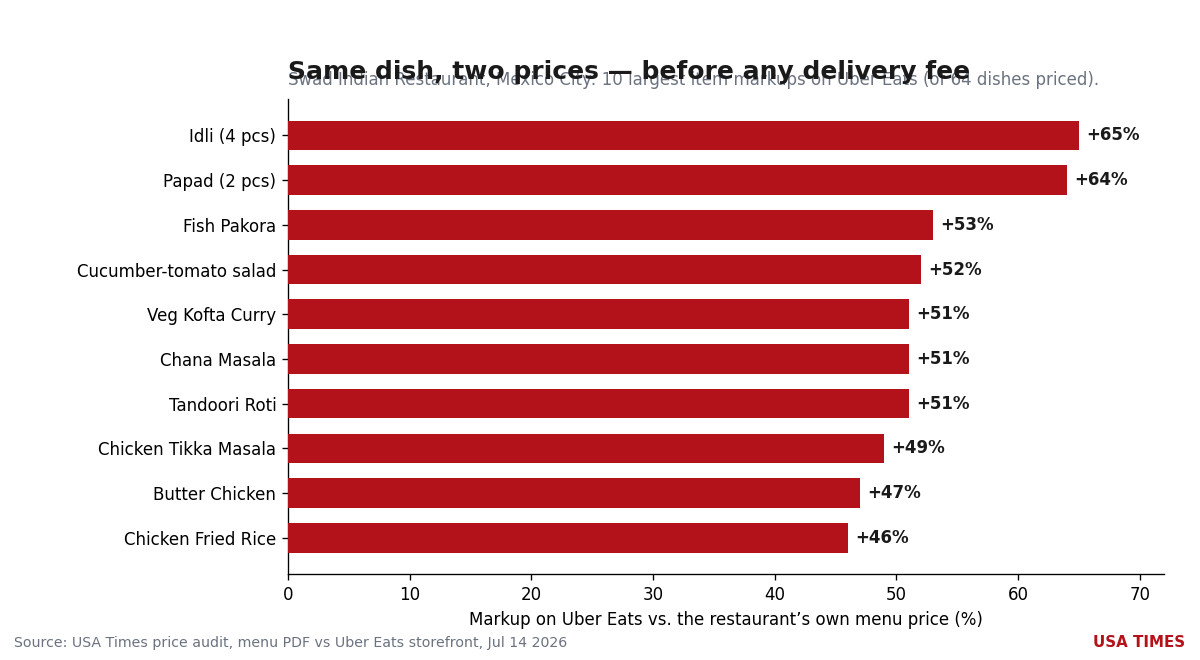
That number, 29.8 percent, is not random. It is almost precisely what Uber Eats is reported to charge the restaurant.
The commission, and where it goes
Uber Eats does not disclose the commission it charges any individual restaurant — those are confidential contract terms, and Swad’s exact rate is not public. But Uber’s commission is well documented in range: the platform charges a percentage of each order that, on the tiers that buy greater visibility in the app, is widely reported at roughly 25 to 30 percent of the order subtotal, with lower rates on entry-level plans. In Mexico, Uber additionally withholds value-added tax on the commission, and some plans push merchants to spend a few percent of sales on in-app advertising.
A restaurant on those terms has a simple problem. If it lists the butter chicken on Uber Eats at the same $235 it charges at the table, roughly a quarter to a third of that disappears to the platform. The kitchen, the cook and the rent do not get cheaper because the order arrived through an app. So the restaurant raises the app price by approximately what the platform takes — which is what the data shows: a mean markup of 29.8 percent against a reported commission of roughly 25 to 30 percent. The effect is that Uber’s commission is not, in any practical sense, paid by the restaurant. It is paid by the customer, embedded invisibly in the price of the food.
The second charge
Having recovered its commission through the marked-up menu price, Uber then charges the customer again — directly, at checkout, as a delivery fee and a service fee. Uber’s own help documentation distinguishes the two: the delivery cost is what the customer pays for the courier; the commission is what the restaurant pays for the platform. Two charges, two payers — on paper. In practice there is one payer. The diner funds the courier through the visible fee and the commission through the invisible one. Swad’s page advertises free delivery for Uber One members above a threshold — a promotion whose existence confirms non-members pay a delivery fee on top of everything else.
Uber has the number — and doesn’t show the diner
Uber does not set these prices, and says so: merchants control their own in-app pricing. That defense is factually correct. But Uber is not unaware of what its commission structure produces. The company maintains a merchant metric it calls “Menu Markup.” By Uber’s own description, it is “a comparison of the prices of your most frequently ordered items on Uber Eats to your in-store pricing” — a measurement of precisely the gap this investigation set out to find. Uber has the number. It shows it to the restaurant. It does not show it to the diner. Nothing on Swad’s storefront tells a customer the food is priced roughly 30 percent above what the same kitchen charges a walk-in.
One detail rules out an accident
Two items are priced identically in both places: Indian chai is $70 in the restaurant and $70 on Uber Eats; sharbat is $68 in both. Zero markup, twice. That small fact forecloses a large excuse: the uplift is not a platform-wide multiplier applied automatically. It is a set of item-by-item prices set by the merchant, dish by dish — and the two left unchanged are the cheap drinks, where a 30 percent bump would be conspicuous.
| Dish | Restaurant menu | Uber Eats | Markup |
|---|---|---|---|
| Idli (4 pcs) | $145 | $240 | +65% |
| Papad Roasted (2 pcs) | $55 | $90 | +64% |
| Fish Pakora | $180 | $275 | +53% |
| Veg Kofta Curry | $175 | $265 | +51% |
| Chicken Tikka Masala | $245 | $365 | +49% |
| Butter Chicken | $235 | $345 | +47% |
What this is, and what it isn’t
This is not a story about a restaurant gouging its customers. Swad’s markup tracks its costs almost exactly; strip out the platform’s commission and the delivery price and the two menus converge. It is a story about who actually pays for a business model. Uber Eats presents itself to diners as a courier service that charges a delivery fee. In practice it also collects a share of the food itself — large enough that the restaurant raises the food price to survive — and then collects a fee from the same customer for delivery. Both land on one person. Only one is disclosed. It is the same structure U.S. regulators are now examining: the FTC has opened a rulemaking on whether delivery platforms adequately disclose fees and price differences.
Method & limits. Prices were taken from Swad Indian Restaurant’s own menu PDF at swad-restaurant.com and its Uber Eats storefront in delivery mode, both on July 14, 2026. Only dishes appearing on both with matching descriptions were compared; combination plates were excluded. All prices are in Mexican pesos. Two limits: the storefront was closed at capture, so we could not reach checkout to record the exact delivery and service fees on a live order (they are charged; we do not state their size); and this is one restaurant — a single case cannot establish a citywide pattern. USA Times is extending the same item-by-item audit across 100 Mexico City restaurants and will publish the full dataset. USA Times has requested comment from Uber Eats and will update this article with any response.
Sources: USA Times price audit (Swad menu PDF vs. Uber Eats storefront, July 14 2026); Uber Eats merchant help, “How is the ‘Menu Markup’ metric calculated”; reported Uber Eats commission ranges. Analysis by the USA Times Data Desk.