New York quietly became the first state to make companies confess, on screen, when an algorithm used your personal data to set the price you see. USA Times found DoorDash showing that confession at a New York checkout — and a carve-out in the same law that leaves Uber and Lyft ride fares largely untouched.
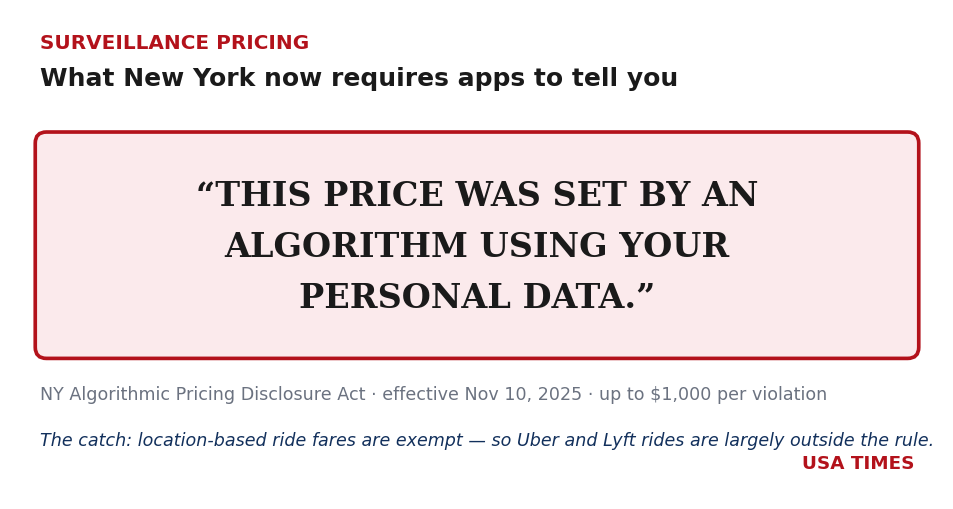
Since November 10, 2025, New York’s Algorithmic Pricing Disclosure Act has required any business that uses an algorithm relying on a consumer’s personal data to set a price to say so, clearly, right next to that price, in specific words: “THIS PRICE WAS SET BY AN ALGORITHM USING YOUR PERSONAL DATA.” The state can seek penalties of up to $1,000 per violation, and enforcement runs through the New York Attorney General.
It is a remarkable sentence for a company to have to publish about its own pricing. And at least one of the apps most New Yorkers use every week is publishing it.
Batmandir · Founders A numbered seat at the table. S3 · The Founders Club — 161 seats per location. By invitation. Explore membership →What we observed
On July 15, 2026, from a logged-in New York session with a Manhattan delivery address, USA Times’ Data Desk reached DoorDash’s home screen and recorded the disclosure the app shows New York users. In its own words, DoorDash tells customers that “regulations in New York City have increased the cost of facilitating deliveries” — the basis for its $1.99 “NYC Regulatory Response Fee” — and then adds the state-mandated line, verbatim: “This price was set by an algorithm using your personal data.”
That is not our characterization of what DoorDash does. It is DoorDash’s own on-screen statement, made to comply with New York law. What it establishes as a fact is narrow but real: on this app, in this market, the required disclosure appears.
The federal echo
The timing matters because Washington is now asking the same question. In April 2026, the Federal Trade Commission opened a rulemaking on delivery-app fees whose list of questions includes personalized pricing — whether platforms disclose when “the prices of items ordered are the same as, or different from, the prices of the same items offered to other consumers on the platform.” New York already answered that question with a statute; the FTC is deciding whether to answer it nationally. (See our report on the FTC’s move.)
The carve-out that protects Uber and Lyft
Here is the part that will surprise most riders. New York’s law contains an exemption written for exactly the companies people most associate with algorithmic, surge-based pricing. The definition of “personal data” excludes location data used by for-hire vehicles and transportation network companies solely to calculate fares based on mileage and trip duration. In plain terms: the moving, distance-and-time fare on an Uber or Lyft ride is largely outside the disclosure mandate, even though it is one of the most obviously algorithmic prices in a New Yorker’s life.
The result is an uneven map of who has to tell you and who does not:
| Service | Must show the disclosure? |
|---|---|
| Food & grocery delivery (DoorDash, Uber Eats, Instacart) | Yes — if personal data sets the price |
| Online retail & grocery (Amazon, Walmart, Target) | Yes — if personal data sets the price |
| Uber / Lyft ride fares (mileage- and time-based) | No — location-fare carve-out |
| Insurance & regulated financial institutions | No — exempt |
| A subscription discount below your contract price | No — exempt |
What we can say — and what we can’t
We are being deliberately careful here. From the outside, we can verify two things: whether the required disclosure appears at a checkout (a fact we can screenshot), and, with a controlled test, whether the same item shows different prices to different accounts at the same moment. We cannot see inside a company’s pricing engine, so we do not claim that any specific price “was set using your personal data,” and the absence of a disclosure is not proof that a company broke the law — a business that does not personalize prices owes no disclosure at all. Those judgments belong to the Attorney General.
What we can do is document what appears on the screen. DoorDash shows the line. Over the coming weeks, the Data Desk is running the same check across the other major apps New Yorkers use — Uber Eats, Grubhub, Instacart, Amazon, Walmart and Target — and will publish a scored, screenshotted compliance table. We have requested comment from each named company and will include their responses.
Sources: New York S8623 / Algorithmic Pricing Disclosure Act (effective Nov. 10, 2025); legal analysis via Kelley Drye; USA Times Data Desk observation of DoorDash’s NYC disclosure (July 15, 2026); FTC food-delivery-fee ANPRM (April 2026). Related: the FTC’s move on hidden fees and the $554M tip report.