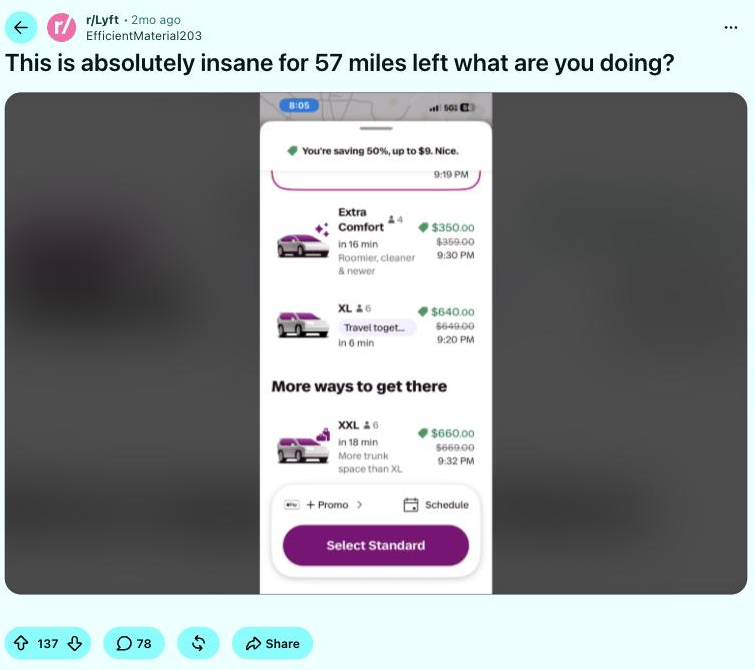
It was a 57-mile ride to Houston’s Bush Intercontinental Airport, and the price on the screen was staggering. Standard “Extra Comfort” ran $350. The XL was $640. The XXL, $660. Stamped across the top, without irony, was a coupon: “You’re saving 50%, up to $9. Nice.”
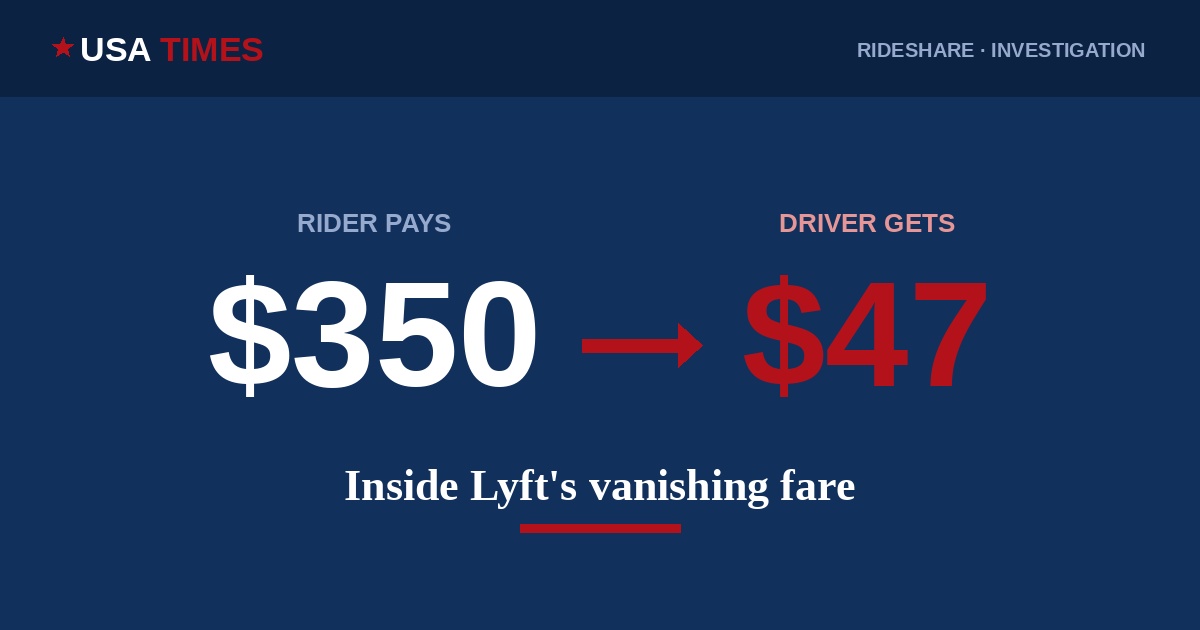
The rider, who posted the screenshot to r/Lyft in the spring, didn’t take any of them. In the comments, Lyft drivers did the math the app doesn’t show you. “You’ll be happy to know they offer the driver $47 for that ride,” one wrote. Another: “the driver gets $25.” Another: “And the driver gets $15.” A driver summed up the whole business in nine words: “And Lyft drivers don’t even see half of that.” The rider eventually gave up on the app entirely, called a driver he knew, and paid him $150 in cash.
That gap — between what the rider pays and what the driver keeps — is the through-line of a USA Times review of hundreds of posts on r/Lyft, the ride-hail giant’s largest driver-and-rider community, over the past six months. What the forum describes in anecdotes, federal and state regulators have described in legal filings. The picture that emerges is of a company whose own drivers and riders increasingly can’t tell where their money goes.
Batmandir · Founders A numbered seat at the table. S3 · The Founders Club — 161 seats per location. By invitation. Explore membership →What the government found
This is not just forum grievance. In October 2024 the Federal Trade Commission ordered Lyft to pay a $2.1 million penalty for deceiving drivers about pay. The agency found Lyft advertised hourly earnings — up to $43 an hour in Los Angeles, $41 in Portland, $33 in Atlanta — that were based only on the top 20% of drivers and overstated what a typical driver made by as much as 30%. Those advertised rates, the FTC said, also quietly included passenger tips, money drivers assumed would be added on top. And Lyft’s “earnings guarantees” — “$975 for 45 rides in a weekend” — paid drivers only the difference if they fell short, not a bonus. According to the FTC, Lyft kept making the claims even after being formally warned.
The cut nobody can see
How did a $350 fare become a $47 offer? In late 2022 Lyft, like Uber, moved to “upfront pricing,” setting the rider’s fare and the driver’s pay separately — and no longer tying the two together. Worker advocates say that severed the link that once guaranteed drivers a fixed share. The National Employment Law Project, in a 2025 analysis, estimated the two companies now take “around 40 percent on average, and sometimes 65 or 70 percent on individual rides.” NELP cautions that a precise, audited Lyft-only number “is a question only Uber or Lyft can answer,” because neither releases full pay data. In other words, the exact size of Lyft’s cut is a secret — which is itself the complaint.
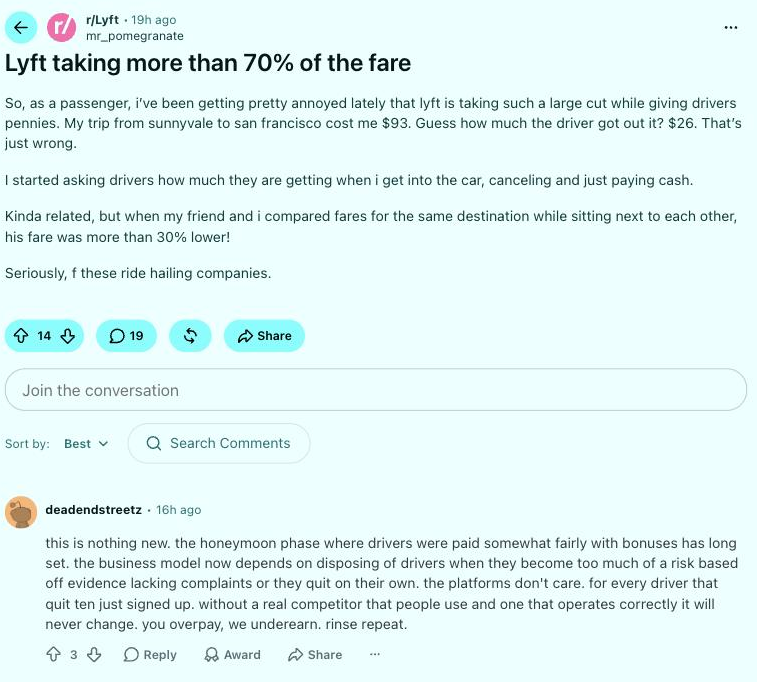
Riders are increasingly doing that arithmetic in public. One passenger posted a $93 fare from Sunnyvale to San Francisco and reported the driver was paid just $26 — roughly a 72% gap — under a blunt headline: “Lyft taking more than 70% of the fare.”
Riders feel the other end of it. “Just paid $22+ for an 8-minute, 4-mile ride with no traffic, no surge — over $5 a mile,” wrote u/AnaLeKage. “Absolutely absurd.” A veteran driver in another thread: “I get requests for 45-minute drives for like $30 all the time.”
Even the tip isn’t safe
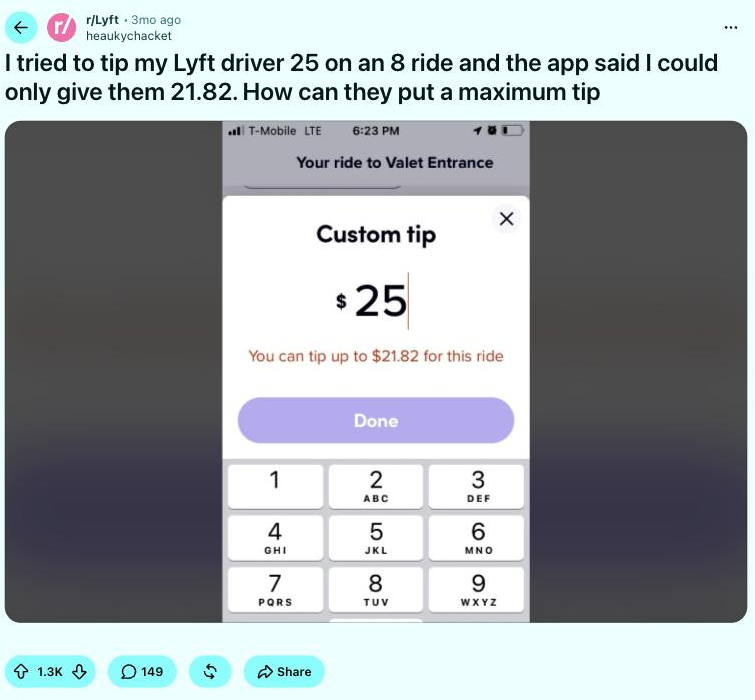
One of the most-upvoted posts of the year was a rider discovering the app wouldn’t let them be generous. Trying to add a $25 tip to an $8 ride, u/heaukychacket found the app capped it at $21.82. “I tried to tip more money,” echoed u/fathornyhippo, “but it wouldn’t let me.” The one part of the transaction that goes entirely to the driver, and the app puts a ceiling on it.
Phantom fees, no appeal
Then there are the charges for nothing. u/Great-Lettuce-3316 was charged a $1 cancellation fee for cancelling while the app was still “looking for a driver” — before one had even been assigned. Others describe cleaning-fee “vomit scams” that Lyft honored on the driver’s word, and question whether the “Price Lock” subscription delivers what it promises.
And when the platform turns on you, drivers say there is no one to call. u/redalert8352 described being “permanently deactivated over a sexual-misconduct allegation — no evidence.” u/Practical_Extent2444, after 40,000 rides, had an account frozen over a single disputed complaint: “This is probably my last straw. I’m seriously thinking about being done with rideshare altogether.”
Regulators keep writing the checks
The FTC isn’t alone. In November 2023, New York Attorney General Letitia James secured a $328 million settlement with Uber and Lyft over withheld driver pay — $38 million of it from Lyft. In June 2024, Massachusetts AG Andrea Campbell reached a $175 million settlement setting a floor of $32.50 per hour of engaged time. Three levels of government, in under two years, have concluded the same thing: drivers weren’t getting what they were owed.
What Lyft says
Lyft has cast itself as the transparent alternative. In February 2024 it announced an “Earnings Commitment” promising drivers at least 70% of rider payments each week, after external fees, and calling itself “the first and only company to guarantee drivers their share.” Responding to the FTC penalty, the company said it settled because “we recognize the importance of transparency.” (In 2026 it revised that pledge into a monthly cap on Lyft’s own fee — a change drivers are still parsing.)
Back on r/Lyft, the promises haven’t landed. Drivers and riders alike now describe routing around the app entirely — cash deals, direct arrangements, “skip the middleman.” That’s not loyalty; it’s leakage. And it’s what happens when 52,000 people a week gather in one place and conclude, fare by fare, that the math no longer adds up.

Methodology & sourcing: This article is based on a review of public posts in the r/Lyft community over roughly the past six months, and on public records from the Federal Trade Commission, the New York and Massachusetts Attorneys General, the National Employment Law Project, and Lyft’s own published statements, all linked above. Driver and rider comments reflect the views of individual posters and are presented as such; per-ride pay figures cited from comment threads are estimates by drivers, not confirmed by Lyft. Lyft does not publish a company-wide “take rate.” USA Times has linked Lyft’s public responses; the company’s statements appear above.
Related from the USA Times Data Desk
- The Decade Shift: How the Box Office Became Winner-Take-All
- The 1% of Screens That Now Rule the Box Office: How IMAX Won the Post-Streaming Era
- Every True IMAX 1.43:1 Theatre in the World
- The 38.2% Club: The ‘Betelgeuses’ That Run the Box Office
- Box-office coverage index · the Star Index methodology