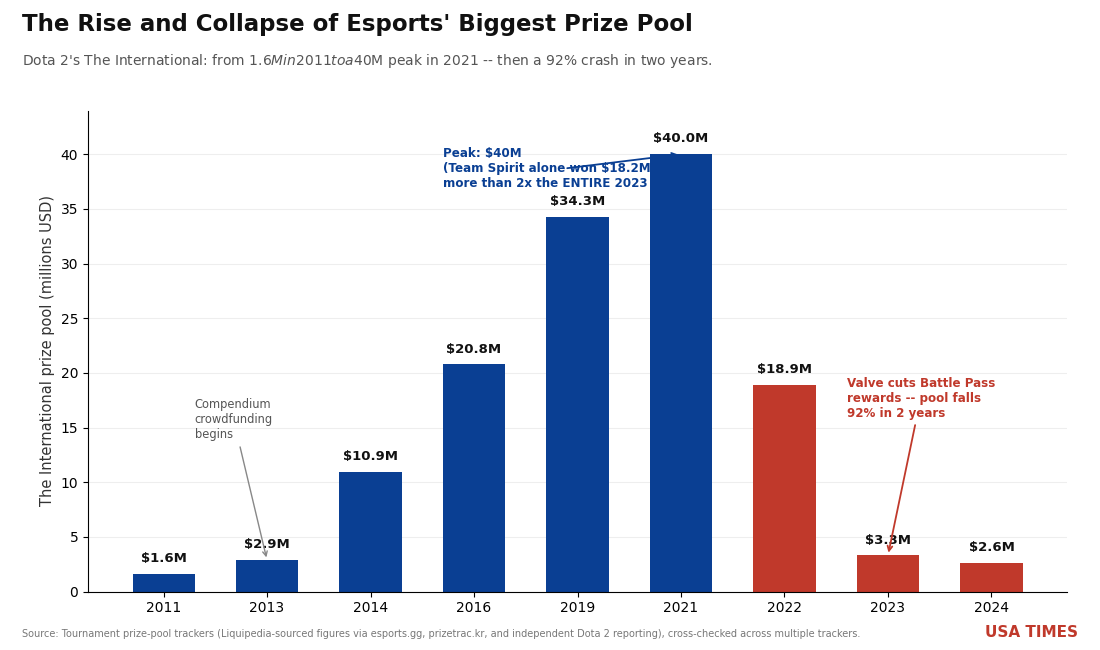
In 2021, a Dota 2 team called Team Spirit won $18.2 million for a single tournament victory — more money than any team has ever collected for winning one esports event, before or since. That prize came out of a total tournament pool of $40 million, itself the largest prize pool any esports competition had ever offered. Two years later, the same annual tournament’s entire prize pool was smaller than what Team Spirit alone had taken home in 2021 — and it wasn’t close.
The tournament is The International, Dota 2 developer Valve’s annual championship, running every year since 2011. Its prize-pool history is one of the cleanest boom-and-bust charts in modern sports or entertainment economics — a decade-long climb built almost entirely on voluntary fan spending, followed by a collapse that took less than a fifth of the time to unwind.
The International (Dota 2) Prize Pool, 2011–2024
Batmandir · Founders A numbered seat at the table. S3 · The Founders Club — 161 seats per location. By invitation. Explore membership →Hover any bar for the year, the exact total, and what drove it.
How a video game prize pool got bigger than most sports championships
Valve funded the first International in 2011 with $1.6 million of its own money — a startling sum at the time for a competitive gaming event, but a fixed, developer-funded number with no obvious way to keep growing year over year. That changed in 2013, when Valve introduced the “Compendium,” a purchasable in-game item bundle where 25% of sales revenue flowed directly into the prize pool. That year’s total climbed to $2.87 million. It was a modest bump, but it proved the model worked: fans, given a direct financial stake in how big the trophy would be, would pay for it themselves.
What followed was close to a straight line up. TI4 in 2014 jumped to $10.93 million — the single largest year-over-year percentage leap in the tournament’s history, a 281% increase in one year. TI6 in 2016 crossed $20 million for the first time. TI9 in 2019 reached $34.3 million. Then TI10, held in 2021, hit the $40 million peak — a 25-fold increase over the first crowdfunded pool just eight years earlier, funded almost entirely by players buying cosmetic items and battle pass tiers for a video game.
Then Valve pulled the mechanism that built it
The prize pool’s entire growth engine was voluntary spending on a specific product: the Battle Pass, later reverted to the Compendium branding, sold each year in the run-up to the tournament. When Valve scaled back what that product offered — trimming the Dota Pro Circuit season structure that the Battle Pass had been built around and replacing the elaborate, multi-tier Battle Pass with a slimmer Compendium — fan spending didn’t decline gradually. It fell off a cliff.
TI11 in 2022 dropped to roughly $18.9 million, already less than half the 2021 peak. TI12 in 2023 fell further, to about $3.3 million — a 92% decline from the 2021 high in just two years, and the lowest total since before the crowdfunding model existed. TI13 in 2024 landed at roughly $2.6 million, essentially flat with the prior year’s low and barely above Valve’s original $1.6 million developer-funded seed amount from 2011 — meaning thirteen years of crowdfunding growth had, by 2024, almost entirely round-tripped back to where it started.
Why the fall was so much faster than the climb
The asymmetry itself is the real finding here. It took Valve eight years of steadily expanding the crowdfunding product — more cosmetic tiers, more stretch goals, more reasons to keep spending through the summer — to build the pool from $2.87 million to $40 million. It took two years of a less appealing product to erase 92% of that growth. A voluntary-spending model has no floor built into it the way a sponsorship contract or broadcast rights deal does; when the product gets worse, the revenue doesn’t decline in proportion to how much worse it got, it declines in proportion to how many fans decide the purchase isn’t worth it anymore, which can move much faster than a gradual product downgrade would suggest.
That’s also why The International’s funding model looks so different from Riot Games’ League of Legends Championship Series, which draws its prize pools from sponsorship and media-rights revenue rather than fan cosmetic purchases, and hasn’t seen anything resembling a comparable single-year collapse. A contract-funded prize pool is boring by comparison — but it doesn’t depend on whether this year’s cosmetic bundle looked appealing enough to a fanbase that has plenty of other places to spend money on a video game.
A sponsor-funded rival passed it in the same year it collapsed
The timing sharpens the point. In 2023, the same year The International’s crowdfunded pool fell to roughly $3.3 million, a Saudi-backed event called the Riyadh Masters offered a Dota 2 prize pool of roughly $15 million — funded by direct sponsorship rather than player spending, and worth roughly four to five times what the sport’s flagship tournament could raise from its own fans that year. For over a decade, The International’s crowdfunded model had been esports’ proof of concept that a passionate fanbase could out-fund traditional sponsorship. In 2023, a single sponsor-backed regional event quietly demonstrated the opposite: that a fixed budget, however unglamorous, is a more reliable way to fund a large prize pool than hoping a cosmetic item sells well enough, year after year, to keep climbing.
Valve has made incremental changes since the collapse — a return closer to the original developer-funded seed amount, new cosmetic items tied to popular heroes, and expanded regional qualifying seats — but has not restored anything resembling the Battle Pass structure that drove the 2014–2021 run. Whether that’s a deliberate step back from an unsustainable growth model, or simply a company that hasn’t found a replacement for what stopped working, is something Valve hasn’t said publicly in any detail.
What we did
We cross-checked prize-pool figures for each cited year across multiple independent trackers — including figures sourced from Liquipedia, the standard community-maintained esports reference, via esports.gg’s and prizetrac.kr’s tournament trackers, plus historical reporting on the tournament’s early crowdfunding years — to confirm the reported totals agreed within a reasonable margin before using them. Where trackers differed slightly (2023 and 2024 figures range from about $2.6 million to $3.3 million depending on the source and exact cutoff date used), we used the range and noted it rather than picking a single unverified number.