
USA Times Data Desk
The USA Times Data Desk is the newsroom’s data and investigations unit. It collects prices, fees and public records directly from the source, verifies them item by item, and builds the charts and tables behind USA Times investigations. Every figure it publishes is traceable to a named, dated source.
-
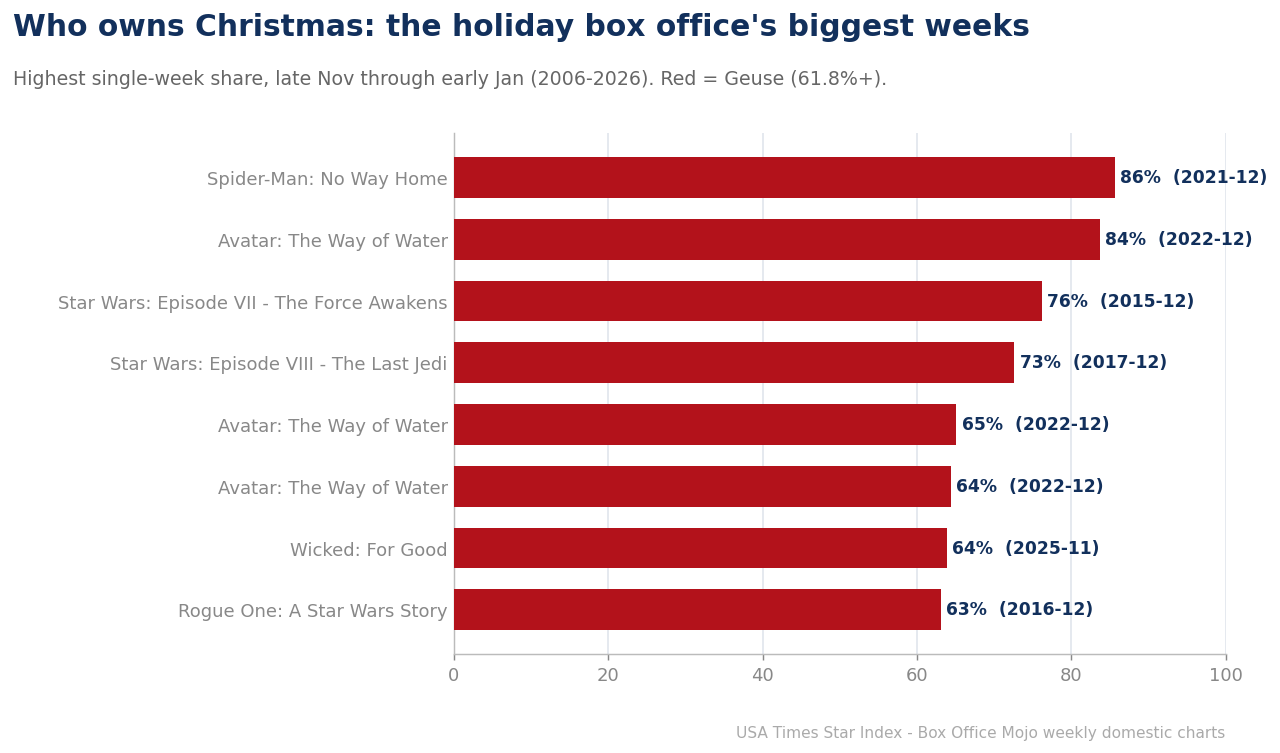
Who Owns Christmas: Twenty Years of the Holiday Box Office, in One Chart
The last six weeks of the year are the box office’s crown jewels, and a very short list owns them. The most dominant holiday week in twenty years is Spider-Man: No Way Home at 86%, with Avatar: The Way of Water close behind – and appearing three times – plus the Star Wars sequels.
-
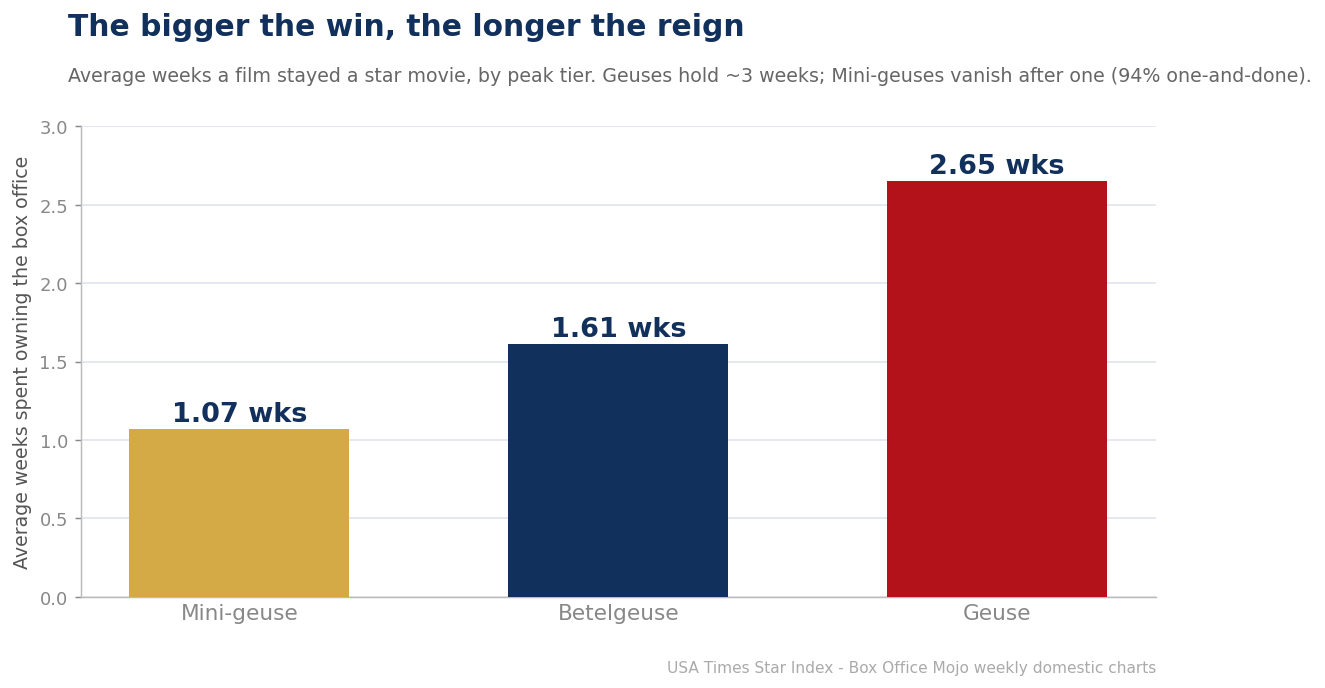
The Bigger the Win, the Longer the Reign: How Long Each Box-Office Tier Holds the Throne
Owning the box office two weeks running is a different order of achievement than one – and it scales with size. Geuses reign 2.65 weeks on average, Betelgeuses 1.61, and Mini-geuses barely more than one, with 94% gone after a single week. Domination compounds.
-
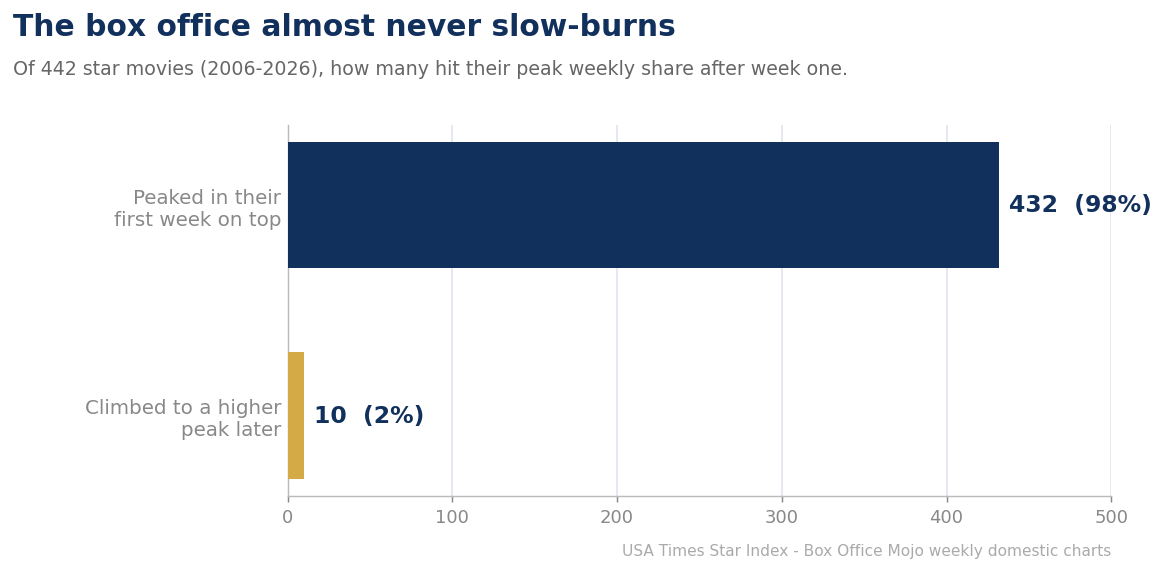
The Box Office Almost Never Slow-Burns: 98% of Star Movies Peak in Their First Week on Top
The sleeper hit that climbs for weeks is a myth. Across 442 star movies in twenty years, 98% hit their biggest week of market share the very first week they reached No. 1 – only ten ever climbed higher later, and even those were second-week vacuums, not long builds.
-

Arizona and Tennessee Led the Nation in Do Not Call Complaint Rates—But the Data Measure Reporting, Not Ringing
Arizona residents filed 1,028 National Do Not Call Registry complaints for every 100,000 people in fiscal 2025, the highest rate among the 50 states. Tennessee followed at 1,017. At the other end of the table, Hawaii recorded 393 complaints per 100,000—meaning Arizona’s reported rate was about 2.6 times Hawaii’s. Those figures provide a useful answer…
-

Do Corrections Travel Beyond the Original Article?
Last checked: August 7, 2026 A news organization can correct an article in seconds. Correcting every copy of that article is a different problem. The distinction matters because modern news does not remain on one webpage. A wire story may be copied into hundreds of customer systems. A photograph and its caption can be downloaded,…
-

The Hidden Arithmetic of a Long AI Conversation
Rates checked: August 6, 2026. Recheck vendor pricing before publication. Scope: API list-price illustration. Consumer subscriptions and enterprise contracts can be priced differently. A 100-message conversation with an artificial-intelligence model does not necessarily cost the same as 100 separate questions. The difference is context. To answer the latest message coherently, an AI service may send…
-

How Long Do Federal Vehicle-Defect Investigations Take? A 10-Year NHTSA Baseline
A vehicle owner can file a safety complaint in minutes. What happens afterward may take months or years—and the public data does not support a simple stopwatch from one complaint to one recall. To establish a useful baseline, we analyzed closed National Highway Traffic Safety Administration defect investigations with opening dates from 2016 onward. After…
-

When “Patch Now” Means Three Days: What 1,661 Exploited Vulnerabilities Reveal About Federal Deadlines
Security warnings routinely use urgent language. The federal government’s Known Exploited Vulnerabilities catalog provides something more concrete: a date by which civilian agencies must complete the required action. A USA Times analysis of all 1,661 entries in the Cybersecurity and Infrastructure Security Agency catalog available on August 6, 2026 found that the typical deadline was…
-
Is This the New Normal? What Twenty Years of Box Office Data Says About Where Moviegoing Goes Next
This series set out to answer a simple-sounding question — what does the gap between box office revenue and ticket admissions actually mean — and ended up mapping a single, consistent story across nine separate angles: a shrinking audience, paying substantially more per visit, for a smaller and more concentrated slate of films, increasingly funneled…
-
Explosions Won, Everything Else Lost: How Genre Concentration Reshaped the Box Office
Adventure and Action films alone have accounted for 48% of every dollar the U.S. box office has generated since 1995 — nearly half of all theatrical revenue concentrated in two genres, according to three decades of data from The Numbers. Drama and Comedy, once the reliable backbone of a varied studio release calendar, combine for…