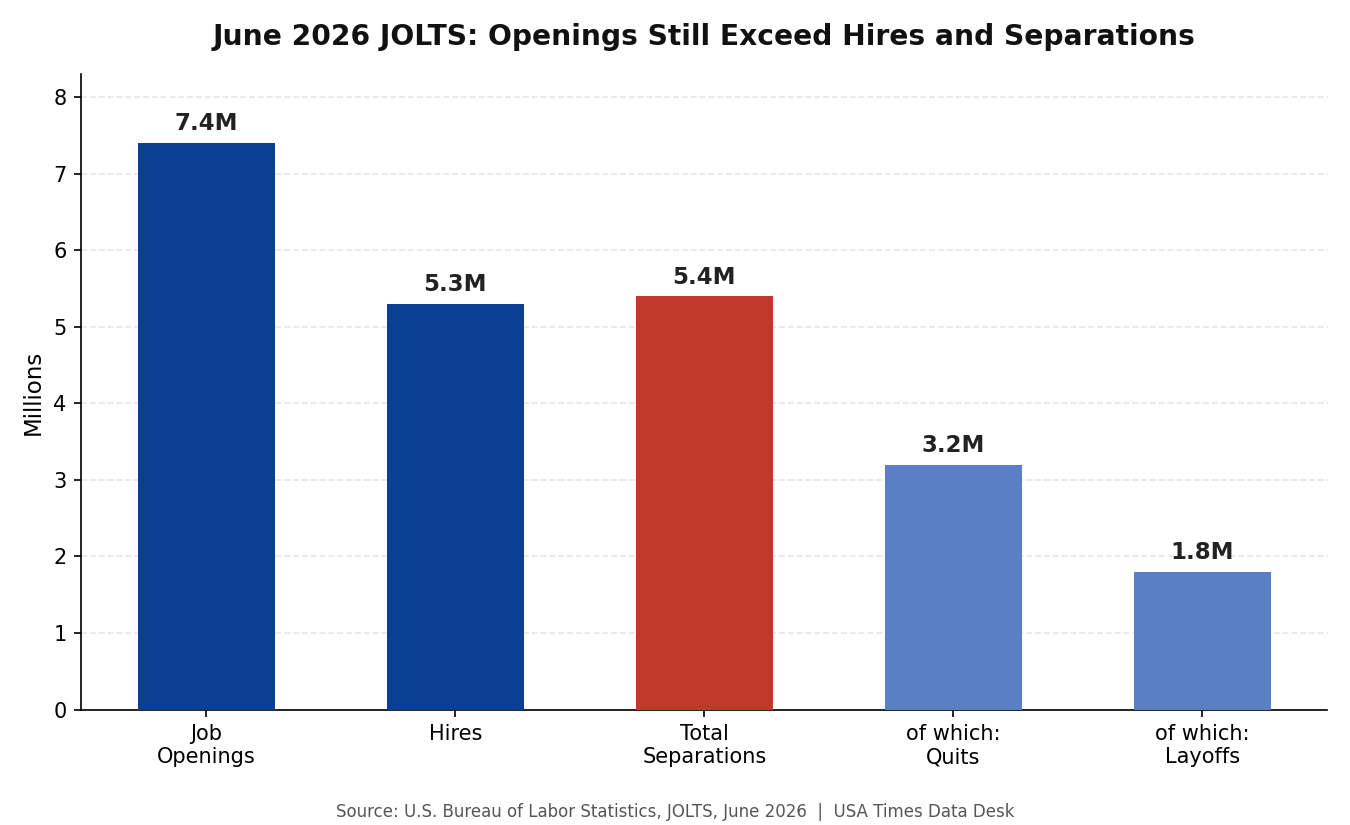
U.S. job openings held roughly steady at 7.4 million in June 2026, according to the Bureau of Labor Statistics’ Job Openings and Labor Turnover Survey (JOLTS). Hires were similarly flat at 5.3 million, and total separations — the combination of quits, layoffs, and other departures — held at 5.4 million. USA Times’ Data Desk covered this same monthly release’s quits figure two months ago; this piece looks at a different part of the same report: what’s actually happening to job openings themselves, industry by industry.
The job openings rate — openings as a share of total filled-plus-unfilled positions — sat at 4.4% in June, essentially unchanged from May. On the surface, that stability looks unremarkable. Underneath it, individual industries moved sharply in opposite directions.
Federal government openings are climbing while wholesale trade cuts them
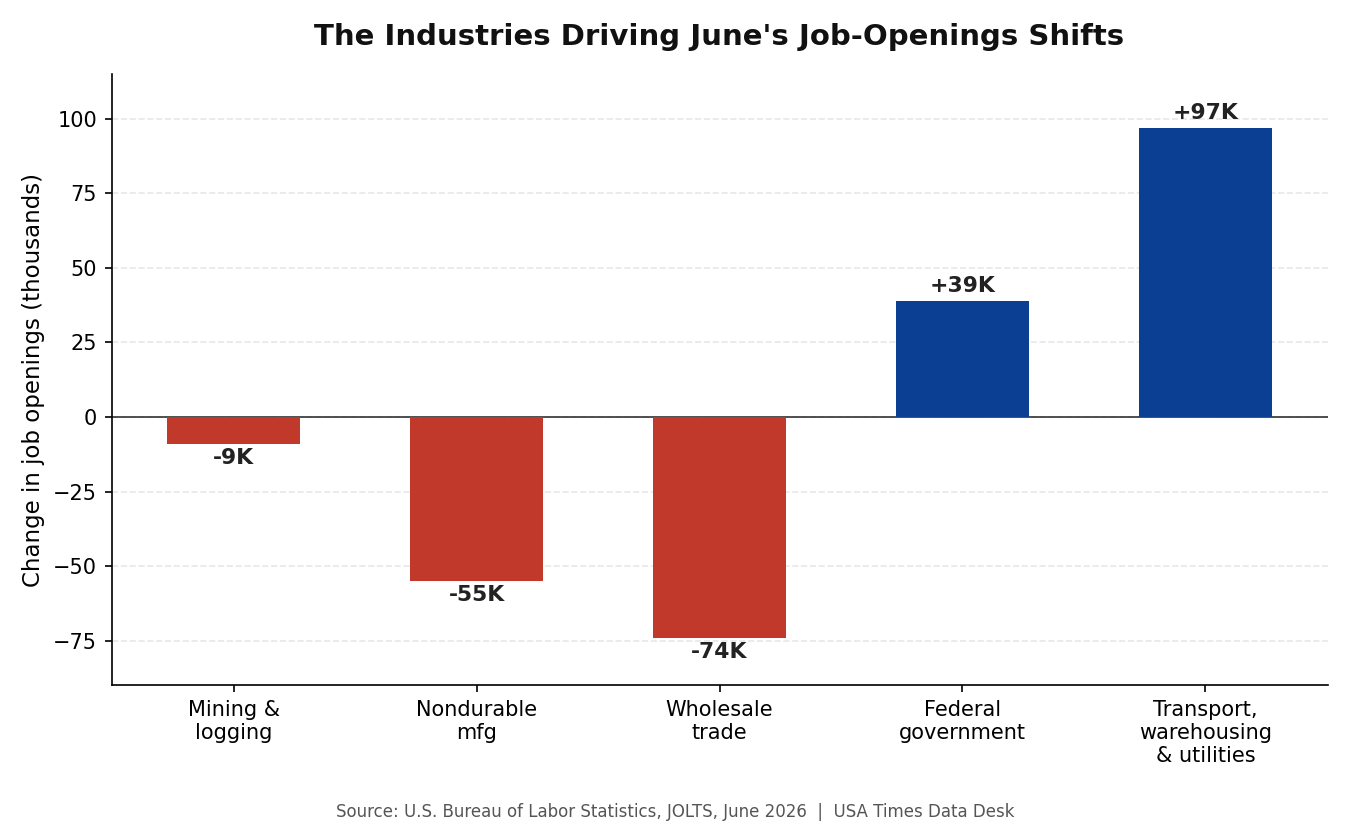
Job openings rose the most in transportation, warehousing, and utilities (+97,000) and in federal government (+39,000) in June. The federal government figure is notable on its own: at a moment when headlines have focused heavily on federal workforce reductions and reorganization efforts, the JOLTS data shows federal job openings actually increasing month over month — meaning more federal positions were sitting unfilled at the end of June than at the end of May, regardless of how the total federal headcount itself is trending.
Batmandir · Founders A numbered seat at the table. S3 · The Founders Club — 161 seats per location. By invitation. Explore membership →On the other side, job openings fell most in wholesale trade (-74,000), nondurable goods manufacturing (-55,000), and mining and logging (-9,000). Wholesale trade’s decline is the largest single-industry drop in the report — a sizable pullback in a sector that serves as a middleman between manufacturers and retailers, and one that tends to be sensitive to broader shifts in consumer and business demand forecasts.
Hires barely moved, and one industry actually cut back
Total hires were unchanged at 5.3 million and a 3.4% hiring rate. The only industry BLS flagged with a notable hiring change was, again, federal government — where hires actually fell by 6,000 even as job openings rose by 39,000 in the same month. That combination — more federal openings, fewer federal hires — is worth sitting with: it suggests federal agencies may be posting positions faster than they’re able to, or are choosing to, fill them, whether due to hiring freezes, budget uncertainty, or slower internal approval processes for actually bringing someone on.
Quits and layoffs both held flat — the report’s quietest signal
Quits held at 3.2 million (a 2.0% rate) and layoffs and discharges held at 1.8 million (a 1.1% rate), both essentially unchanged from May and both little-changed across every industry BLS tracks. Other separations — retirements, deaths, disability, and internal transfers — came in at 353,000. Taken together with the flat openings and hires numbers, June’s JOLTS report describes a labor market that, in aggregate, simply isn’t moving much in any direction: not adding jobs quickly, not cutting them quickly, not seeing workers quit or get laid off at unusual rates. The interesting movement in this report is entirely at the industry level, not the topline.
Why openings still outnumber hires by such a wide margin
One structural feature of this report is easy to miss: 7.4 million job openings against 5.3 million monthly hires is not, by itself, evidence of 2.1 million “excess” demand for workers. JOLTS openings are a stock measured at a single point in time (the last business day of the month), while hires are a flow measured across the entire month — the two numbers aren’t directly comparable in a one-to-one way. What the gap does indicate, when tracked over time, is the overall tightness or slack in the labor market: a shrinking gap between openings and hires generally signals a cooling market, while a widening one signals employers competing harder for workers. June’s gap was roughly in line with recent months, consistent with the broader “little changed” framing BLS used throughout this release.
What “little changed” actually means in a BLS release
BLS used the phrase “little changed” or “changed little” to describe nearly every topline JOLTS figure in this release — job openings, hires, total separations, quits, and layoffs all got that label. That phrasing isn’t editorial softening; it’s a specific statistical statement. BLS calculates standard errors for each of these series and only characterizes a month-over-month move as a directional change (an “increase” or “decrease”) when it clears a formal significance threshold. When five consecutive topline measures in the same release all fail to clear that bar, it means the survey’s sampling methodology can’t confidently distinguish June’s numbers from May’s — the underlying labor market may be moving in either direction by a small amount, but JOLTS’ sample size isn’t precise enough this month to say so with confidence at the national level.
That’s part of why the industry-level breakdowns matter more than the topline in a release like this one. Individual industry moves — like wholesale trade’s 74,000-opening drop or federal government’s 39,000-opening gain — were large enough relative to their smaller sample bases to register as genuine, reportable changes, even in a month where the national aggregate didn’t move enough to describe as anything but flat.
What we did
All figures in this piece — the job openings, hires, and separations levels and rates, the industry-level breakdowns, and the quits and layoffs figures — come directly from the Bureau of Labor Statistics’ Job Openings and Labor Turnover Survey news release for June 2026, read directly from bls.gov. This report covers the same monthly JOLTS release USA Times’ Data Desk previously covered for its quits-rate figure; this piece deliberately focuses on the job-openings and industry-level hiring data from that same release rather than repeating the quits-rate analysis. The explanation of why openings (a stock measure) and hires (a flow measure) aren’t directly comparable one-to-one reflects standard JOLTS methodology as described in BLS’s own technical documentation, not a claim made in the June release’s summary text specifically. The next JOLTS report, covering July 2026 data, is expected roughly one month after this release per BLS’s standard publication schedule for the series.