There used to be a kind of film that formed the backbone of Hollywood: the mid-budget movie for grown-ups. The forty-million-dollar thriller, the romantic drama with two stars and a good script, the mid-scale comedy — not a tentpole, not a micro-indie, just a solid professional film aimed at adults who go to the movies on a Friday. That film has largely disappeared, and its absence has quietly reshaped what it takes to reach the top of the box office.
The number that tells the story
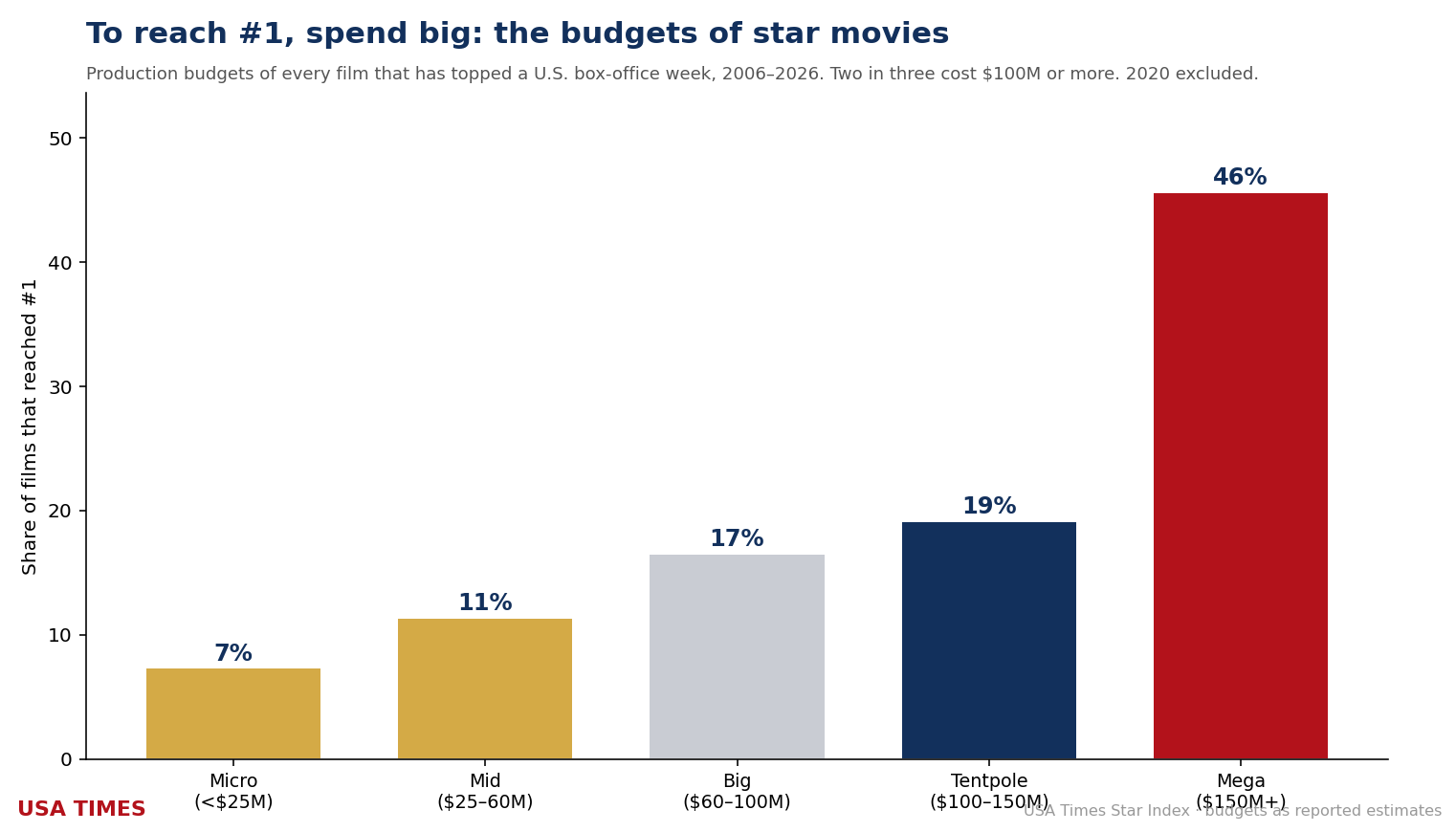
Look at every film that has topped a U.S. box-office week since 2006 — the roughly 430 movies the USA Times Star Index calls “star movies” — and sort them by budget. The result is lopsided. Nearly two in three cost $100 million or more to produce. Fewer than one in five cost under $60 million. The mid-budget band that once defined studio filmmaking — the $25-to-$60-million picture — accounts for barely a tenth of the films that reach the top. To lead the American box office today, you almost have to spend like a tentpole.
Where the middle went
The mid-budget movie did not die of natural causes; it was squeezed from two directions at once. From above, the economics of the franchise made the tentpole irresistible: a known title with a built-in audience and global merchandising can justify a $200-million budget in a way an original drama never can, and studios rationally pour their money where the downside feels smallest. From below, streaming absorbed the exact kind of film the mid-budget slot used to hold — the star-driven thriller, the prestige adult drama — because those movies play beautifully on a subscription service and no longer need a theatrical window to find their audience. What was once the safe center of the business became the riskiest place to stand: too expensive to be a cheap gamble, too small to be an event.
Batmandir · The Circle Full access to theatres, museums & exhibitions. S2 · ongoing membership, without a Founder’s seat. Explore membership →What replaced it: a barbell
The market that remains is shaped like a barbell. At one end sit the mega-budget spectacles — the superhero finales, the animated sequels, the legacy franchises — that can command a whole week of the box office because they are engineered to be unmissable on the biggest screen. At the other end sit the micro-budget genre films, chiefly horror, that reach #1 not by spending but by efficiency: a $15-million fright film can top a quiet week and return its budget many times over. Both ends are thriving. It is the middle — the film that costs real money but isn’t built as an event — that has thinned out, because it can no longer count on a theatrical audience large enough to justify its price.
This is why the two most reliable ways to lead the box office now look nothing alike. You either spend $150 million to manufacture an event that overwhelms the market, or you spend $15 million on a genre hook sharp enough to win a slow week. The strategies that used to sit between them — the mature, mid-priced, star-powered drama — increasingly skip theaters entirely. The barbell isn’t a temporary distortion. It is the new shape of the business.
What we lose in the middle
It is tempting to shrug at this as mere economics, but the middle was where a certain kind of movie lived — and where a certain kind of career was built. The mid-budget film was the training ground for directors who would later be trusted with tentpoles, the place where movie stars proved they could open a film on their name alone, the format flexible enough to take a real chance on an original idea without betting the studio on it. When the middle vanishes, so does the ladder. Filmmakers now leap from tiny indies straight to $200-million franchises, with little in between to learn on, and audiences lose the steady supply of well-made films for adults that never needed to be an event to be worth the trip.
None of this means the mid-budget movie is gone for good. A few studios have made a deliberate bet on it, and every so often an adult drama or a mid-priced thriller breaks out and reminds everyone the audience was never the problem. But the data from the top of the box office is unambiguous about where the momentum has gone. For now, reaching #1 is a game for the very expensive and the very cheap. The comfortable middle — the movies that once were simply, professionally good — has been squeezed off the chart, and the box office is poorer, and stranger, for its absence.
The horror exception proves the rule
The clearest evidence that the middle has hollowed out is which cheap films still make it to #1. It is almost always horror. A genre built on tension rather than spectacle can be made for a fraction of a tentpole’s cost, marketed on a single unsettling image, and sold on the promise of an experience that is genuinely better in a packed theater than alone on a couch. That combination lets a film made for the price of a mid-budget drama’s catering reach the top of the chart and out-earn films that cost ten times as much. The mid-budget drama had no such edge: it was neither cheap enough to be a low-risk swing nor spectacular enough to demand the big screen. Horror thrives in the low end precisely because it offers something the living room can’t; the mid-budget adult film, which the living room reproduces perfectly well, had no such argument to make.
Seen this way, the barbell is less a failure of taste than a sorting mechanism. The films that survive at the top are the ones that give an audience a reason to leave the house — either overwhelming scale or a communal thrill — and the films that vanish are the ones that don’t. That is a useful lens for anyone trying to predict what reaches #1 next: not the best film, and not the most expensive, but the one whose appeal collapses the moment you watch it small. Everything else, increasingly, is a stream.
Method: budgets are reported production-cost estimates for every film that reached #1 in a U.S. box-office week, 2006–2026, via the USA Times Star Index, with 2020 excluded as a pandemic anomaly. Figures reflect films that topped the chart and are not a census of all films produced.