For a decade, the movies were something you did to yourself at home — a queue, a couch, a phone glowing in your other hand. But a certain kind of evening is coming back into fashion, and it is worth naming: the proper night out at the cinema, treated not as a chore to minimize but as an occasion to design. And the more the best films retreat to a handful of rare screens, the more the logistics of getting there become part of the pleasure rather than a tax on it.
The case for the occasion
Streaming won the argument about convenience, and it was never close. But convenience and occasion are different goods, and the thing streaming cannot manufacture is the sense that tonight is different — that you are going somewhere, with someone, to see something you cannot summon on demand. A true IMAX 70mm screening, a revival house showing a restored print, a premiere with the director in the room: these are events precisely because they are bounded in time and place. You cannot pause them, and you cannot have them tomorrow. That scarcity, which the streaming era treats as a bug, is exactly what turns watching a film into an evening you remember.
Why the getting-there matters
Here is the unglamorous truth that anyone who has tried to make a night of it knows: the film is the easy part. The friction is everything around it. The scramble to park near a sold-out theatre. The math of whether you’ll make the trailers. The low-grade dread, all through the third act, of where the car is and how long the wait will be. A great movie night is not really about the movie — that part takes care of itself. It is about removing every small anxiety that sits between your front door and your seat, so that the two hours in the dark are the only thing your evening is actually about.
Batmandir · The Circle Full access to theatres, museums & exhibitions. S2 · ongoing membership, without a Founder’s seat. Explore membership →This is where a driver changes the entire shape of the night, and not for the reason people assume. It is not about luxury for its own sake. It is about subtraction. Being dropped at the door means you arrive unhurried, in time for the good seats, without having circled three blocks. It means the drink beforehand is a drink, not a calculation about who’s driving home. It means that when the credits roll on a film that has genuinely moved you, you walk out into the night still inside it — not yanked back to reality by a parking garage and a merge onto the highway. The car handles the parts of the evening that were never the point, and hands you back the parts that were.
How the studios have always done it
There is a reason a premiere looks the way it does. No one who has spent real money to make a film wants its first audience arriving frazzled, having fought traffic and hunted for parking. So the industry solved that problem long ago: you are collected, delivered to the door, walked in, and collected again at the end. The point was never the spectacle of the arrival — it was to guarantee that the audience met the film in the right state of mind, unhurried and undistracted. That instinct, once reserved for people with a stake in the movie, is simply good sense for anyone who takes an evening at the cinema seriously.
Building the night
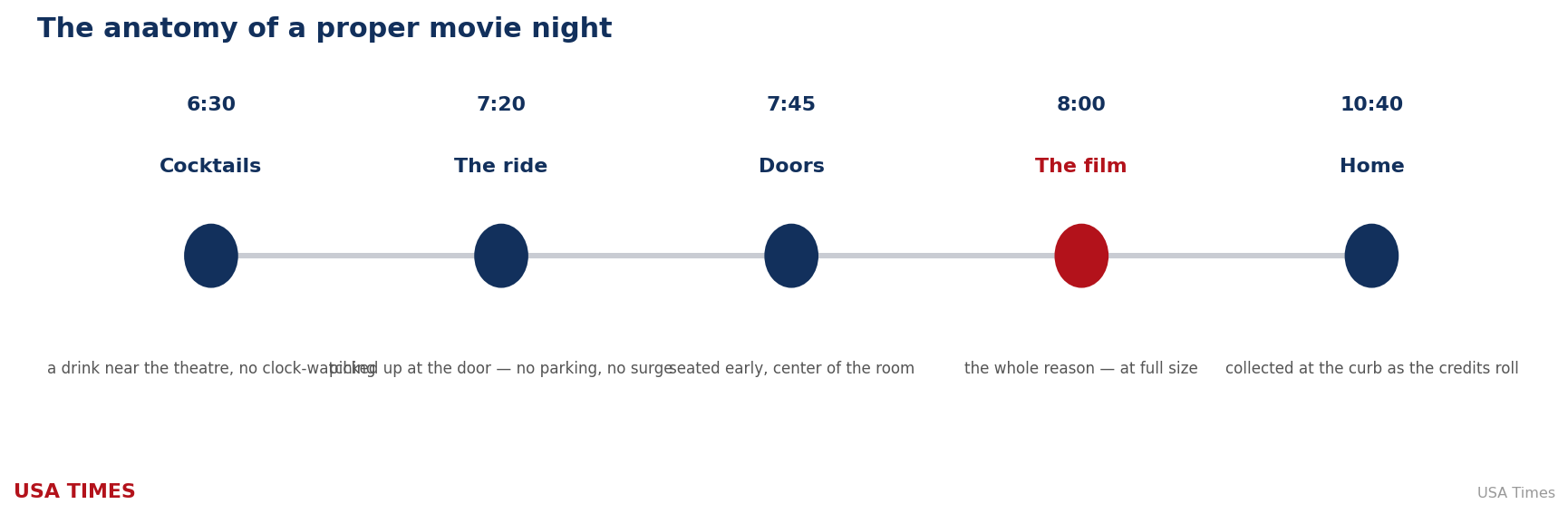
The template is not complicated, and it does not require a red carpet. Start with a drink or a small dinner near the theatre — close enough that you are not racing the clock, good enough that the meal is part of the evening rather than fuel for it. Time the arrival so you are seated before the lights drop, in the middle of the room where the sound and the screen are calibrated to land. Choose the film for the room, not the room for the film: a picture shot for the big screen, ideally in a format the living room cannot reproduce, so the trip is justified by something you genuinely cannot get at home. And arrange the logistics — the ride there, the ride back — so that they never enter your mind once the evening begins. Do that, and a movie stops being content you consume and becomes, again, a night you had.
The theatres are betting on it too
Exhibitors have read the same tea leaves. The multiplex that once competed on showtimes and popcorn now competes on experience: recliner seats, in-theatre dining, premium large-format screens, members-only rooms. This is not nostalgia; it is strategy. When the ordinary version of a film is a tap away at home, the only thing a theatre can charge a premium for is an evening the home cannot match — a bigger image, a better sound field, a room full of people reacting at the same instant. The venues that are thriving are the ones that stopped trying to beat streaming on convenience and started beating it on occasion. They are, in effect, selling the night out, and the film is the centerpiece rather than the whole product.
Which is why the smartest way to think about a great movie night is as a small production of your own. You are not just buying a ticket; you are staging an evening whose only job is to let a film land the way it was meant to. Handle the meal, the timing, the seats, and the getting-there with the same care a studio brings to a premiere, and an ordinary Tuesday becomes something you look forward to for a week and remember for a year. The ingredients were never expensive or complicated. They were just, for a while, forgotten.
The great irony of the streaming decade is that by making every film available everywhere, it made almost none of them feel like an event. The correction is already underway: audiences are traveling for rare formats, booking prestige screenings weeks out, treating a great theatre the way music fans treat a great venue. The films worth this kind of evening were always going to survive. What’s returning is the evening itself — the dinner, the film, the drive home in the dark, talking about what you just saw. The movies never stopped being worth it. We just forgot, for a while, how to make a night of them.