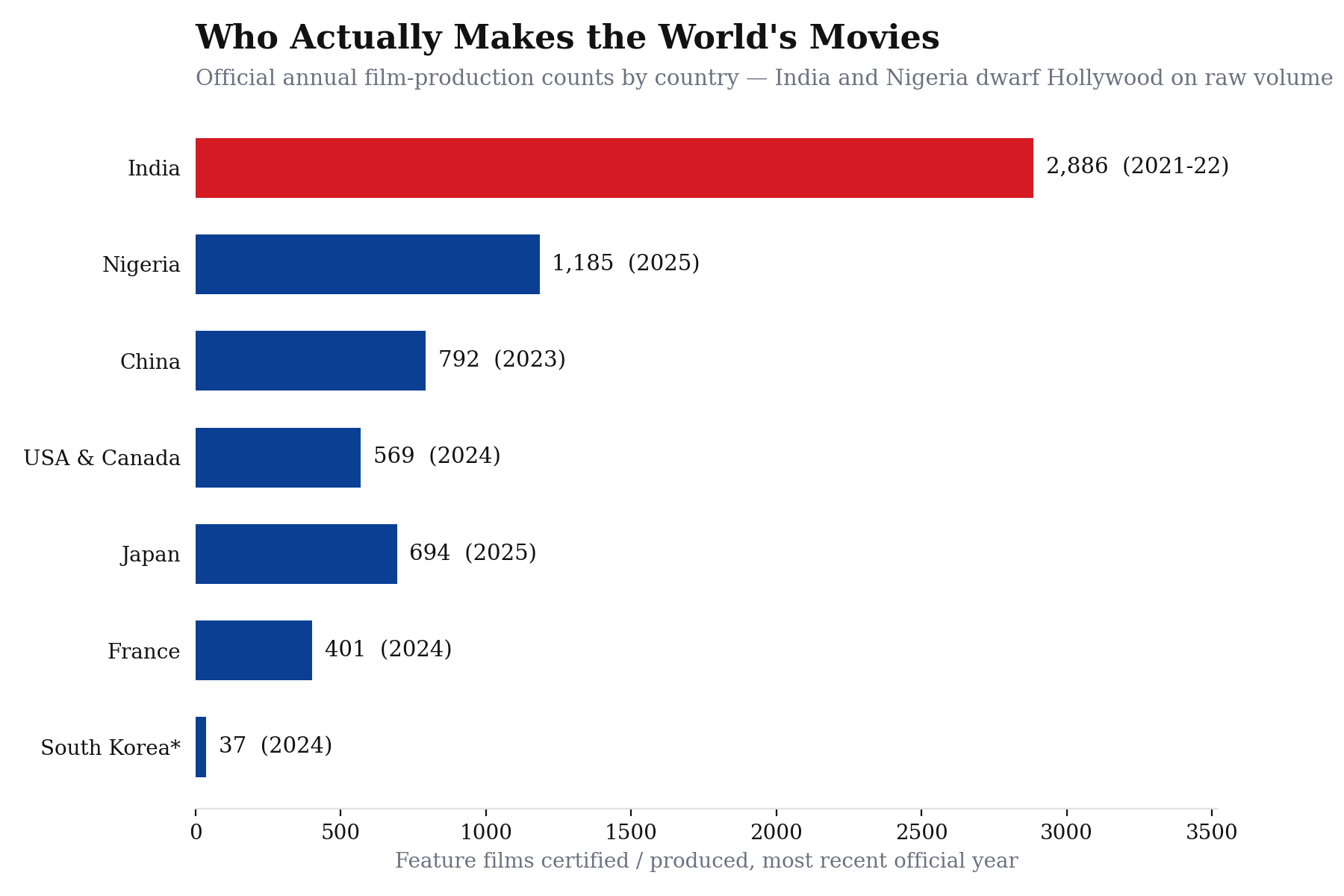
Ask most Americans which country makes the most movies and the reflex answer is the United States. It isn’t close. By official government counts, India certified 2,886 feature films in the most recent reporting year, Nigeria’s regulator classified 1,185, and China put out 792 — all comfortably ahead of the roughly 569 titles that hit U.S. and Canadian theaters in 2024. Hollywood dominates global box-office revenue. It does not dominate global film production, and the gap between those two facts is one of the more persistent misreadings of the industry.
Volume and revenue are different games
India’s film industry isn’t one industry at all — it’s several, running in parallel. Hindi-language Bollywood gets the international attention, but Telugu, Tamil, Kannada, Malayalam, Marathi and Bengali cinema each certify hundreds of films a year through India’s Central Board of Film Certification, and the combined total dwarfs any single national output elsewhere in the world. Nigeria’s Nollywood runs on a different model entirely: lower budgets, faster turnaround, and distribution built for home video and streaming as much as theaters, with the National Film and Video Censors Board reporting steady growth in films classified — 1,088 in 2024, 1,185 in 2025.
Hollywood runs on the opposite model: fewer films, vastly larger budgets, and a distribution and marketing machine built to extract maximum revenue from each release worldwide. The result is a strange asymmetry. The U.S. and Canada produced roughly a fifth as many films as India last year, yet North America still pulled in the single largest regional share of global box-office revenue. Volume and revenue, in this business, are almost unrelated variables.
Batmandir · Founders A numbered seat at the table. S3 · The Founders Club — 161 seats per location. By invitation. Explore membership →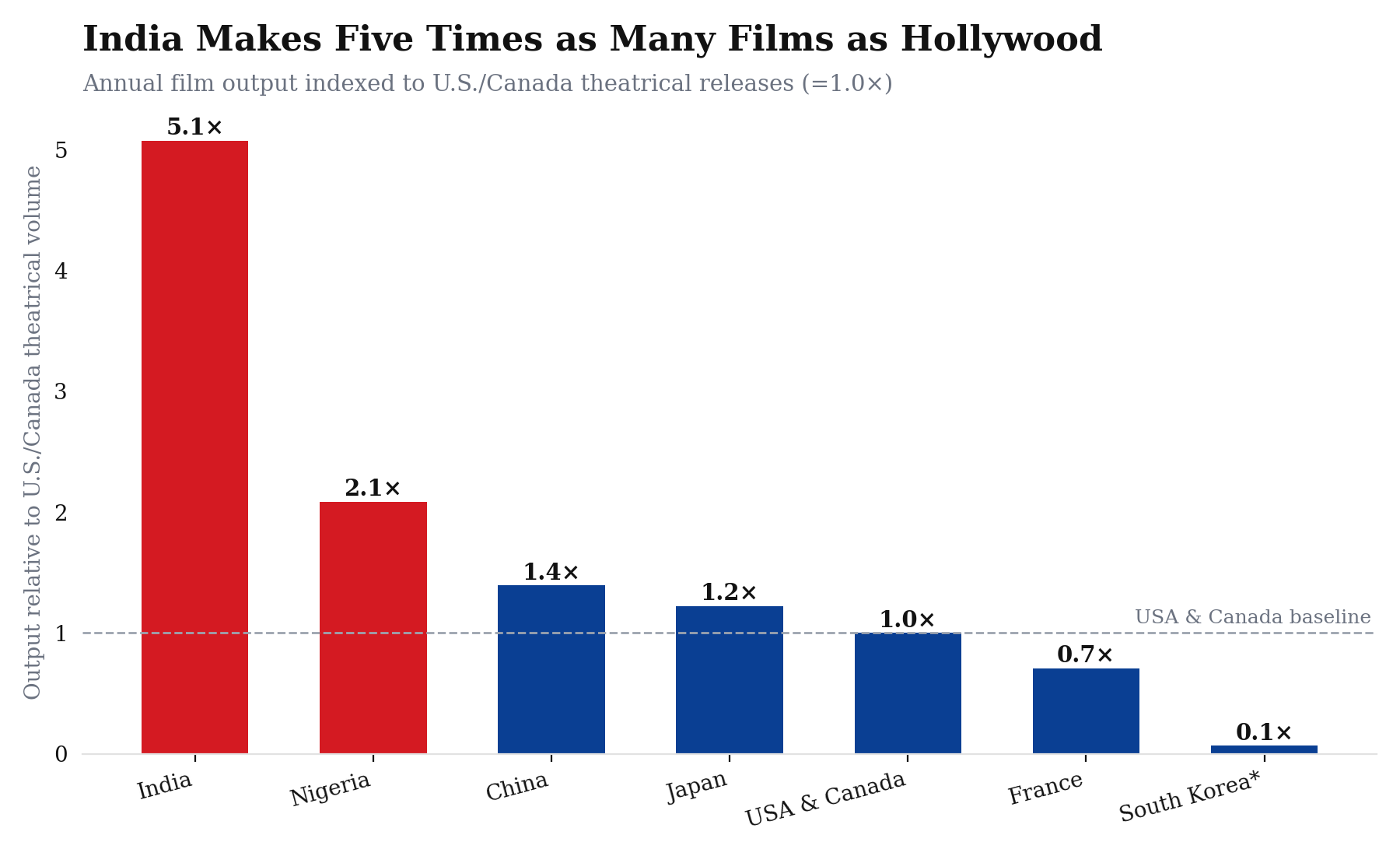
A note on comparing apples to very different apples
We want to be upfront about a real limitation in this comparison: every country counts “a film” differently. India’s CBFC certification covers every theatrical-bound feature across all its language industries. Nigeria’s NFVCB figure covers films classified for release, which increasingly means streaming and home video rather than cinemas. The France and Japan figures come from national funding and trade bodies that count films receiving formal production credit, not just theatrical releases. And the U.S./Canada number, sourced from The Numbers’ theatrical release calendar, counts only titles that actually opened in a cinema — it excludes the enormous volume of direct-to-streaming and direct-to-video U.S. production that never gets a theatrical certification at all.
None of that changes the headline: even the most theater-narrow read of India and Nigeria’s output still leaves them well ahead of the U.S. on raw film count. It just means the honest takeaway isn’t “India makes five times as many movies as America” as a precise multiplier — it’s that the world’s largest film industries by volume have never been the ones Americans picture first, and that’s been true for well over a decade.
Where the rest of the world sits
Japan certified around 694 films in the most recent year tracked, roughly on par with China and ahead of the U.S./Canada theatrical count. France, whose CNC has tracked production data since the 1940s, put out 401 — a figure that has held remarkably steady even as streaming reshaped how those films reach audiences. South Korea is the outlier worth flagging: the country’s five major studios released only 35 to 37 wide theatrical titles a year in 2023 and 2024, and are planning just 10 to 14 commercial releases in 2025 — a contraction the Korean Film Council has described in stark terms, even as Korean films that do get released are winning a larger share of their home box office than in years past.
That divergence — fewer films, but each one performing better — is worth watching. It suggests an industry consolidating around bigger bets rather than one simply shrinking, and it’s the same tension playing out globally: as production costs and marketing budgets climb, the calculation between making more films and making fewer, better-marketed ones is shifting almost everywhere except the two markets built on sheer volume.
Sources: Central Board of Film Certification (India); National Film and Video Censors Board (Nigeria); China Film Administration; The Numbers theatrical release calendar (U.S./Canada); Centre national du cinéma (France); Korean Film Council (KOFIC); UNESCO Institute for Statistics.