Every movie you have ever seen arrived inside a rectangle, and that rectangle was a choice. Directors and cinematographers argue about the shape of the frame the way painters argue about the shape of the canvas, because it governs everything: how a face fills the screen, how much world you can show at once, whether a shot feels intimate or epic. And hovering over the whole debate is a rectangle nobody actually shoots in but everybody invokes — the golden one, 1.618 to 1.
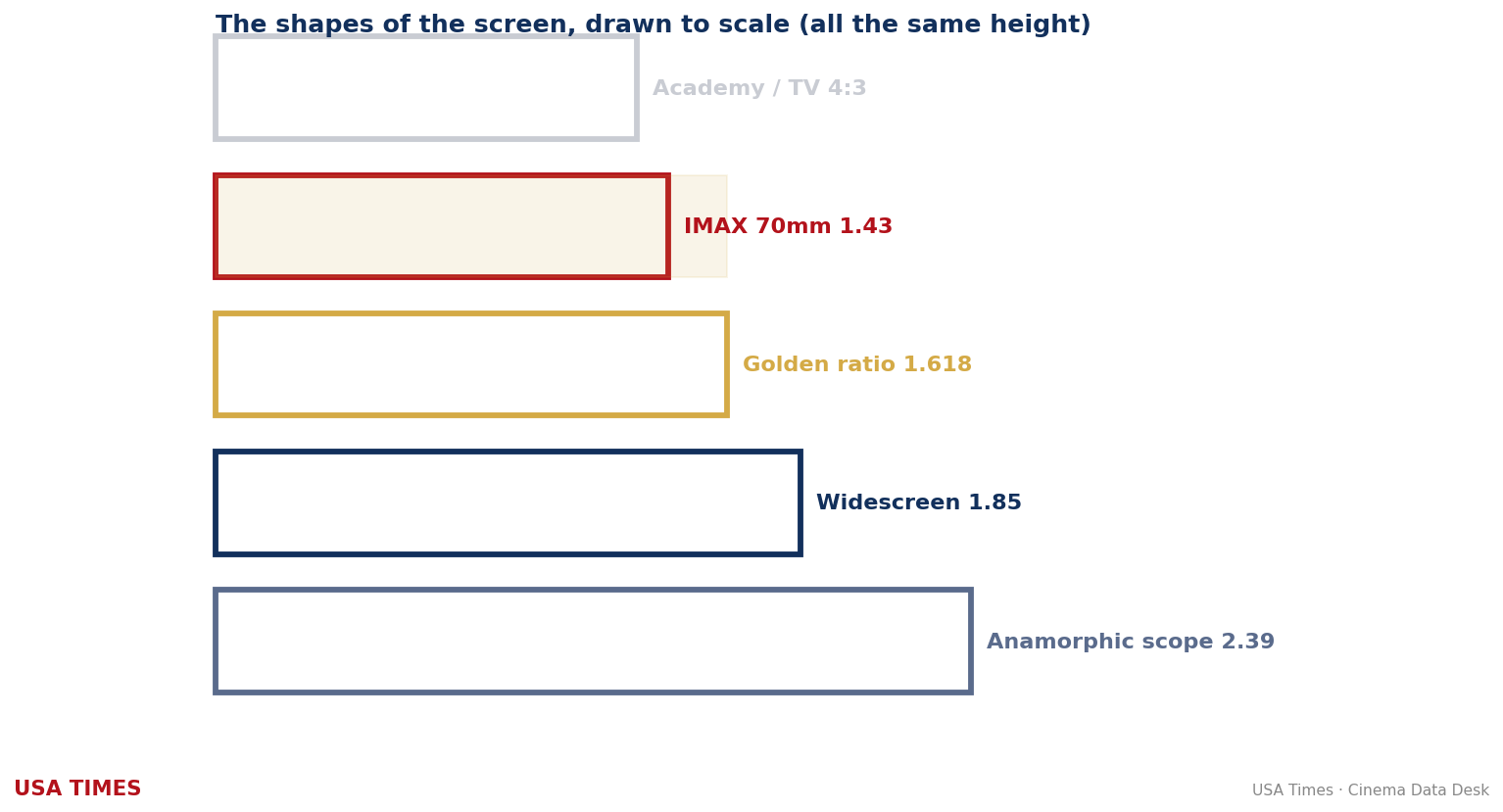
The real shapes of the screen
Hollywood settled long ago on two workhorse widescreen shapes. 1.85:1 — often called “flat” — is the standard for most dramas and comedies; it is a gently elongated rectangle, close to the golden ratio but a touch wider. 2.39:1 — anamorphic “scope” — is the long, letterboxed shape of epics and Westerns, built to sweep across landscapes. Older films and classic television used the nearly square 1.33:1 (the “Academy” ratio). And the giant-screen format that premium exhibition is built around, full-frame IMAX 70mm, is a tall, almost boxy 1.43:1.
Line them up, as the chart above does, and the golden 1.618 sits almost exactly between the intimate IMAX box and the standard widescreen flat — a kind of compromise rectangle, wider than the immersive giant-screen shape but narrower than the everyday movie frame. It is close enough to 1.85 that most audiences could not tell a golden frame from a flat one at a glance. Which raises the obvious question: does any of this shape-mysticism actually matter, or is the golden rectangle just a nice-looking coincidence that marketing decks love to cite?
Batmandir · Founders A numbered seat at the table. S3 · The Founders Club — 161 seats per location. By invitation. Explore membership →Where φ helps, and where it’s hype
Here we want to be honest rather than mystical. There is no evidence that filmmakers deliberately frame in 1.618, and no controlled study showing audiences prefer a golden rectangle to a 1.85 one. The claim that the golden ratio is uniquely “pleasing” has been tested in psychology for over a century, and the results are famously muddy — people’s rectangle preferences are broad and easily swayed by context. When a film-school lecture overlays a golden spiral on a famous shot, it is usually drawing the spiral to fit the image, not revealing a rule the director followed.
What is true is more interesting than the myth. The ratios that cinema actually uses were chosen for concrete reasons — film stock dimensions, projection economics, the desire to distinguish the theatrical image from television. IMAX chose 1.43 because it maximizes the vertical immersion of a colossal screen, filling more of your peripheral vision than a wide letterbox could. Scope chose 2.39 to make horizons feel infinite. These are engineering and storytelling decisions, not appeals to a magic number.
Why we still use the golden ratio
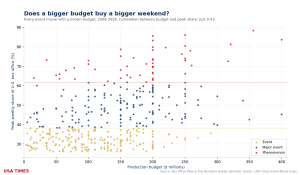
So why does USA Times build an entire box-office index on 1.618 if the number is overhyped in the frame? Because we use it for something it is genuinely good at: not describing beauty, but drawing clean, non-arbitrary lines. The golden ratio gives us defensible thresholds — 26.18%, 38.2%, 61.8% — for sorting how completely a film dominates its week. That is a measurement tool, and it works precisely because those cut points are fixed and principled rather than round numbers we picked to flatter the data.
The golden rectangle, in the end, is a lovely idea that cinema mostly waves at rather than obeys. The real screen is a family of practical shapes, each solving a different problem. And the number’s best use in the movie business turns out to have nothing to do with the frame at all — it lives in the ledger, measuring not what a film looks like, but how much of the box office it managed to take.