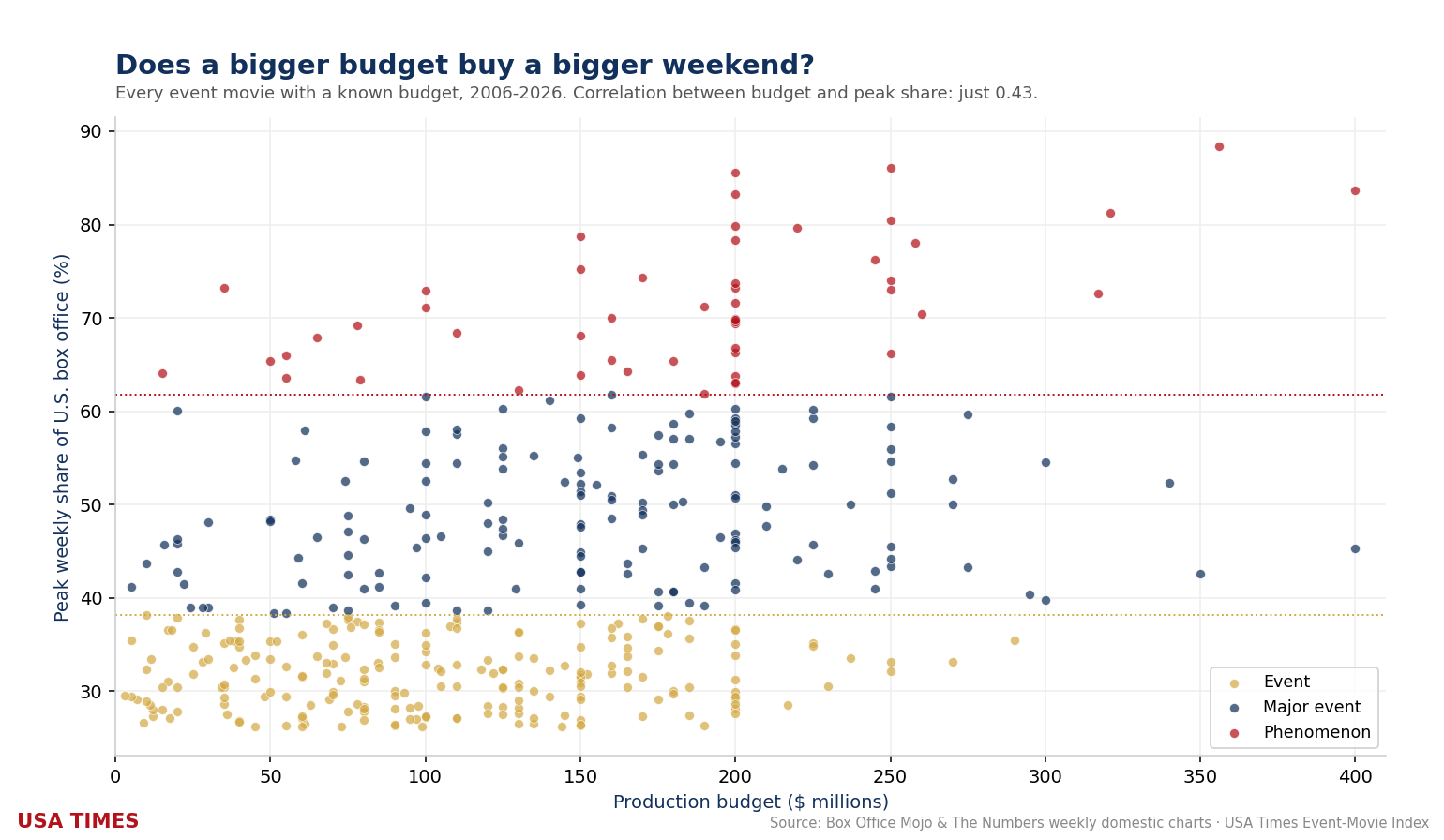
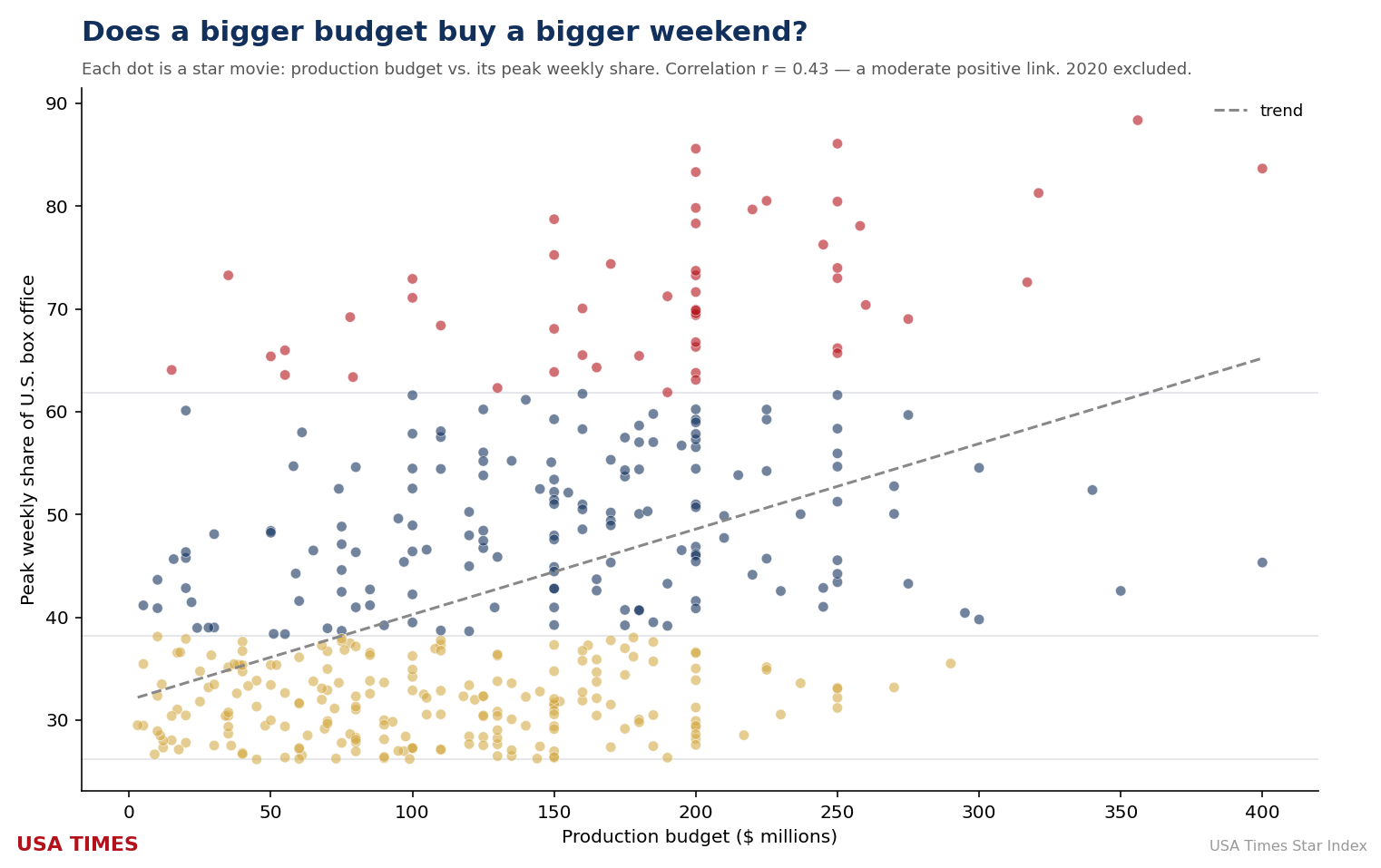
It is an article of faith in the movie business that domination is bought. Spend $250 million on a franchise tentpole, the thinking goes, and you have purchased a weekend. We put that faith to the test against twenty years of data, plotting every star movie’s production budget against the share of the box office it commanded at its peak. The answer is more interesting than a simple yes or no: money helps — but a lot less than the industry’s spending habits would suggest.
A real link, but a loose one
The correlation between what a film cost and how completely it dominated its week is 0.43 — a moderate, positive relationship, not the near-lockstep connection the “domination is bought” story implies. In plain terms: bigger budgets do, on average, come with bigger weekends, but the effect is weak enough that the exceptions are everywhere. Statisticians would say budget explains only a small fraction of the variation in share; the rest is timing, competition, and appeal. The scatter is a broad cloud with an upward tilt, not a tight rising line.
That upward tilt is easy to understand. A giant budget buys a giant opening in absolute dollars and a release wide enough to blanket the country, both of which nudge share upward. What it cannot buy is an empty calendar or a movie audiences are desperate to see first — and those are what separate a good weekend from a total takeover. So the money matters, but it competes with forces it can’t control, which is why the cloud stays a cloud.
Batmandir · Guest Passes Step inside for a day. Guest passes from $161/day — brought in by a member. See guest passes →The cheapest films that still took over
The clearest evidence that budget is not destiny is the roster of low-cost films that cleared the Betelgeuse-event line anyway — taking 38.2% or more of their entire week on a sliver of a tentpole’s budget. If spending were the whole story, these films could not exist.
Cheapest films to reach Betelgeuse-event domination
| Film | Year | Budget | Peak share |
|---|---|---|---|
| Paranormal Activity 3 | 2011 | $5M | 41.2% |
| Halloween | 2018 | $10M | 43.6% |
| Taylor Swift: The Eras Tour | 2023 | $15M | 64.1% |
| Demon Slayer: Kimetsu no Yaiba – The Movie: Mugen Train | 2021 | $16M | 45.7% |
| Demon Slayer: Kimetsu no Yaiba Infinity Castle | 2025 | $20M | 45.8% |
| Five Nights at Freddy’s | 2023 | $20M | 60.1% |
| Halloween Kills | 2021 | $20M | 42.8% |
| Us | 2019 | $20M | 46.4% |
The most expensive star movies
| Film | Year | Budget | Peak share |
|---|---|---|---|
Avatar: Fire and Ash | 2025 | $400M | 45.3% |
| Avatar: The Way of Water | 2022 | $400M | 83.7% |
| Avengers: Endgame | 2019 | $356M | 88.3% |
| Avatar: The Way of Water | 2023 | $350M | 42.6% |
| Fast X | 2023 | $340M | 52.4% |
| Avengers: Infinity War | 2018 | $321M | 81.3% |
| Star Wars: Episode VIII – The Last Jedi | 2017 | $317M | 72.6% |
| Justice League | 2017 | $300M | 39.8% |
Where the golden ratio actually helps
We resisted the urge to draw a golden line through this cloud, because the data doesn’t support one, and inventing a tidy constant would be exactly the number-mysticism we try to avoid. What the golden ratio genuinely provides is the horizontal grid on the chart: the 38.2% and 61.8% lines that turn a formless scatter into a readable map of tiers. Budget spreads films left and right; the golden thresholds sort them up and down. The vertical axis — how completely a film dominated — is only loosely tied to the horizontal one.
The honest takeaway is one working producers already know in their bones: a big budget improves your odds without guaranteeing anything. It buys scale, reach, and a marketing megaphone — and on average that shows up as a somewhat bigger share. But the weekend itself is won by timing, positioning, and a film people want to be first to see, none of which is for sale by the pound. Money moves the needle at the box office. It just doesn’t move it nearly as far as the budgets imply.