The sticker price of intelligence keeps falling, but the menu keeps getting longer. As of mid-September 2026, OpenAI, Anthropic and Google between them list more than two dozen active models, each with its own per-token rate, cache discount and long-context surcharge. This tracker pulls the current published list prices into one place, charts them, and explains what actually moves your bill. Every figure below is a standard, short-context list rate in U.S. dollars per one million tokens, cross-checked against the providers’ own pricing pages and two independent price trackers on September 13, 2026.
The one number that matters: output tokens
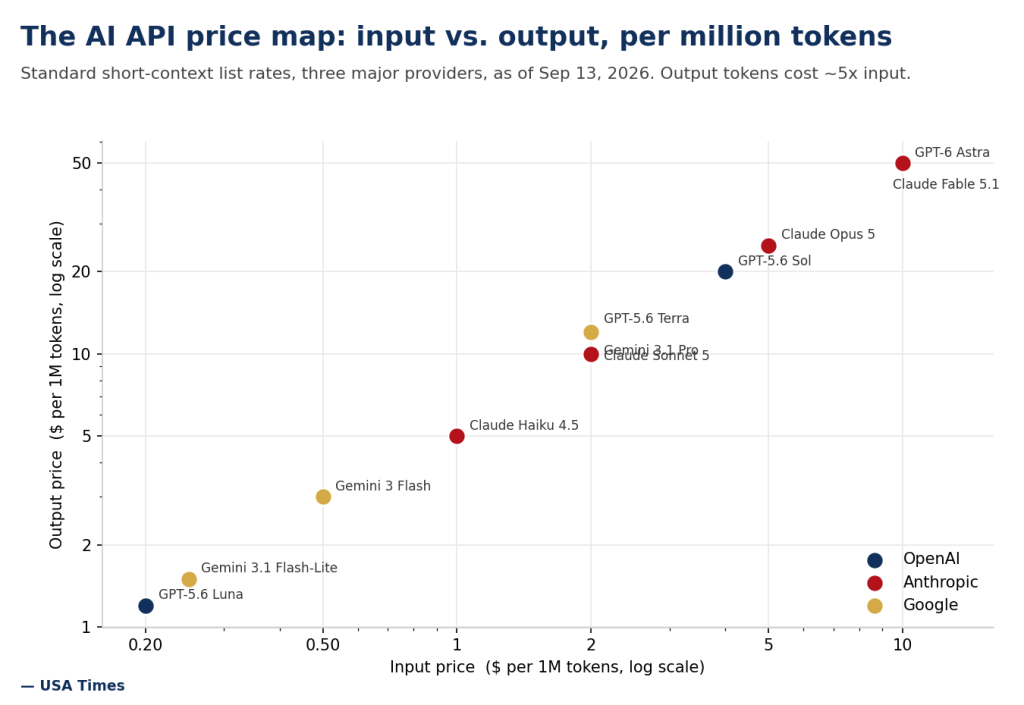
Read a pricing page and you will see two headline numbers per model: input (the tokens you send) and output (the tokens the model generates). Across almost every current model, output costs roughly five times input. That ratio is the single most important thing to internalize before you budget. A chatbot that reads a long document and answers in a sentence is cheap; an agent that writes thousands of lines of code, or a summarizer that produces long structured output, is where the money goes. On the chart above, every model sits on essentially the same diagonal line — the providers have converged not just on price levels but on the input-to-output ratio itself.
The current rate card
Here are the standard short-context list prices for the models most teams will actually reach for, grouped by tier. Prices are per one million tokens.
Batmandir · Founders A numbered seat at the table. S3 · The Founders Club — 161 seats per location. By invitation. Explore membership →| Model | Provider | Tier | Input $/1M | Cached input $/1M | Output $/1M |
|---|---|---|---|---|---|
| GPT-6 Astra | OpenAI | Frontier | $10.00 | $1.00 | $50.00 |
| Claude Fable 5.1 | Anthropic | Frontier | $10.00 | $0.25 | $50.00 |
| Claude Opus 5 | Anthropic | Premium | $5.00 | $0.50 | $25.00 |
| GPT-5.5 | OpenAI | Premium | $5.00 | $0.50 | $30.00 |
| GPT-5.6 Sol | OpenAI | Flagship (promo) | $4.00 | $0.40 | $20.00 |
| GPT-5.6 Terra | OpenAI | Mid | $2.00 | $0.20 | $12.00 |
| Claude Sonnet 5 | Anthropic | Mid | $2.00 | $0.20 | $10.00 |
| Gemini 3.1 Pro | Mid | $2.00 | $0.20 | $12.00 | |
| Claude Haiku 4.5 | Anthropic | Budget | $1.00 | $0.10 | $5.00 |
| Gemini 3 Flash | Budget | $0.50 | $0.05 | $3.00 | |
| Gemini 3.1 Flash-Lite | Budget | $0.25 | $0.025 | $1.50 | |
| GPT-5.6 Luna | OpenAI | Budget | $0.20 | $0.02 | $1.20 |
The frontier tier has quietly converged
The most striking thing in the 2026 data is how little daylight is left between the three labs at the top. OpenAI’s GPT-6 Astra and Anthropic’s Claude Fable 5.1 carry an identical $10 input / $50 output headline. One rung down, OpenAI’s GPT-5.5 ($5/$30) sits alongside Anthropic’s Claude Opus 5 ($5/$25) — same input, Anthropic 17% cheaper on output. In the mid-tier, Claude Sonnet 5, GPT-5.6 Terra and Gemini 3.1 Pro all anchor at $2 input, with output between $10 and $12. When list prices are this close, the token rate stops being the deciding factor. Benchmarks, latency, tool-use reliability and how many failed agent loops each model needs to finish a job matter far more to the total cost of getting work done.
The one genuine outlier is OpenAI’s GPT-5.6 Sol at $4/$20. OpenAI labels that rate promotional and, in its own documentation, commits to keeping it available at least through November 21, 2026 — after which it could rise. If you are building a budget around Sol, treat its price as temporary.
The discounts that actually change the math
List price is the ceiling, not the bill. Three mechanisms routinely cut real costs by half or more:
- Prompt caching. Reused prompt prefixes — system prompts, tool definitions, a reference document you send every turn — bill at roughly 10% of the standard input rate on all three providers. Anthropic is the most aggressive here: Fable 5.1 cache reads dropped to $0.25 per million, a 97.5% discount off its $10 base. For any long-lived agent that re-sends the same context repeatedly, caching is the difference between a viable product and an unaffordable one.
- Batch processing. OpenAI and Anthropic both take a flat 50% off input and output for asynchronous jobs that can tolerate a delay. Stack batch on top of caching and a workload can run at roughly a quarter of list price.
- Model routing. The cheapest lever is simply not using the flagship for everything. Classification, extraction and routing run fine on a budget model at one-fiftieth the output price of the frontier tier. The mature pattern is to default to a mid or budget model and escalate only on a measured quality gap.
Where the headline price stops applying
Two footnotes can double a bill and are easy to miss. First, long context. OpenAI’s current flagships charge a higher meter once a request exceeds 272,000 input tokens — for the GPT-5.6 family, input roughly doubles and output rises 50% for the whole request. Google applies a similar step on Gemini 3.1 Pro above 200,000 tokens ($2/$12 becomes $4/$18). If your prompts are long, the short-context number on the pricing page is not your number. Second, processing tiers. “Fast” or priority modes cost a multiple of standard; Batch and Flex cost a fraction. Every price comparison should carry the provider and the service tier attached, or it is meaningless.
How to actually use this
For most teams the sensible default in September 2026 is a mid-tier model — Sonnet 5, Terra or Gemini 3.1 Pro — at around $2 input and $10 to $12 output, with caching switched on and a cheaper model handling high-volume, low-stakes calls. Reserve the $50-output frontier tier for work where fewer failed attempts genuinely justify the rate. And because these prices move month to month — Sol’s promotional cut, Anthropic making Sonnet 5’s launch rate permanent, Google’s April removal of free Pro access — anchor your budget to a dated snapshot and re-check before you commit. The numbers here are ours, taken on September 13, 2026.
USA Times has tracked the cost side of the AI boom before, from users reporting runaway token consumption on premium models to the capital-expenditure guidance that ultimately pays for all this compute, and the electricity bills underneath it.
What we did
We recorded the standard, published, short-context list price for input, cached input and output tokens for the current generally available models from OpenAI, Anthropic and Google, in U.S. dollars per one million tokens, on September 13, 2026. Where a provider’s own pricing page rendered dynamically, we cross-checked every figure against two independent price trackers that cite the same provider documentation and were synced the same week; we used only numbers on which the sources agreed, and we excluded controlled-access, preview and specialty (voice, realtime, cyber) models from the main table. Prices change frequently and vary by cloud reseller, region and service tier; treat this as a dated snapshot, not a live quote.
- Anthropic — Claude API pricing
- OpenAI — pricing and developer API pricing docs
- Google — Gemini API pricing
- AI Pricing Guru — OpenAI / Anthropic / Google trackers (synced 2026-09-13)
- BenchLM — OpenAI API pricing registry (synced 2026-09-11)