The pitch for running your own AI is seductive: no per-token bill, no content filters you did not write, and your data never leaves the building. The reality in September 2026 is that the hardware to do it well has gotten dramatically more expensive over the past year, driven by a memory shortage that has pushed professional GPU prices up almost 90% since launch. This guide lays out three honest build tiers at current street prices, what each can actually run, and — just as important — what self-hosting does not fix. The prices here were checked against retailer and marketplace listings on September 13, 2026.
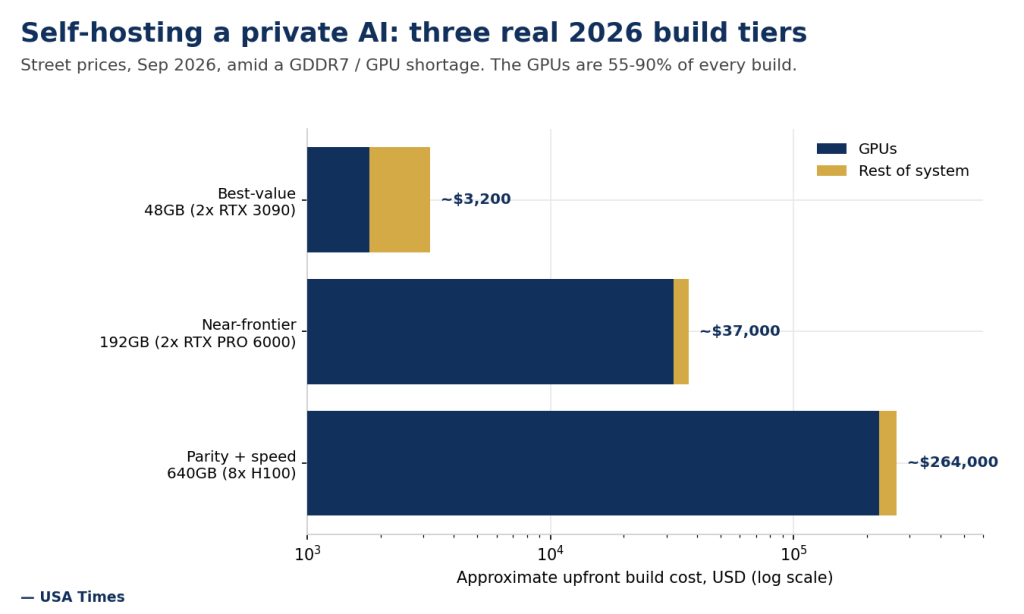
Before the tiers, one number to keep in mind: the GPU is the build. In the entry rig the graphics cards are a little over half the total; in the two larger builds they are 85 to 90 cents of every dollar. Everything else — CPU, board, RAM, power, cooling — is a rounding error by comparison. That means your decision is really a decision about which GPUs, and how many.
Tier 1 — Best value, ~$3,000–3,500 (48GB VRAM)
Two used RTX 3090s remain the value king of local AI. Each 24GB card runs roughly $700 to $1,050 on the used market as of September 2026, giving you 48GB of combined VRAM for around $1,800. Pair them with a mainstream 12-core CPU, a board with proper PCIe spacing, 128GB of system RAM, a 2TB NVMe drive and a beefy 1,300–1,500W power supply, and the whole machine lands around $3,200. It draws about 700W under load, so give it its own 15–20A circuit and space the cards so they do not thermally throttle.
Batmandir · Founders A numbered seat at the table. S3 · The Founders Club — 161 seats per location. By invitation. Explore membership →What it runs: 70-billion-parameter class open models — the Llama and Qwen 70–72B families — quantized to 4-bit, at genuinely useful quality. This is a capable private assistant for drafting, summarizing and everyday coding help. Where it struggles is long, multi-step agentic work and browser automation, where open models still trail the frontier.
Tier 2 — Near-frontier, ~$32,000–37,000 (192GB VRAM)
This is the tier the 2026 GPU shortage has hit hardest, and where our numbers diverge most from guides written even a few months ago. The card that makes it work is NVIDIA’s RTX PRO 6000 Blackwell, with 96GB of GDDR7 each. It launched in March 2025 at an $8,565 MSRP. As of September 2026, NVIDIA’s own marketplace lists it at $16,000 — an 87% increase — with Newegg and B&H both at roughly $15,999 and used listings running even higher. The driver is a GDDR7 memory shortage with no near-term relief; the card’s 96GB clamshell design makes it acutely sensitive to memory supply.
Two of those cards (192GB total) now cost about $32,000 on their own. Add a Threadripper-class workstation platform, 256GB of ECC RAM, fast storage and a 2,000W-class power supply and the build lands near $37,000 — noticeably above the “~$30k” this tier used to cost. One money-saving note our reporting turned up: the 300W Max-Q variant of the same card has been listed around $8,300, and NVIDIA says AI performance is effectively identical to the 600W version, so a two-card Max-Q build can bring the tier back toward the low $20,000s while running cooler in a multi-GPU chassis.
What it runs: the near-frontier open models — Qwen3-235B, DeepSeek-R1, GLM — at real quality in 4-bit. This is the closest realistic match to the kind of agentic work commercial frontier models do, in a single box. Draw is 1.3–1.5kW under load; it needs a ventilated room and ideally a dedicated 20A circuit.
Tier 3 — Parity and speed, ~$250,000+ (640GB VRAM)
An eight-way H100 server is the “run anything, fast, for many users” tier. New H100 80GB cards run roughly $25,000 to $31,000 each, so eight of them is around $224,000 before you add the server chassis, CPUs, high-speed networking and NVLink fabric that make them worth having — call it $250,000 to $320,000 all in. For a single newsroom or small team this is overkill; its real justification is high throughput across many simultaneous users, which most self-hosters do not need.
| Tier | GPUs | VRAM | Upfront (Sep 2026) | Runs well |
|---|---|---|---|---|
| Best value | 2x used RTX 3090 | 48GB | ~$3,200 | 70B-class open models (Q4) |
| Near-frontier | 2x RTX PRO 6000 96GB | 192GB | ~$32,000–37,000 | Qwen3-235B / DeepSeek-R1 / GLM |
| Parity + speed | 8x H100 80GB | 640GB | ~$250,000–320,000 | Anything, high throughput |
Renting is now the honest default for the big tiers
The flip side of hardware inflation is that cloud rental rates have stayed comparatively stable. An RTX PRO 6000 rents for roughly $1.57 to $5.50 per GPU-hour depending on provider; an H100 can be had around $3.20 per hour. At those rates, a $16,000 card is many thousands of hours of rental — and renting carries no depreciation, no maintenance and no exposure to the next memory-price spike. For anything above the entry tier, the buy-versus-rent math in 2026 increasingly favors renting unless you are running the hardware near-continuously or your data-privacy requirements forbid the cloud entirely. That privacy requirement is, for many self-hosters, the whole point — which is a legitimate reason to buy even when the spreadsheet says rent.
The software stack is the same for every build
Regardless of tier, the recipe is consistent: Ubuntu 24.04 LTS with current NVIDIA drivers and CUDA; an inference server (vLLM for speed and an OpenAI-compatible API, or Ollama for simplicity); Open WebUI as a ChatGPT-style front end; and models pulled in 4-bit to fit VRAM. The real hidden cost is not the GPU — it is the agent layer. Tool use, browser control and connector plumbing that come built into commercial assistants have to be rebuilt yourself with an agent framework wired to your API. Budget days, not hours, for that.
What self-hosting fixes — and what it doesn’t
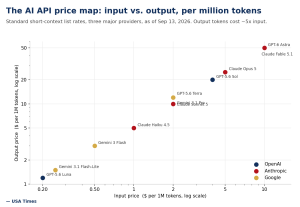
It genuinely fixes three things: no content denylist you did not write, full data privacy and control, and zero per-token cost once the hardware is paid off. It does not fix social-media automation (Reddit, X and LinkedIn block bots at their end, not the model’s), it does not unlock gated SaaS subscriptions, and it does not close the quality gap on long, multi-step agent tasks, where open models still trail the frontier. And there is no managed uptime: if it dies at 2am, that is you. For the token-cost side of the trade — what you are actually saving per million tokens — see our AI model cost tracker. The electricity underneath all of it is its own line item, and we break down the year-one running cost of a home rig in a companion piece.
What we did
We built three reference configurations at the price points commonly cited for private AI, then priced the load-bearing components — the GPUs — against live retailer and marketplace listings on September 13, 2026, and estimated the surrounding system from standard workstation and server parts. GPU prices during a memory shortage are volatile and vary by day, retailer and condition; the totals are approximate and rounded, and should be re-checked before purchase. Rental rates cited are provider on-demand list prices as of the same week.
- Thunder Compute — RTX PRO 6000 Blackwell pricing and cloud rental rates (Sep 2026)
- Tom’s Hardware — RTX PRO 6000 MSRP increase to $16,000
- XDA — used RTX 3090 remains the value king for local AI
- CloudZero — NVIDIA H100 cost in 2026