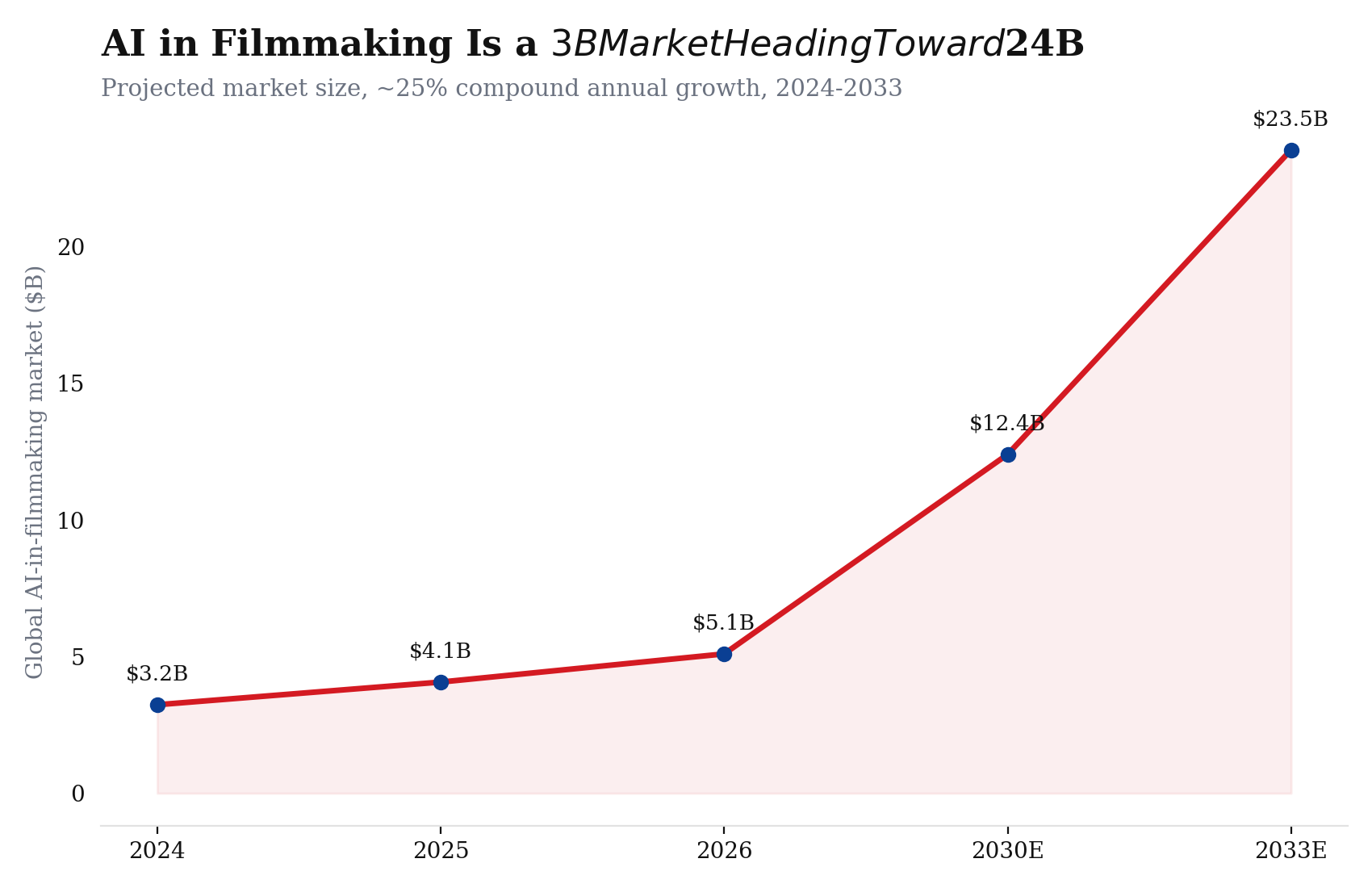
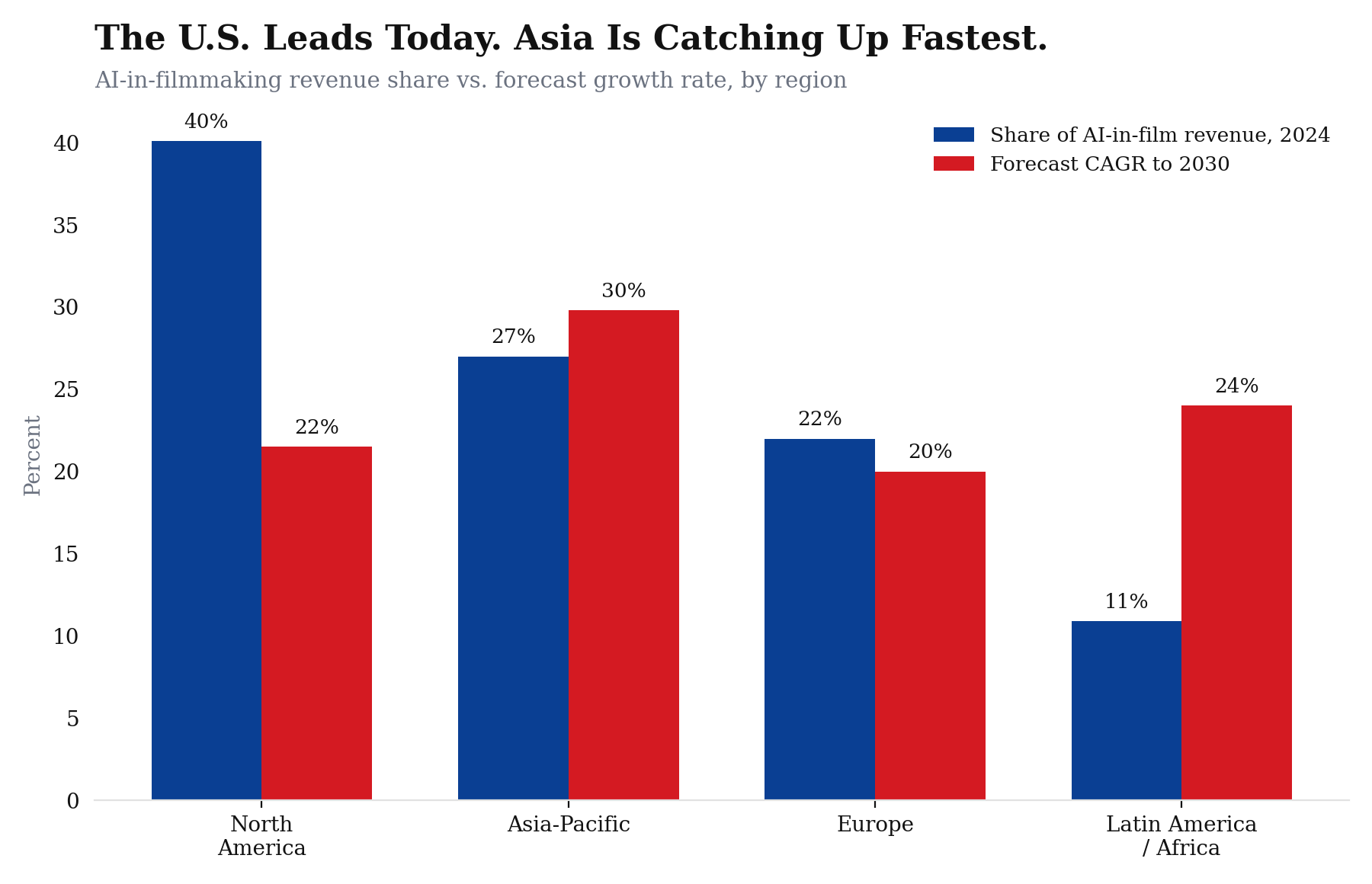
The global market for AI tools in filmmaking — everything from script coverage and previsualization to visual-effects generation and dubbing — was worth an estimated $3.24 billion in 2024 and is projected to reach $23.54 billion by 2033, a compound annual growth rate above 25%. The United States currently sits at the top of that market by dollar volume, with North America holding roughly 40% of global AI-in-film revenue. But revenue share and adoption speed are two different measurements, and by the second one, Asia is moving faster than anywhere else on earth.
Money says America. Momentum says Asia.
North America leads today because it has the infrastructure — the studios, the VFX houses, the capital — already built to absorb new tools quickly. But industry researchers consistently flag Asia-Pacific as the fastest-growing region for AI adoption in film production, not the largest yet. China, India, Japan and South Korea are named repeatedly as the countries integrating AI tools fastest into content creation, visual effects and animation pipelines, and the reasons differ meaningfully by country.
China: platform-native AI at industry-event scale
China’s AI video-generation startups — Kling, Minimax, ShengShu AI, TapNow AI among others — have moved from research projects to production tools given prominent placement at major industry events like Hong Kong’s Filmart, where AI was reported as the single dominant theme in 2026. That’s a meaningfully different posture than early experimentation: it signals tools built specifically for commercial production pipelines, not just visual novelty.
Batmandir · Founders A numbered seat at the table. S3 · The Founders Club — 161 seats per location. By invitation. Explore membership →India: AI as a cost floor, not just a cost cut
The most striking figure in this space comes from India, where AI-integrated production pipelines are reportedly cutting production costs by 60–80% for comparable quality — a shift researchers describe as moving the floor of production costs from “the price of a bank loan” to “the price of a software subscription.” For an industry that already produces more films annually than any other country in the world, that kind of cost compression doesn’t just make existing films cheaper — it changes who can afford to make a film at all, which is a different and arguably bigger story than efficiency gains at the high end of the market.
Japan: AI folded into animation, not bolted on
Toei Animation, one of Japan’s largest and longest-running animation studios, announced in May 2025 that it was integrating AI across multiple stages of production — drawing assistance, motion generation and background design — explicitly to improve both efficiency and creative capability. That a studio with Toei’s institutional weight and catalog is building AI into its core pipeline, rather than treating it as an experimental side project, is a meaningful adoption signal from an industry not usually associated with moving fast on new production technology.
What this means for the next few years
The likely trajectory isn’t Asia overtaking North America in AI-in-film revenue anytime soon — the U.S. has too much of a head start in tooling and capital. It’s that the adoption rate gap keeps narrowing until the practical difference in how films actually get made in Los Angeles, Mumbai, Seoul and Tokyo becomes smaller than the difference in how much money changes hands in each market. Cost structure, in other words, may end up converging faster than revenue share does — and for an industry where India and Nigeria already outproduce Hollywood on volume, a lower AI-enabled cost floor in the highest-volume markets is the kind of shift worth watching closely rather than treating as a Silicon Valley story that happens to touch movies.
Sources: Grand View Research, AI in Filmmaking Market Report; McKinsey & Company; The Hollywood Reporter; industry statements from Toei Animation; market research aggregated via Research and Markets.