London’s BFI IMAX is the biggest cinema screen in Britain and the only one in the country that can project The Odyssey the way Christopher Nolan shot it — on 70mm film, in IMAX’s full 1.43:1 frame. On Thursday we recorded the status of every show the venue has on sale — 159 showtimes across 41 days — and then opened the seat map behind every single show still marked bookable. This is the fullest public accounting of the run that exists, and it says one thing loudly: London hasn’t just bought the tickets. It has bought the good seats, all of them, more than a month ahead.
Chapter one: seventeen days of red
Start with the wall. From opening night, Friday 17 July, through Sunday 2 August — 17 straight days, 75 listed shows — not one seat is bookable. The overall calendar shows 86 of 155 non-glitched shows (55.5%) sold out, but the average is misleading: the sellout isn’t scattered, it’s a solid block at the front, with a lone morning show on 3 August as the first crack of daylight.
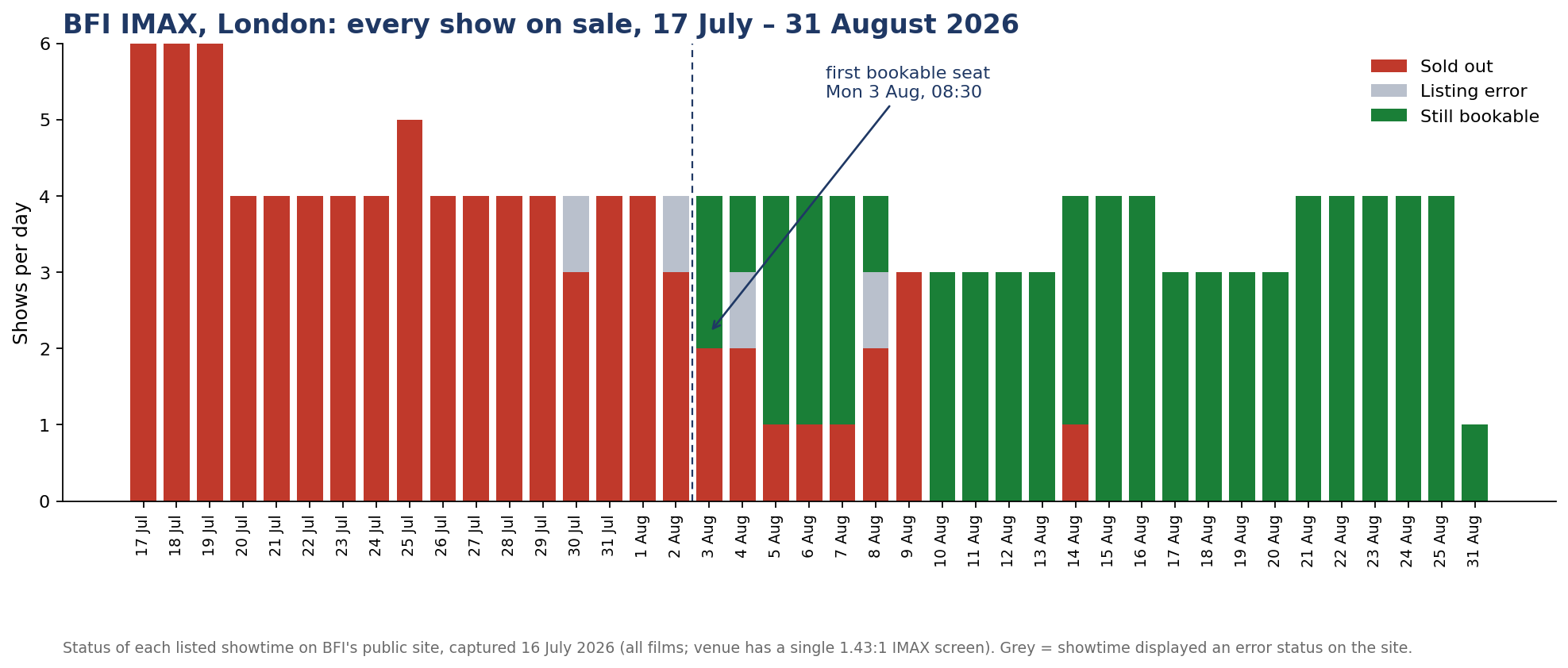
And the venue is not under-programming. For opening weekend BFI scheduled the film around the clock — 12:01 a.m., 4:00 a.m., 8:00 a.m., noon, 4:15 p.m., 8:15 p.m. — six shows in twenty-four hours, three days running. Every one sold out, including all seven overnight screenings in the dataset. Londoners bought out Homer at four in the morning.
Batmandir · The Circle Full access to theatres, museums & exhibitions. S2 · ongoing membership, without a Founder’s seat. Explore membership →Chapter two: what “available” actually means
The listings say 69 shows still have seats. So we opened the seat map on every bookable show at the front of the calendar, plus controls deep into August — eleven shows, 5,423 seats. What we found: 372 seats open, 6.9% of the total. The “Buy” button is technically telling the truth and practically hiding a sellout.
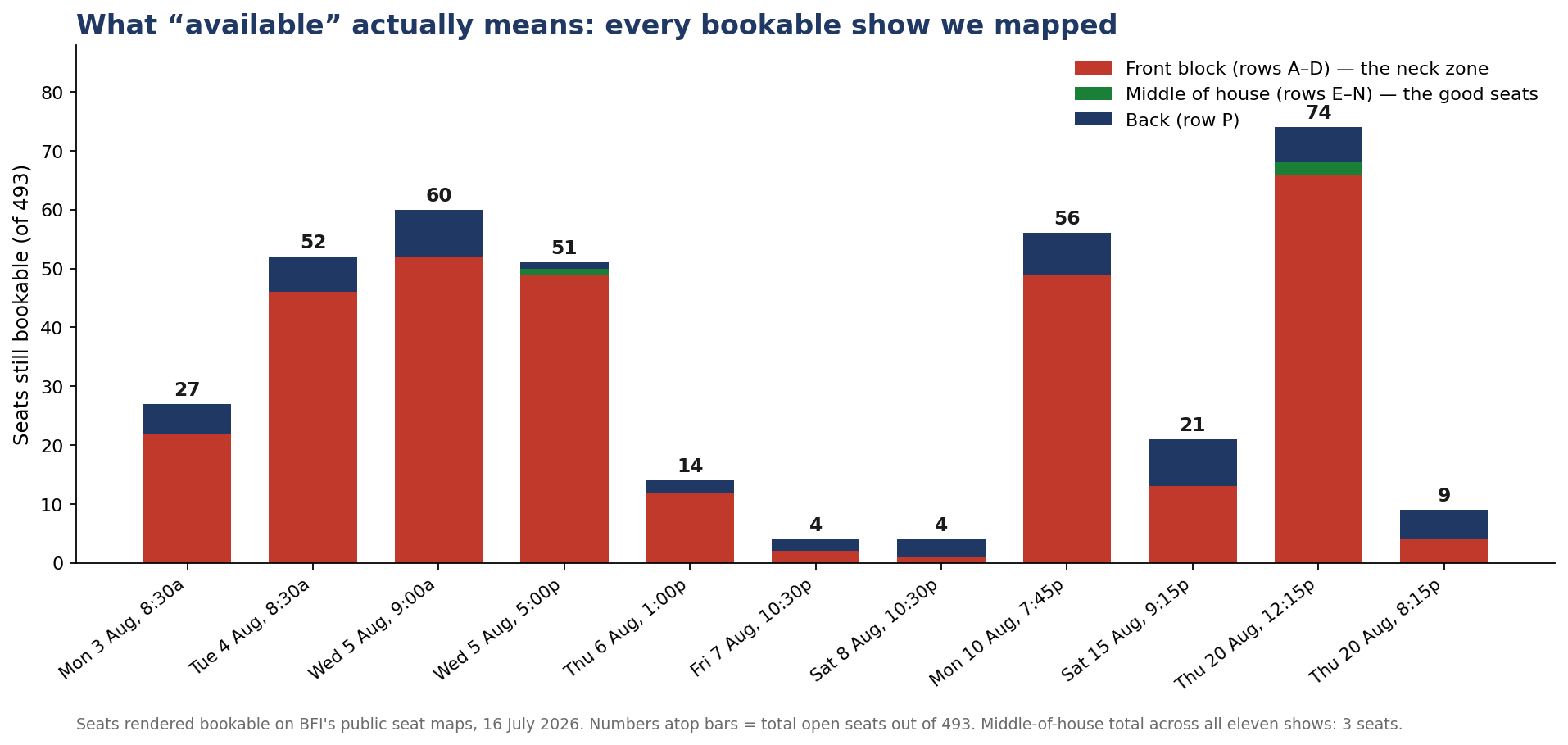
Friday and Saturday late shows in early August are down to four seats each. The Thursday evening show five weeks out has nine. The single most available show we could find anywhere — a Thursday matinee on 20 August — still has 85% of its house gone.
| Show | Seats open | Front rows A–D | Elsewhere |
|---|---|---|---|
| Mon 3 Aug, 8:30a (first bookable show) re-checked 2h later: down from 29; the day’s 12:30 sold out between our checks | 27 | 22 | 5 in P |
| Tue 4 Aug, 8:30a | 52 | 46 | 6 in P |
| Wed 5 Aug, 9:00a | 60 | 52 | 8 in P |
| Wed 5 Aug, 5:00p | 51 | 49 | 1 E, 1 P |
| Thu 6 Aug, 1:00p the 5:00p, bookable that morning, sold out by afternoon | 14 | 12 | 2 in P |
| Fri 7 Aug, 10:30p | 4 | 2 | 2 in P |
| Sat 8 Aug, 10:30p | 4 | 1 | 3 in P |
| Mon 10 Aug, 7:45p (first bookable evening (subtitled)) | 56 | 49 | 7 in P |
| Sat 15 Aug, 9:15p | 21 | 13 | 8 in P |
| Thu 20 Aug, 8:15p | 9 | 4 | 5 in P |
| Thu 20 Aug, 12:15p (most seats found anywhere) | 74 | 66 | 2 E, 6 P |
Chapter three: the middle of the house is extinct
Here is the part that answers the question everyone actually asks — are the leftover seats any good? No. They are not. Map every open seat by row and the picture is brutal:
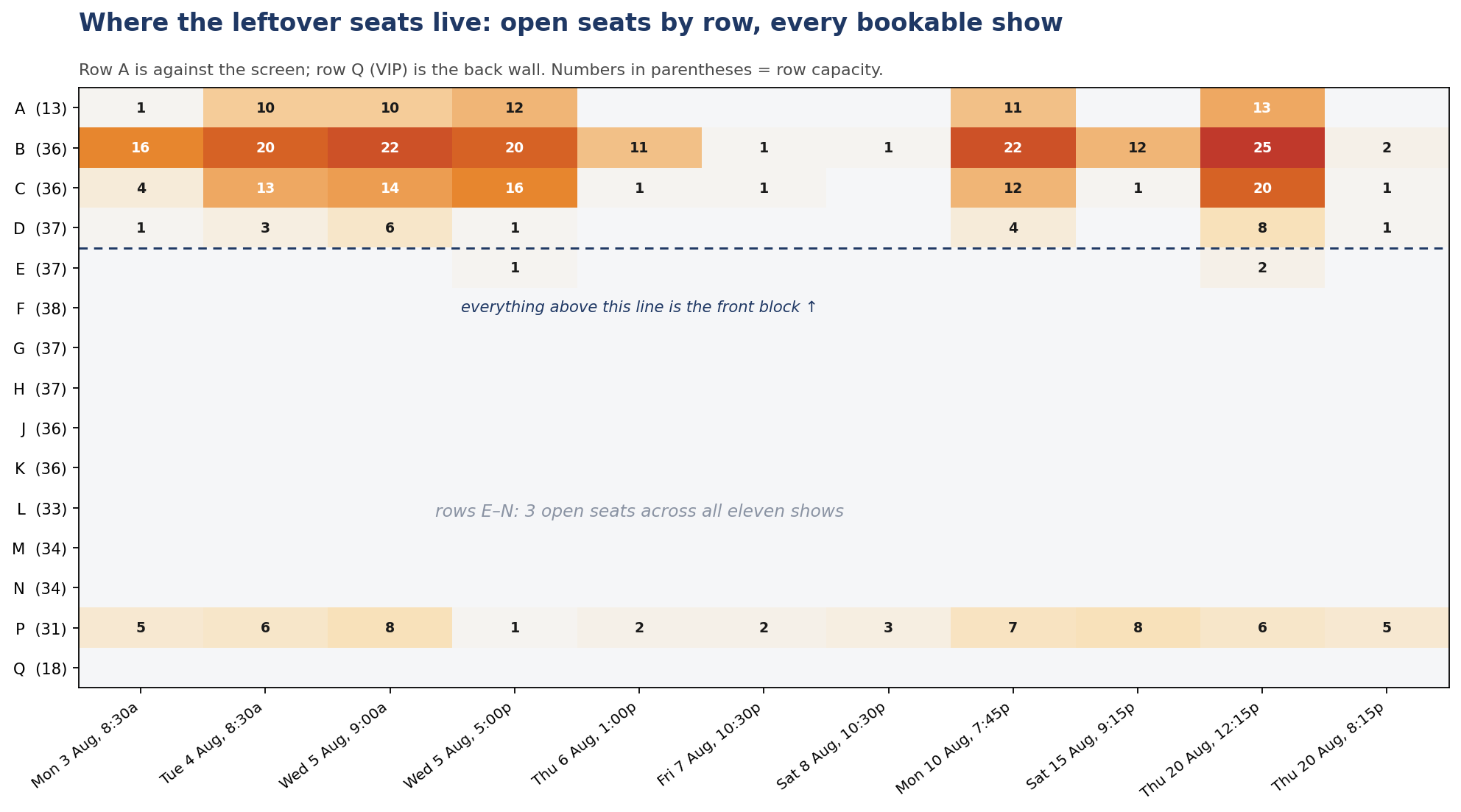
85% of everything still on sale is in rows A–D, the front block directly beneath a screen the height of five double-decker buses — seats where 1.43:1 stops being a format and becomes a neck exercise. Rows E through N — roughly 280 prime seats per show — have three open seats across all eleven shows combined. The 18-seat VIP back row Q: zero, in every show we mapped. What isn’t front block is a thin ration of row P, second from the back wall.
Chapter four: it’s vanishing in real time
We measured the calendar twice on Thursday, hours apart, and the two snapshots don’t agree — because the inventory moved between them:
Thu 6 Aug, 5:00p — sold out entirely
Mon 3 Aug, 8:30a — 29 seats → 27 seats
At that pace, several of the shows in our table above will be gone before the weekend. A back-of-envelope on the 86 already-sold-out shows — roughly 40,000 seats at £26–30 — puts the run’s locked-in seat revenue in the neighborhood of £1.0–1.2 million before fees, for one room, before the film has opened. (Indicative only: we can’t see discounts, memberships or holds.)
So when can you actually go?
The honest consumer guidance, from the data: there is currently no date on which you can book a seat in the middle of the house. Your options, in descending order of dignity: a weekday matinee deep in August (Thu 20 Aug, 12:15 — 74 seats, but 66 of them front block); a scattering of row-P seats at the back of most bookable shows; the front rows and a flexible neck; or waiting for BFI to release dates beyond 25 August — where, on this evidence, the same thing will happen again. Tickets are £26 standard, £29 premium, £30 VIP, plus booking fee.
Why one room in London matters
The Odyssey was shot entirely with IMAX film cameras, and 1.43:1 — the full height of the IMAX negative — is how its images were composed. Fewer than forty venues on Earth can project it that way; BFI IMAX is the UK’s only one, and it runs the format around an already-packed repertory calendar (The Empire Strikes Back, Kiki’s Delivery Service, The Dark Crystal and a midnight premiere share the screen in late August). When a format exists in one room per country, the room sells out before the film opens — back to front, best seats first. This is the first report from our 1.43 Desk, which is building a live, show-by-show record of the world’s giant screens. New York’s Lincoln Square — where we found tonight’s 70mm houses at 99% of capacity — is next.
How we did this. On 16 July 2026 we recorded the publicly displayed status of all 159 showtimes on sale on BFI IMAX’s official booking site (17 July – 31 August window), then opened the public seat map of every show still marked bookable at the front of the calendar plus late-August controls (eleven shows), via the venue’s guest booking flow — no account, no purchase. “Open” means a seat rendered bookable at capture time; the site does not distinguish sold seats from house holds, and four showtimes displaying a site-side error status were excluded from percentages. Revenue figure is an indicative estimate from list prices only. The full dataset — every showtime status, every per-row seat count, and the scripts that compute every number and chart in this article — is archived by the USA Times Data Desk.
Related from the USA Times Data Desk
- IMAX Just Had Its Best Q2 Installation Quarter in a Decade. Its Backlog Grew Anyway.
- 1,089 of IMAX's Screens Still Run on 2008 Technology. Only 63 Can Show the Format's Full Frame.
- Every Screen on Earth That Can Show The Odyssey in True IMAX 70mm — All 41 of Them
- IMAX at Home: Every Film That Opens Up to the Expanded Frame — and Why It’s Never the Real 1.43
- Box-office coverage index · the Star Index methodology
Sources
- Box Office Mojo — Weekend Domestic Box Office
- IMAX — format & venue background (Wikipedia)
- USA Times — Star Index methodology & data sources