Despite two years of intense hype, most American businesses still aren’t using artificial intelligence. According to the U.S. Census Bureau’s Business Trends and Outlook Survey (BTOS), national AI use among U.S. businesses hovered between just 17% and 20% from December 2025 through early May 2026 — essentially flat over six months, despite a wave of corporate AI capital spending announcements over the same period. Between 20% and 23% of businesses said they expected to use AI within the next six months, a gap between current and expected use that has also stayed roughly constant.
BTOS is a biweekly, nationally representative survey the Census Bureau runs to track real-time business conditions, and it’s one of the only data sources tracking AI adoption at this frequency and scale rather than through a one-off annual survey. In November 2025, the Bureau widened its core question from asking whether a business used AI “in producing goods or services” to asking about AI use “in any business function” — a broader bar that, if anything, should have made the adoption number look higher, not lower.
Size is the single biggest predictor of AI use
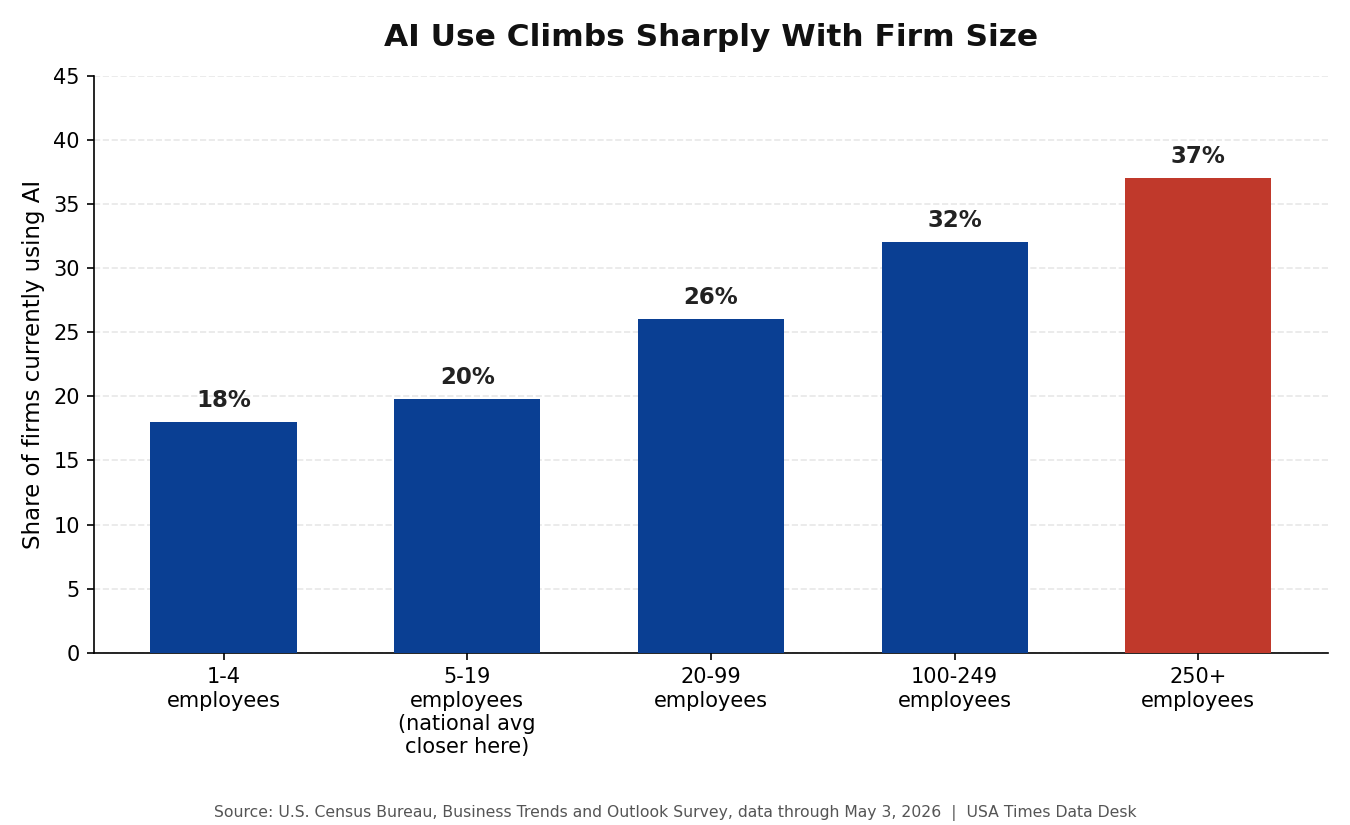
The clearest pattern in the BTOS data isn’t industry — it’s headcount. As of the data collection period ending May 3, 2026, 37% of firms with at least 250 employees reported using AI in their operations, and 32% of firms with 100 to 249 employees said the same. That adoption rate falls off sharply as firm size shrinks: fewer than 20% of businesses with four or fewer employees reported using AI at all, a rate that has barely moved since December.
Batmandir · The Circle Full access to theatres, museums & exhibitions. S2 · ongoing membership, without a Founder’s seat. Explore membership →Census Bureau researchers found that AI use grew specifically among firms with at least 20 employees between December and May, while adoption among the smallest firms — those with fewer than 20 employees — showed no statistically significant change over the same period. In practice, that means essentially all of the AI adoption growth counted by this survey over the past six months happened at businesses that already had the scale to absorb new software, staff training, and workflow changes. The smallest businesses in the country, which make up the large majority of all U.S. firms, are adopting AI at close to the same rate they were adopting it in December.
Two sectors are running well ahead of everyone else
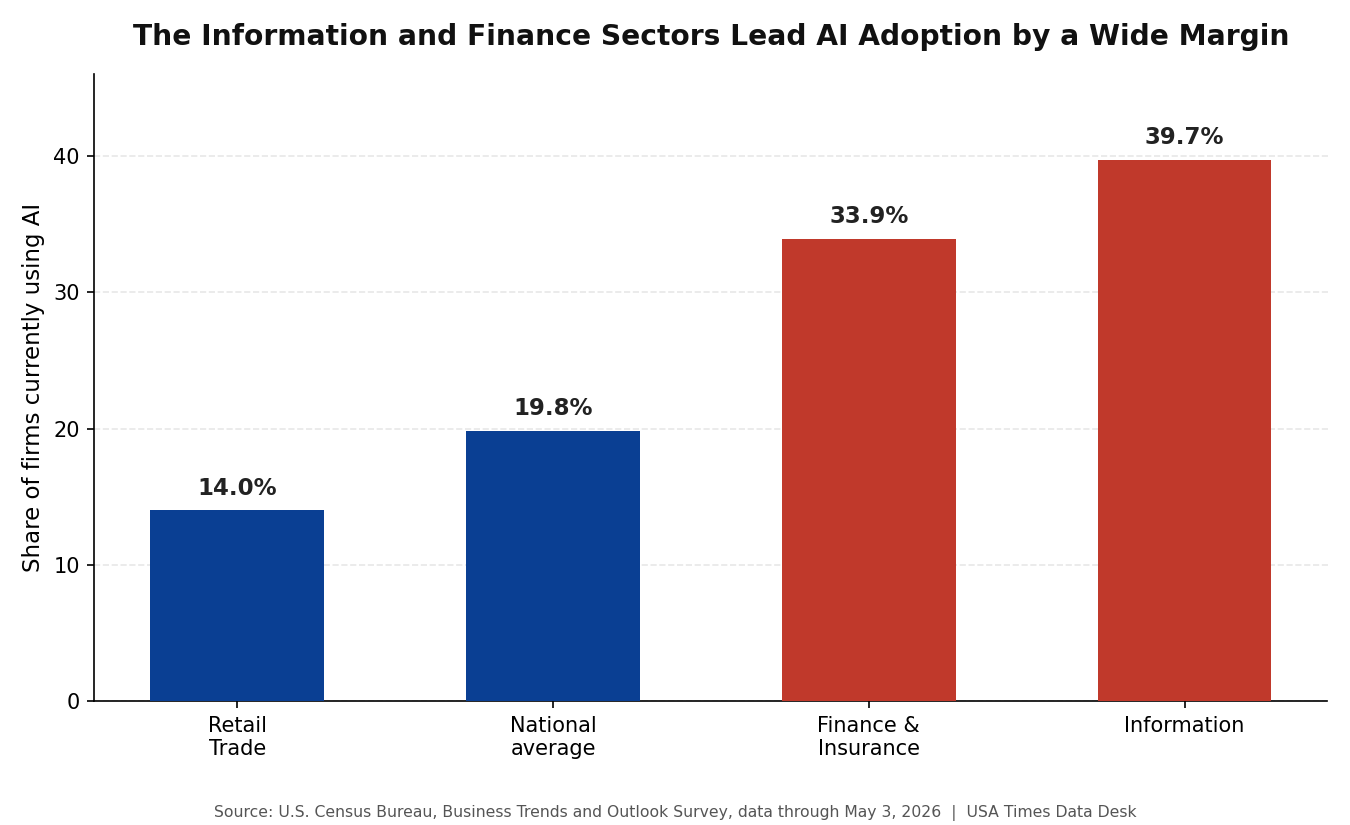
Sector data tells a similarly lopsided story. As of May 3, 2026, the Information sector reported a 39.7% AI use rate and Finance and Insurance reported 33.9% — both roughly double the 19.8% national average at the time. Expected future use follows the same pattern: about 42% of Information-sector businesses and roughly 39% of Finance and Insurance businesses said they expect to use AI in the next six months, both comfortably above the national average.
Retail Trade sits at the opposite end. Around 14% of retail businesses reported current AI use, and about 17% expected to adopt it within six months — both below the national average, in a sector where customer-facing AI tools (chatbots, personalized recommendations, inventory forecasting) have received significant press coverage. The gap between retail’s press coverage and its actual measured adoption rate is itself notable: media attention to AI in a sector doesn’t necessarily track the sector’s real adoption numbers.
Why the flat national number matters
A stagnant 17-20% national adoption rate cuts against a common assumption in AI industry commentary — that adoption is accelerating rapidly across the broad economy. The BTOS data, collected directly from businesses every two weeks rather than estimated from surveys of AI vendors or enterprise software analysts, suggests the diffusion of AI into day-to-day U.S. business operations has been real but narrow: concentrated in large firms and in a small number of information-intensive and finance-heavy sectors, while the median small business — which employs the largest single share of U.S. private-sector workers — has adopted AI at a rate that hasn’t moved much in six months.
That pattern connects to a story USA Times’ Data Desk covered two months ago, when we found that the share of S&P 500 companies naming AI as a business risk in SEC filings jumped from 12% in 2023 to 72% in 2025. Large, publicly traded companies are both the most likely to be using AI and the most likely to be formally disclosing the risks that come with it — while the actual mechanics of day-to-day AI use at the country’s small businesses remain, per this Census data, a much smaller and slower-moving story than the corporate disclosure trend alone would suggest.
The survey is about to get more granular
The topline adoption numbers only tell part of the story, and the Census Bureau appears to know it. On November 17, 2025, BTOS launched a second AI supplement that goes well beyond a simple yes/no adoption question. The expanded supplement now tracks AI use across 15 separate business functions — including finance, human resources, customer service, marketing, information technology, and research and development — rather than treating “AI use” as a single undifferentiated category. It also asks businesses about the operational changes that come with adoption, such as staff training, workflow redesign, and new technology purchases, and separately asks non-adopting businesses why they haven’t used AI.
That expansion matters for interpreting the topline number correctly. A business that uses an AI tool for one narrow task, like drafting internal emails, and a business that has restructured its customer service, marketing, and R&D functions around AI both currently count as “AI users” in the same binary yes/no figure. The function-level data, once there’s enough of it collected to report reliably, should make it possible to distinguish shallow, single-task AI use from the kind of deep functional adoption that shows up in productivity statistics — a distinction the current national 17-20% figure can’t make on its own.
What we did
All figures in this piece — the national AI use range, the firm-size breakdown, the sector-level use and expected-use rates for Information, Finance and Insurance, and Retail Trade, and the methodology details about the November 2025 question revision — come directly from the U.S. Census Bureau’s Business Trends and Outlook Survey, specifically the America Counts story “Large Firms With at Least 20 Employees Biggest AI Users,” published May 26, 2026 and authored by Census Bureau statisticians Adam Grundy, Cory Breaux, and Dhanapati Khatiwoda, read directly from census.gov. BTOS is described by the Census Bureau as an experimental data product using biweekly, nationally representative data collection; as an experimental series, its methodology and question wording are still evolving, which is itself part of this story — the Bureau revised its core AI-use question in November 2025 specifically because it judged the original wording too narrow.