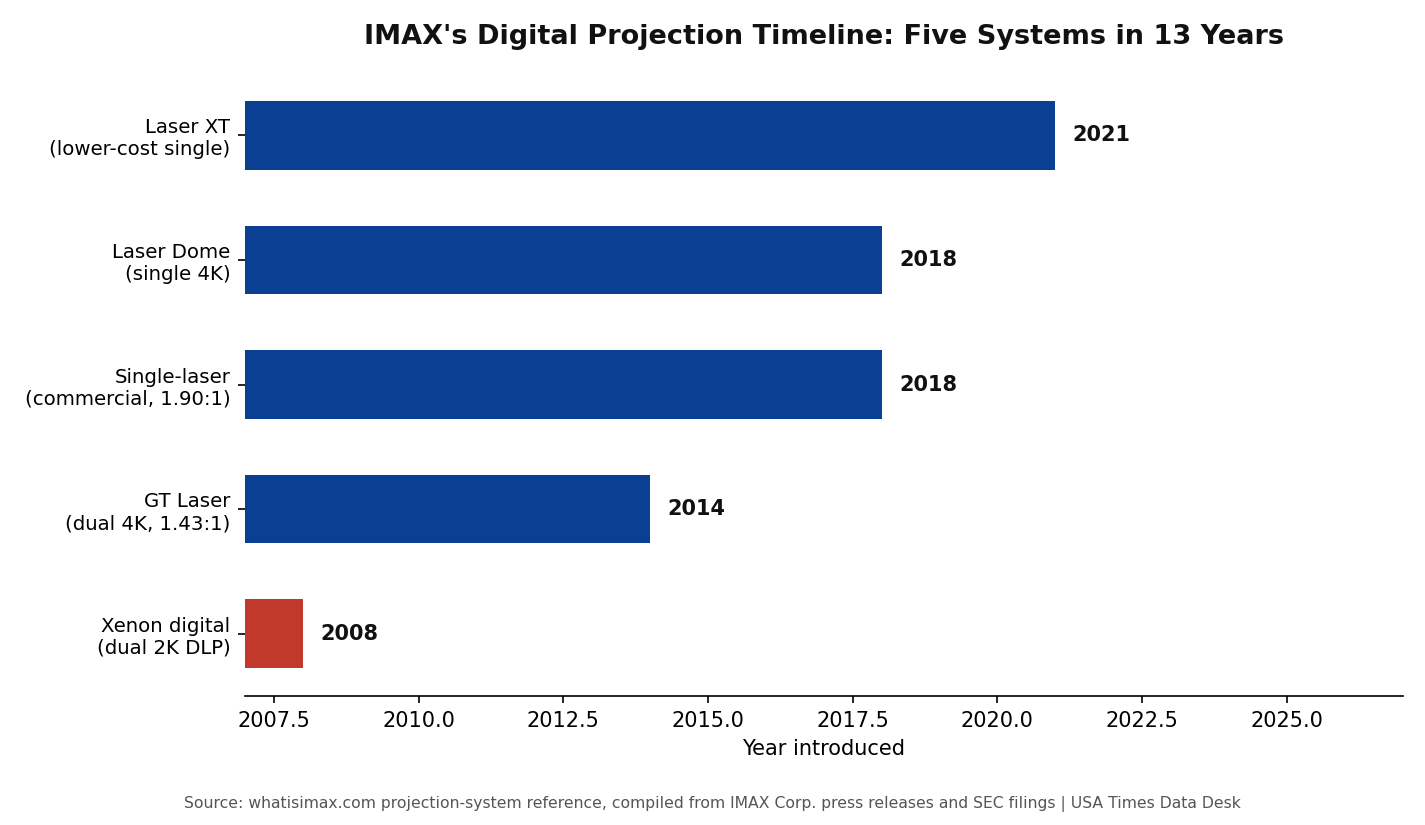
When people say a movie is “in IMAX,” they’re almost never describing the same experience. Most are watching on IMAX’s 2008-era xenon digital system — two modified 2K projectors that still make up the bulk of IMAX’s commercial network. A much smaller number are watching on GT Laser: a dual 4K laser system built specifically for IMAX’s largest “Grand Theatre” screens, and the only digital configuration capable of filling the format’s full 1.43:1 frame. USA Times’ Data Desk previously mapped every true 1.43:1 IMAX theatre in the world; this piece looks at the actual hardware inside those rooms — what GT Laser is, what it replaced, and why the gap between it and standard “IMAX Digital” is bigger than most ticket buyers realize.
According to the projection-system reference site whatisimax.com — which cross-references IMAX Corporation press releases, SEC filings, and patent records — IMAX currently operates seven distinct projection configurations, ranked by the tallest picture each is capable of delivering. GT Laser sits in the second tier, just below true 15/70 film, and well above the single-laser and xenon systems that make up most of IMAX’s commercial footprint.
Two projectors, aligned on one image — not two images blended together
GT Laser, which IMAX began rolling out in December 2014, uses two separate 4K digital laser projectors whose output is precisely aligned into a single picture on screen, rather than one projector alone. That’s a meaningfully different engineering approach than most people assume: it isn’t “double the resolution” so much as two full-strength light engines working in concert to hit the brightness and contrast levels needed to fill a screen that can run seven stories tall. The system uses dual RGB laser light sources instead of the xenon arc lamps that power older IMAX digital systems, paired with IMAX’s 12-channel surround sound system.
Batmandir · Guest Passes Step inside for a day. Guest passes from $161/day — brought in by a member. See guest passes →The practical result, according to reporting on the system’s 2015 rollout, is a sequential contrast ratio above 10,000:1 — a large jump over xenon-generation IMAX digital — along with higher peak brightness and a substantially wider color gamut, letting filmmakers push more saturated, vivid color than xenon projection could reproduce. IMAX has also said GT Laser format masters can present up to 40% more picture content than a standard digital presentation, a reference to the extra vertical frame the 1.43:1 ratio captures versus the more common 1.90:1 IMAX digital frame.
67% more picture than a standard movie screen — if the film was actually shot for it
The 1.43:1 aspect ratio is IMAX’s original film ratio, dating to the format’s 1970 launch, and GT Laser is the only digital laser configuration built to reproduce it at full scale. Measured against a standard 2.39:1 scope frame — the wide, letterboxed ratio most blockbusters are shot and projected in — a full 1.43:1 IMAX frame shows roughly 67% more picture area. The more common single-laser IMAX system, installed in ordinary commercial multiplex auditoriums since 2018, tops out at 1.90:1: still about 26% more picture than scope, but nowhere near what GT Laser can deliver.
That caveat matters, because the extra picture area only shows up on screen if the film itself was mastered for it. A movie shot conventionally and simply projected on a GT Laser screen won’t fill the extra frame — it’ll show black bars top and bottom, same as it would on any other IMAX system. Only films with an actual 1.43:1 or IMAX-expanded master take advantage of the format’s full capability, which is why studios and directors who shoot specific sequences (or entire films) with IMAX cameras tend to promote that fact explicitly in marketing.
What GT Laser replaced, and what’s still running instead of it
Before GT Laser, IMAX’s flagship digital screens ran on the same xenon digital system introduced across the company’s commercial network in 2008 — two modified 2K DLP Cinema projectors, each using a xenon arc lamp, aligned to create a single combined image capped at 1.90:1. That system is still, by a wide margin, what most people are actually watching when they buy a ticket marked simply “IMAX Digital” without any further qualifier. Xenon bulbs also degrade steadily over their service life and require periodic replacement, an ongoing maintenance cost that laser light sources are designed to reduce substantially over the projector’s lifespan.
IMAX has continued layering additional laser variants on top of GT Laser since 2014: a single-projector 4K laser system for standard commercial auditoriums starting in 2018 (capped at 1.90:1, not 1.43:1), a laser adaptation for IMAX’s dome theatres the same year, and Laser XT — a lower-cost, single-projector laser configuration — starting in 2021. None of those later systems restored the full dual-projector, 1.43:1 capability that defines GT Laser specifically; they extended laser’s brightness and contrast advantages to smaller rooms without the format’s signature giant frame.
Why the terminology gets confusing at the box office
Ticket listings rarely distinguish between these tiers with any precision. A listing that says only “IMAX Digital” without the word “Laser” is very likely the 2008-era xenon system. A listing that says “IMAX with Laser” could mean either the single-projector commercial laser system (1.90:1 maximum) or the full dual-projector GT Laser configuration (1.43:1 maximum) — chains generally don’t specify which, and the terms “GT,” “Grand Theatre,” or an explicit promise of a 1.43:1 presentation are the more reliable signals that a venue has the flagship system rather than its smaller commercial cousin. For moviegoers trying to find the most capable screen near them, the room’s screen size and aspect ratio capability matter as much as whether the word “laser” appears on the ticket at all.
What we did
The projection-system tier structure, launch years, technical descriptions, and picture-area percentages in this piece come from whatisimax.com’s projection-format reference, an independent site (not operated or sponsored by IMAX Corporation) that compiles its data from IMAX Corporation press releases, SEC filings, and patent records, with sources cited on the page itself. The contrast-ratio figure (above 10,000:1 sequential) and the “40% more picture content” claim reflect contemporaneous 2015 press coverage of GT Laser’s rollout and IMAX’s own marketing language at the time; we were not able to independently verify current, up-to-date brightness and contrast specifications directly from an IMAX Corporation technical data sheet, so these figures should be read as describing the system as originally launched and reported, not necessarily its exact current calibration standard. The claim about xenon bulb maintenance costs reflects general industry reporting on the rationale for the digital-cinema industry’s broader shift to laser light sources, not a specific IMAX-published maintenance-cost figure.
Related from the USA Times Data Desk
- 39 Films in 1.43
- The National Average Movie Ticket Is $10.75. IMAX Routinely Charges Double That in New York and LA.
- IMAX Just Had Its Best Q2 Installation Quarter in a Decade. Its Backlog Grew Anyway.
- Britain’s Biggest Screen Is Selling Out Back to Front: We Checked All 159 Shows — and Every Seat Map — for ‘The Odyssey’
- Box-office coverage index · the Star Index methodology