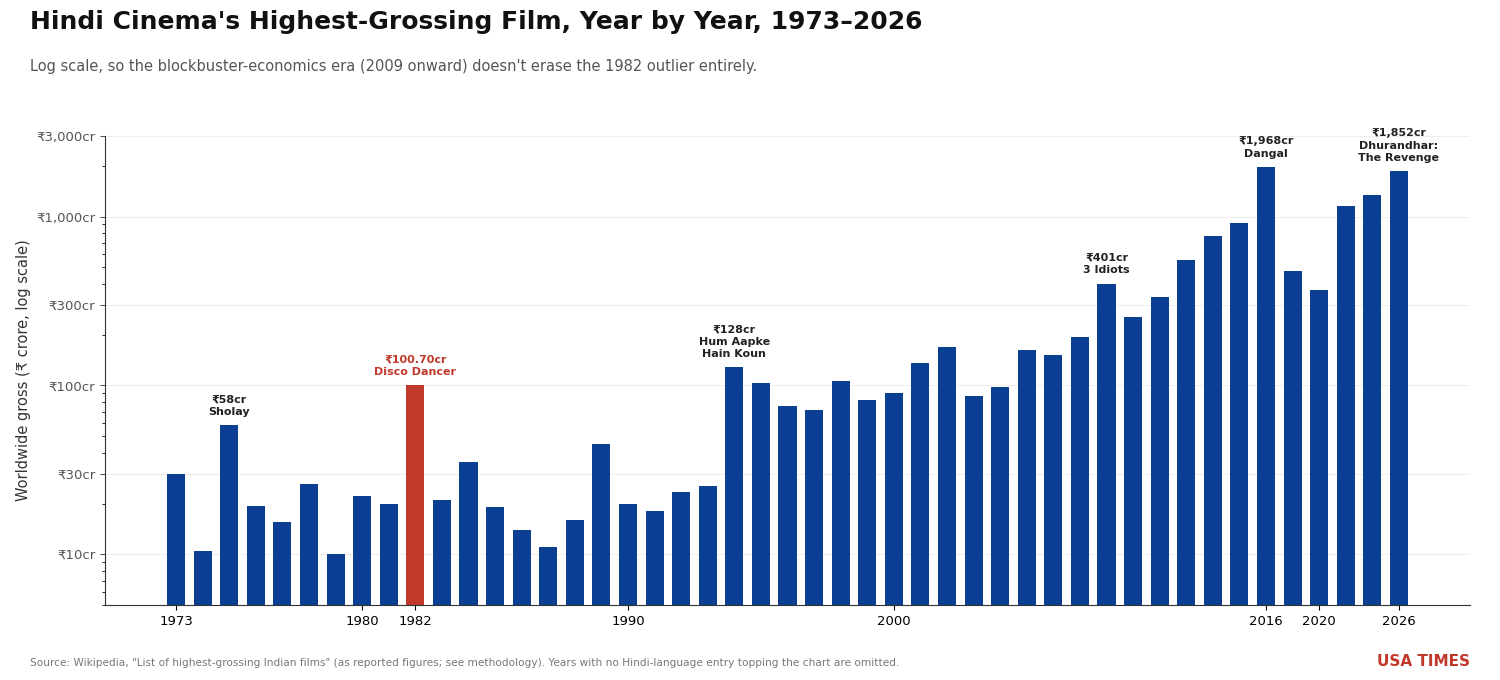
Scroll Wikipedia’s “List of highest-grossing Indian films,” down to the year-by-year table of Hindi cinema’s biggest earner, and one row breaks the pattern so hard it looks like a typo. Nineteen-eighty-two’s top film is credited with nearly double the gross of Sholay — the film most Indians would call the biggest Bollywood blockbuster ever made — and nothing else comes close to it again for twelve years.
Hindi Cinema’s Highest-Grossing Film, Year by Year — 1973 to 2026
Log-scaled bar heights, so the 1982 outlier stays visible next to the modern blockbuster era. Hover any bar for the film, year and gross.
Batmandir · Founders A numbered seat at the table. S3 · The Founders Club — 161 seats per location. By invitation. Explore membership →The film is Disco Dancer, Mithun Chakraborty’s neon-lit 1982 musical. Wikipedia’s table credits it with ₹100.70 crore (about US$106 million) worldwide. The years on either side of it — Kranti in 1981, Coolie in 1983 — are credited with ₹20 crore and ₹21 crore. Even Sholay, six years earlier, tops out at ₹58 crore. Nothing in the table reaches ₹100 crore again until Hum Aapke Hain Koun in 1994, at ₹128 crore.
That’s the kind of number that deserves a citation check, so we ran one. What we found split into two completely different stories: the number itself has a real, well-documented origin — and the footnotes Wikipedia actually attaches to it, on that specific page, are broken beyond repair.
What the citations on that table actually say
The Disco Dancer row carries two footnotes, marked [288] and [303] in the current version of the page. We pulled both. Neither has anything to do with Disco Dancer, 1982, or Bollywood box office history at all:
| Footnote | What it’s cited for | What it’s actually about |
|---|---|---|
| [288] | Disco Dancer’s ₹100.70 crore gross (also reused for 1978’s Muqaddar Ka Sikandar) | “Jatt And Juliet 3 Set To Be Biggest Punjabi Worldwide Grosser Ever” — Box Office India, July 2024 |
| [303] | Disco Dancer’s ₹100.70 crore gross | “OTT releases: List of new movies and shows to beat boredom this long weekend” — Deccan Chronicle, August 2023 |
It isn’t just Disco Dancer. We checked every footnote attached to the surrounding rows in that section of the table — 1978 through 1987 — and every single one pointed to an unrelated 2023–2026 news story about a completely different, much more recent film:
| Row it’s attached to | Footnote | What it’s actually about |
|---|---|---|
| 1981 Kranti, ₹20cr | [302] | “…India box office closes H1 2023 at Rs 4,868 crore” — Business Today, July 2023 |
| 1983 Coolie, ₹21cr | [304] | “Zara Hatke Zara Bachke to Adipurush: Know the OTT Releases for August” — News18 |
| 1985 Ram Teri Ganga Maili, ₹19cr | [306] | “Worldwide Box Office: Pushpa 2 enters the Rs. 400 crore club…” — Bollywood Hungama, Dec 2024 |
| 1986 Karma, ₹14cr | [307] | “Dhurandhar 2 worldwide box office collection day 1: ₹240 crore start…” — Hindustan Times, March 2026 |
| 1987 Hukumat, ₹11cr | [308] | “Dhurandhar 2 craze peaks…” — The Economic Times, March 2026 |
This has the signature of a very common, very boring Wikipedia failure mode, not a conspiracy: on a page with hundreds of bare, unnamed <ref> tags, inserting or removing a citation anywhere earlier in the article shifts every footnote number that comes after it. If the table’s numbers were hand-typed against an older version of the reference list rather than generated dynamically, a single edit upstream — say, someone adding sourcing for Dhurandhar 2‘s 2026 opening weekend — can quietly detach dozens of older rows from their real sources and reattach them to whatever now happens to sit at that footnote number. The visible number in the table doesn’t change. The citation underneath it silently does.
So is the number fake?
Not necessarily — and this is the part that surprised us. Wikipedia’s own dedicated Disco Dancer article carries a separate, properly sourced box office breakdown that lands almost exactly on the disputed figure:
- Domestic (India): ₹6.4 crore, cited to Monthly Commentary on Indian Economic Conditions, Vol. 28, Indian Institute of Public Opinion, 1986 — a real, contemporaneous print source.
- Overseas (Soviet Union): 60 million roubles — converted at the era’s exchange rate (cited to an archived Bank of Russia historical rate table and an RBI publication) to roughly US$75.85 million, or about ₹94.28 crore.
Add the two territories together — ₹6.4 crore domestic plus roughly ₹94.28 crore from the Soviet Union — and you land at almost precisely the ₹100.70 crore the highest-grossing-films table reports, via completely different footnotes than the broken ones we found. The number appears to be real. It’s just cited to the wrong evidence on the page where the user found it.
The Soviet Union number is the whole story
Disco Dancer‘s domestic Indian gross — ₹6.4 crore — is unremarkable for 1982; it’s in line with, or below, several other films in the table. Every bit of the outlier comes from one place: the film’s release in the Soviet Union in 1984, where Mithun Chakraborty became, by multiple independent accounts, a genuine mainstream celebrity. Contemporary and retrospective coverage describes packed Soviet theatres for weeks, and the film is widely reported as one of the highest-grossing foreign releases in Soviet box office history.
That said, the exact scale varies by source in a way that’s worth being upfront about. Different retellings over four decades cite the USSR run at anywhere from roughly 60 million to 120 million tickets sold, and gross figures that range from roughly $75 million to $198 million depending on which currency conversion, which year’s exchange rate, and which inflation adjustment is used. Soviet state cinema distribution in the 1980s wasn’t audited by any outside box-office tracker the way modern releases are — there was no Indian or Western equivalent of today’s studio-reported opening-weekend numbers. The core claim — that Disco Dancer was a colossal, record-setting hit in the USSR — is corroborated across independent sources and grounded in archival exchange-rate data. The precise crore figure is a calculation built on top of that, not an audited receipt.
The Reddit corroboration — and one detail that sharpens the comparison
The Soviet Union figure has been independently kicked around for years on Reddit, where the numbers converge on roughly the same range we found elsewhere: threads in r/bollywood put the USSR run at 120 million tickets sold and a gross of about $75 million (roughly $198 million adjusted for inflation), describing it as the highest-grossing foreign film in Soviet box office history. A companion thread in r/AskARussian, where the audience is presumably closer to the source, backs the broad claim without treating it as some kind of fluke — one highly upvoted answer calls Disco Dancer “maybe a pinnacle” of Indian cinema’s Soviet popularity but “definitely not an outlier,” pointing to a run of other Bollywood films (Awaara, Mera Naam Joker, Bobby) that also charted among the USSR’s all-time highest grossers.
One comparison from that discussion is worth pulling out on its own: 120 million Soviet ticket sales — about 12 crore — is a bigger footfall number than Sholay managed even domestically in India, where it stands as the only Hindi film reported to have crossed 12 crore admissions at home. Whatever the exact final figure, the shape of the claim holds up under independent, crowd-sourced scrutiny: this wasn’t a modest overseas release someone rounded up. It was, by every account we could find, a genuinely enormous one.
What we did
We pulled the live text and HTML of Wikipedia’s “List of highest-grossing Indian films,” isolated the Hindi-films-by-year table, and extracted every footnote number attached to the 1978–1987 rows. For each footnote, we located its corresponding entry in the page’s reference list and read the actual cited source — title, publication, and date. We then separately checked the dedicated Disco Dancer Wikipedia article’s own box-office table and its footnotes, and searched independent entertainment-press and historical coverage of the film’s Soviet Union release to see whether the ₹100-crore-plus claim is corroborated outside Wikipedia. It is, in outline; the specific figure is not independently audited.
This is a live Wikipedia article and can change at any time; the citation numbers and mismatches described here reflect the version we reviewed. We did not edit the Wikipedia page ourselves.
Related from the USA Times Data Desk
- The Star Movies of 2024: Every Film That Took Over a Week at the Box Office
- The Star Movies of 2026, So Far (Updated Weekly)
- The Star Movies of the Last 20 Years: The Complete USA Times Index
- The Star Movies of 2025: Every Film That Took Over a Week at the Box Office
- Box-office coverage index · the Star Index methodology
Sources
- Disco Dancer (1982) — Wikipedia
- List of highest-grossing Indian films — Wikipedia
- USA Times — Star Index methodology & data sources