Read in: English · Español · Русский · 中文 · Português
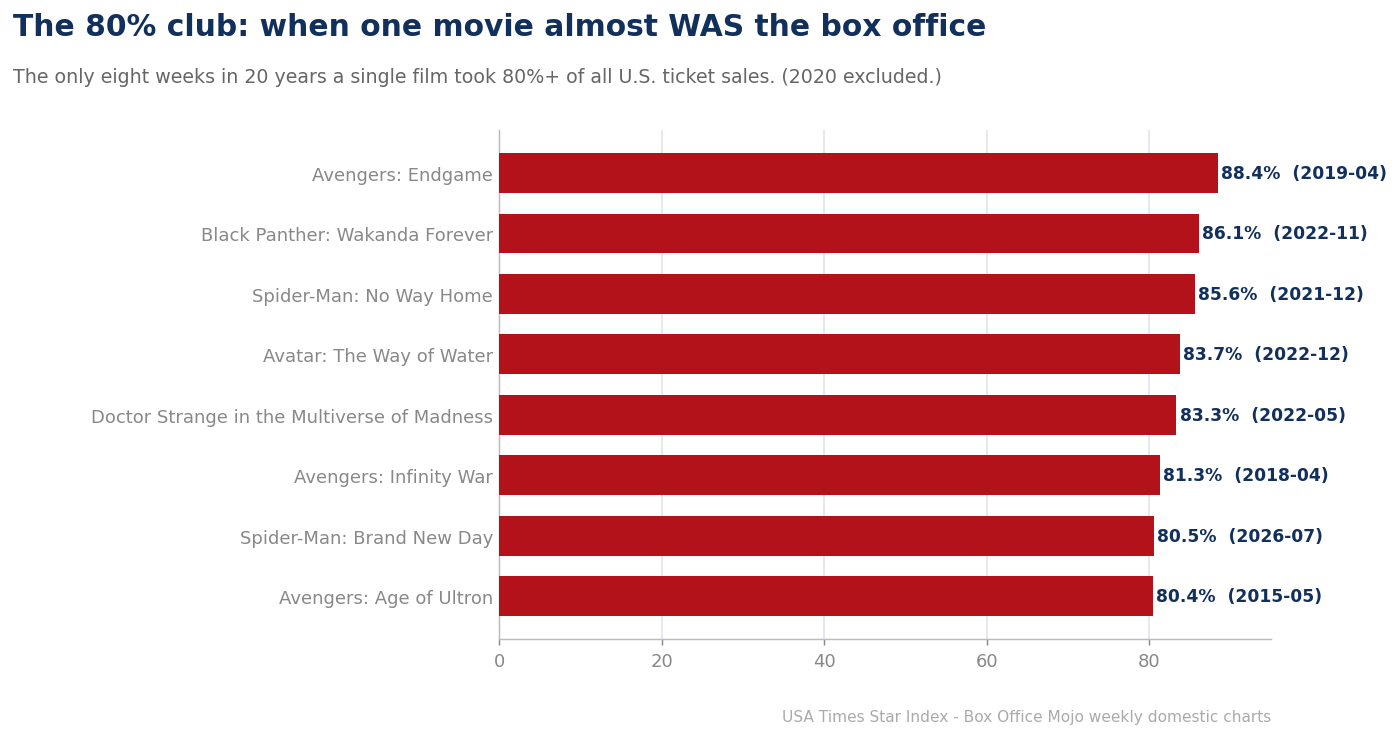
On a handful of extraordinary weekends, one movie hasn’t just led the box office — it has very nearly been the box office. In twenty years and more than a thousand weeks, only eight times has a single film taken 80% or more of all U.S. domestic ticket sales in a week. Every one of them is a superhero or event spectacle, and the list reads like a roll call of the biggest openings of the century.
The record: Endgame’s 88%
The most dominant week ever recorded belongs to Avengers: Endgame, which in late April 2019 took a scarcely believable 88.4% of the entire American box office. For one week, essentially nine of every ten dollars spent at U.S. theaters went to a single film — a level of concentration that would be a rounding error for the entire rest of the market. It is the high-water mark of the blockbuster era, and it may stand for a long time.
Batmandir · The Circle Full access to theatres, museums & exhibitions. S2 · ongoing membership, without a Founder’s seat. Explore membership →A Marvel-and-Avatar monopoly
The rest of the club is nearly as exclusive. Black Panther: Wakanda Forever (86%), Spider-Man: No Way Home (86%), Doctor Strange in the Multiverse of Madness (83%), Avengers: Infinity War (81%), Avengers: Age of Ultron (80%) and 2026’s Spider-Man: Brand New Day (81%) mean Marvel Studios accounts for the large majority of all 80%+ weeks in history. The only non-Marvel member is Avatar: The Way of Water (84%), James Cameron’s 2022 juggernaut. No comedy, no drama, no original property has ever come close — the 80% threshold is the exclusive preserve of the pre-sold, globe-conquering franchise event.
| Film | Week | Share |
|---|---|---|
| Avengers: Endgame | Apr 2019 | 88.4% |
| Black Panther: Wakanda Forever | Nov 2022 | 86.1% |
| Spider-Man: No Way Home | Dec 2021 | 85.6% |
| Avatar: The Way of Water | Dec 2022 | 83.7% |
| Doctor Strange: Multiverse of Madness | May 2022 | 83.3% |
| Avengers: Infinity War | Apr 2018 | 81.3% |
| Spider-Man: Brand New Day | Jul 2026 | 80.5% |
| Avengers: Age of Ultron | May 2015 | 80.4% |
What an 80% week actually means
A film taking 80% of a week is a genuinely strange economic event. It means every other movie in wide release — a dozen or more titles, some of them substantial in their own right — is collectively splitting the remaining fifth of the market. Theater owners effectively turn their entire operation over to one film; competing releases either flee the date entirely or accept being crushed. These weeks are the purest expression of the winner-take-all box office, the moments when the market stops being a marketplace and becomes, briefly, a monopoly.
That the club has admitted new members as recently as 2026 — Spider-Man: Brand New Day — suggests the phenomenon isn’t fading. If anything, as studios concentrate ever more resources into a handful of guaranteed events, the 80% week may become slightly less rare. But 88% remains the ceiling, and Endgame remains the film that came closest to owning an entire week of American moviegoing outright.
The near-misses
Just outside the 80% club sits a cluster of films that came within a point or two — the high-70s weeks posted by titles like the biggest Star Wars openings and other Marvel entries. The 80% line is somewhat arbitrary, but it captures a real psychological threshold: the point at which a single film isn’t merely dominating the box office but has effectively become it, with every other release reduced to a rounding error. That so few films clear it — eight in over a thousand weeks — is a reminder of how rare true total domination is, even in the franchise era.
What happens to everything else
An 80% week is defined as much by absence as by presence. When one film takes four of every five dollars, the dozen-plus other titles in wide release are collectively fighting over the remaining fifth — and most studios simply refuse the fight. The weekends around a known 80%-caliber opening are among the emptiest on the calendar, as competitors flee to safer dates rather than be crushed. The giant doesn’t just win its week; it warps the entire schedule around itself, clearing a buffer of soft weekends on either side. The 80% club is therefore also a map of the box office’s biggest dead zones.
A superhero-shaped record book
That seven of the eight members are superhero films — six of them Marvel Studios releases — is the single clearest statistic on how thoroughly one genre and one studio have defined the extreme top of the market. The lone exception, Avatar: The Way of Water, is itself a once-a-decade event from a singular filmmaker. No comedy, animated film, horror title, or original drama has ever taken 80% of a week; the threshold is reserved entirely for pre-sold, globally marketed spectacle. If you want a one-line summary of what the blockbuster era rewards above all else, the membership list of the 80% club is it.
Is the club still growing?
The most recent inductee, Spider-Man: Brand New Day, joined in July 2026 — evidence that total-domination weeks are not a relic of a passing moment but an ongoing feature of a consolidating market. As studios pour ever more resources into a shrinking number of guaranteed events, the conditions that produce an 80% week — one overwhelming film against a thin field — recur more readily than they once did. What almost certainly won’t change is the ceiling: Endgame’s 88.4% represents very nearly the maximum a single film can take when a handful of other releases still exist at all. It is as close as the American box office has ever come to a one-film week.
The number that won’t move
Endgame’s 88.4% is very likely the practical ceiling for a single film’s weekly share, and the reason is arithmetic. Even when one film utterly dominates, a dozen other titles remain in wide release — holdovers, specialty films, kids’ matinees — and they will always collectively claim several percentage points of the market simply by existing. To reach 90% or beyond, a film would essentially need the rest of the theatrical ecosystem to go dark, which only happened, briefly and abnormally, during the 2020 shutdown we exclude from these counts. In a functioning market, the high-80s is the edge of the possible, and only one film has ever pressed against it.
That is what makes the 80% club such a meaningful boundary. It is not an arbitrary round number but a real frontier — the zone where a film stops competing in the market and briefly becomes the market. Eight times in twenty years, one movie got there. Each was a globally pre-sold event, each cleared the field around it, and each is remembered as a cultural moment precisely because it swallowed a week of American moviegoing almost whole. The club is small by design; the economics of a functioning box office make sure of it.
What we did: We pulled every week in which the No. 1 film’s share of the total domestic box office reached 80% or higher and ranked them. Weekly share is each film’s gross as a percentage of that week’s total U.S. domestic box office, from Box Office Mojo’s weekly charts, 2006–2026. We exclude 2020 as a pandemic anomaly.
Related from the USA Times Data Desk
Sources
- Box Office Mojo — weekly and weekend box office grosses
- The Numbers — historical domestic box office records
- USA Times — Star Index methodology (how our tiers and box-office share are computed)