For thirty years, “video-game movie” was a punchline — shorthand for a film that would be critically savaged, commercially disappointing, and quietly forgotten. The curse was real and it was long. Then, sometime around the end of the last decade, it broke. Measure video-game adaptations the way the USA Times Star Index measures every film — by the share of the entire week’s box office they command — and the arc is unmistakable: the genre that couldn’t buy a hit now produces some of the most dominant films in the market.
From punchline to phenomenon
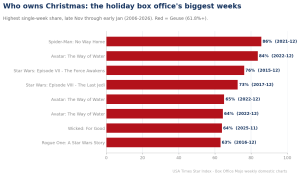
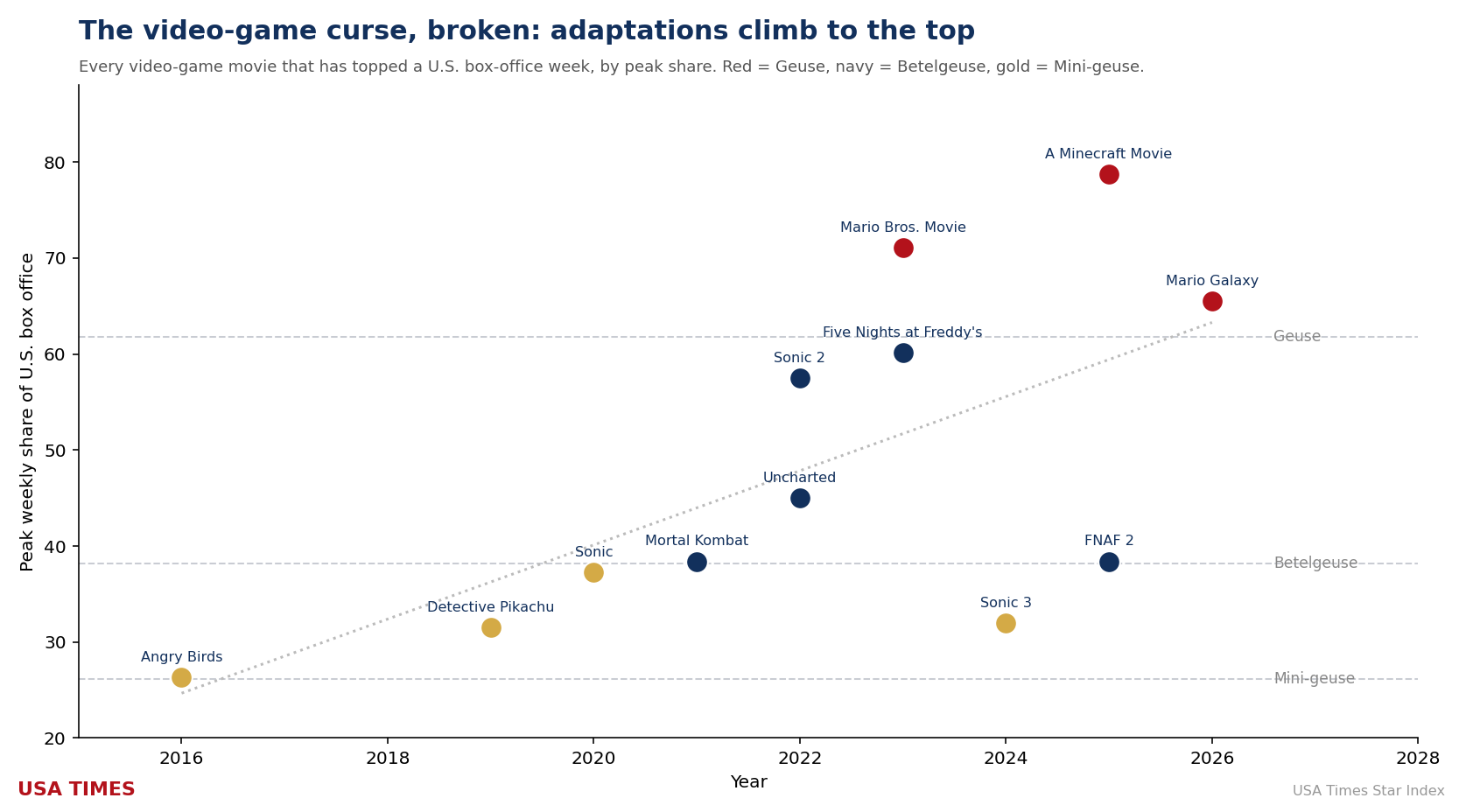
The turning point is easy to date. As recently as 2016, The Angry Birds Movie could only scrape a 26.3% week — barely a Mini-geuse, the lowest rung of star status. Detective Pikachu nudged higher in 2019, the first Sonic higher still in 2020. Then the ceiling simply lifted. Sonic 2 took 57.5% of its week in 2022, a strong Betelgeuse. In 2023, The Super Mario Bros. Movie took 71.1% — a Geuse, one of the most dominant weeks any film managed that year. In 2025, A Minecraft Movie went further still, to 78.7%. And in 2026, The Super Mario Galaxy Movie reached 65.5%. A category that could not clear the lowest bar a decade ago now routinely produces the highest kind of domination the index measures.
What actually changed
The old failures shared a diagnosis: they treated the game as a plot to be adapted rather than a world to be honored. Early adaptations bent beloved properties into generic action films, alienating the built-in audience without winning a new one. The modern hits inverted that. They are made for the fans first — faithful to the look, the tone, and the texture of the source — and trust that fidelity to travel outward to everyone else. Crucially, most of the recent winners are animated or family-friendly, which aligns them with the single most reliable format at the box office: the four-quadrant film that parents will take children to see two and three times. A faithful game world rendered as a bright, communal, big-screen event turns out to be a nearly ideal box-office product.
Batmandir · Founders A numbered seat at the table. S3 · The Founders Club — 161 seats per location. By invitation. Explore membership →The one that started the money, and the one that proved it
Two films bookend the shift. The first Sonic the Hedgehog is the quiet hinge: after fan backlash forced the studio to famously redesign the character before release, the film arrived faithful and was rewarded, and every studio sitting on a game license took notice. The Super Mario Bros. Movie is the proof: a Geuse-level phenomenon that demonstrated a game adaptation could not merely succeed but dominate, owning better than seven of every ten dollars spent at the movies in its opening week. Once that was possible, the category stopped being a gamble and became a strategy. The result is a pipeline of adaptations arriving with real budgets, real craft, and real box-office expectations — a complete reversal from the direct-to-bargain-bin era.
Where the ceiling is
Not every adaptation is a Geuse, and the data is honest about that. Sonic 3 settled back to a 32% Mini-geuse in 2024; the live-action horror route, as with Five Nights at Freddy’s, produces solid Betelgeuses rather than towering Geuses. The pattern suggests the very top of the range belongs to the big animated family tentpoles — the Marios and Minecrafts — while live-action and more niche titles land a rung or two lower. That is not failure; a Betelgeuse is a film owning nearly half its week. It simply means the genre now has a full spread of outcomes, from respectable to overwhelming, rather than a single tragic one.
The larger point is that the “video-game curse” was never a curse at all — it was a craft problem, and the craft caught up. The audience was always there; the games are, after all, among the most popular entertainment on earth. What was missing was the willingness to treat that audience’s affection as an asset rather than an obstacle. Now that studios have learned the lesson, expect the trend line to keep climbing. The next great box-office phenomenon is at least as likely to come from a console as from a comic book — and on the evidence of the last five years, it is likely to be a Geuse.
Why the format matters as much as the franchise
It is worth dwelling on how much of this success is animation. The biggest game adaptations — Mario, Minecraft, the animated Sonic films — are family tentpoles, and family tentpoles have a structural box-office advantage no live-action film can match: repeat viewing. A child does not see a film once; a child sees it three times, and brings a different adult each time. That multiplier is why animated four-quadrant films so reliably reach Geuse territory, and why a game with a bright, recognizable, kid-friendly world is sitting on a near-perfect box-office premise before a frame is shot. The games supplied the built-in awareness; animation supplied the repeat business. Together they produce the kind of concentrated, weeks-long domination that used to belong almost exclusively to superheroes.
This also explains why the live-action adaptations, for all their success, sit a rung lower. Uncharted and Mortal Kombat were solid Betelgeuses; Five Nights at Freddy’s turned a horror-game property into a real hit. But live-action skews older, sees less repeat business, and competes directly with every other action and horror film for the same adult audience. The animated route competes for families, a lane with far less crowding and far more repeat value. If a studio wants not just a hit but a Geuse, the data points clearly at the same recipe: a beloved game world, rendered in animation, aimed at every age at once, released as an event. It is not a coincidence that the two highest-scoring adaptations in the index — Mario and Minecraft — both check every one of those boxes.
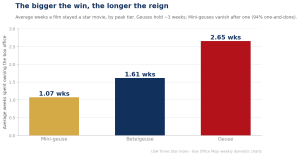
Method: peak weekly share is each film’s highest single-week share of the entire U.S. domestic box office, from Box Office Mojo weekly charts via the USA Times Star Index. Status bands: Mini-geuse 26.18–38.2%, Betelgeuse 38.2–61.8%, Geuse 61.8%+.