The question is no longer whether to see a movie. It is where. For the first time in a century of cinema, nearly every film is available two ways — in a theater now, or on a couch soon — and the choice between them has quietly become the most important decision a moviegoer makes. Get it right and a film becomes an event you remember for years. Get it wrong and you either waste a night out on something that plays fine at home, or you shrink a masterpiece down to the size of a laptop and wonder what the fuss was about.
The one question that decides it
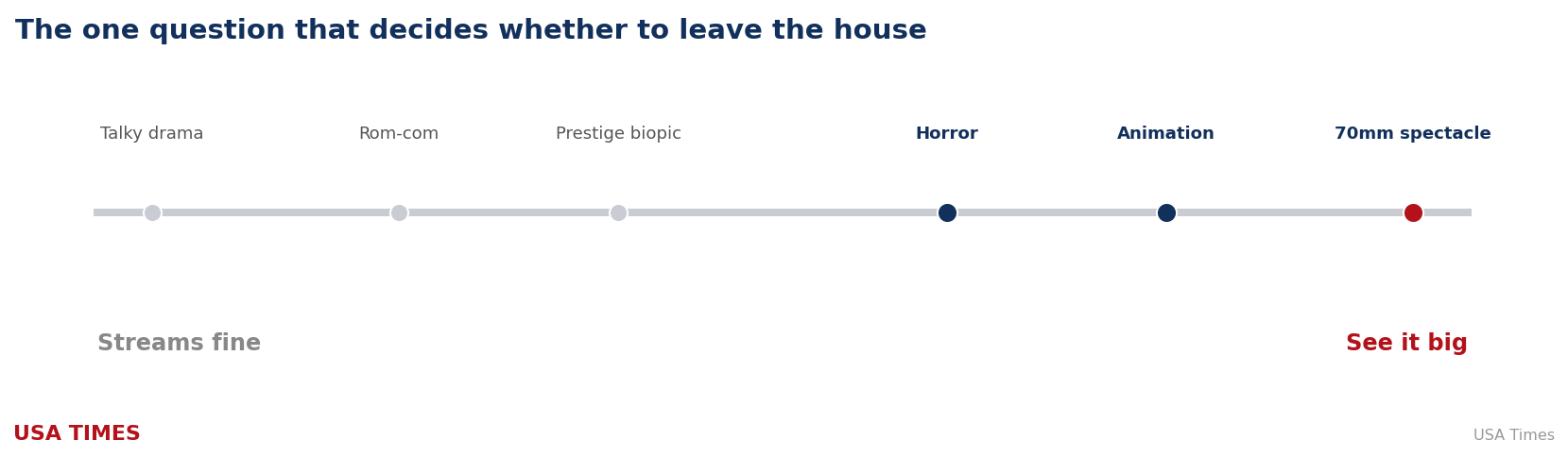
There is a single, reliable test for whether a film is worth leaving the house for, and it is not quality. Plenty of great films — the sharp two-hander, the talky drama, the prestige biopic — lose almost nothing on a good television. The test is whether the movie’s power depends on scale: on an image bigger than you, a sound field that surrounds you, a room of strangers reacting at the same instant. A film built on those things collapses at home, because the very effect that makes it work cannot fit through a 55-inch screen. A film that isn’t built on them travels perfectly well to your living room. The trip to the theater is justified not by how good the movie is, but by how much of it you would lose by watching it small.
What the box office already knows
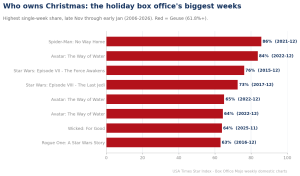
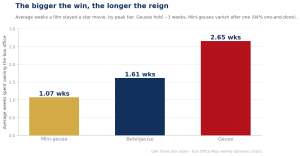
The market has been answering this question for years, and its answer is unambiguous. The films that dominate whole weeks of the box office — the ones our index calls Geuses, taking 61.8% or more of everything spent in a week — are almost entirely spectacle: superhero finales, animated sequels, effects-driven epics. These are films engineered to be unmissable on the biggest screen, and audiences reward them precisely because the big-screen version is the real version. At the other end, the films that thrive on streaming are the mid-budget dramas and comedies that never needed a theater to land. The box office isn’t measuring which films are best. It is measuring which films you have to leave the house to experience — and those are an increasingly specific kind of movie.
Batmandir · The Circle Full access to theatres, museums & exhibitions. S2 · ongoing membership, without a Founder’s seat. Explore membership →The three tiers of a big-screen film
Not every theatrical film demands the same theater. At the top sit the format films — movies shot in true IMAX or 70mm, where the image itself is part of the art and only a few dozen screens on Earth can show them at full size. These are worth planning a trip around, even traveling for. In the middle are the spectacle films that reward a premium large-format screen and a strong sound system but don’t require a specific rare venue — the blockbusters that are simply better big. And at the base are the communal films: horror and comedy, where the value is less the image than the audience, the collective jump and the shared laugh that a solitary living room can never reproduce. Match the film to the room, and every kind of big-screen movie has its ideal way to be seen.
Why getting it right matters more now
In the old world, this calculus didn’t exist: if you wanted to see a film at all, you went to a theater, full stop. Now that nearly everything comes home eventually, the trip has to earn itself — and that is actually good news for the movies. It means the films that still fill theaters are the ones that genuinely reward the effort, and the evening you spend on them is an evening you chose rather than defaulted into. The moviegoers getting the most out of the current era are not the ones who see everything on the big screen, nor the ones who see nothing. They are the ones who have learned to tell the difference: to save the trip for the films that need it, and to let the rest come to them.
The trap of the “wait for streaming” reflex
The most common mistake now is not overspending on tickets — it is defaulting to “I’ll catch it at home” for films whose entire reason to exist is the big screen. A spectacle seen small is not the same film minus some resolution; it is a genuinely diminished work, because the scale that carried its best sequences has been removed. People walk away from a shrunken epic convinced it was overrated, when what they actually experienced was an abridgment. The reflex to wait feels thrifty, but for the right kind of film it is the opposite of a bargain: you have spent two hours on a version that was never going to work, and concluded the film failed when the format did.
The discipline, then, cuts both ways. Be ruthless about letting the intimate films come to you — there is no virtue in dragging a quiet drama onto a giant screen it doesn’t need. But be equally ruthless about protecting the spectacle: when a film is built for scale, see it at scale or don’t judge it at all. Treat the choice of where as seriously as the choice of what, and the modern glut of options stops being a source of paralysis and becomes what it should be — a way to give every film the room it was made for.
So the next time a film arrives with the choice attached, run the test. Ask not whether it’s good, but whether its power lives in its size. If it does — if it’s built on an image bigger than you, or a crowd around you, or a format your television cannot reproduce — then it is one of the films worth leaving the house for, and it will repay the evening many times over. If it doesn’t, let it wait for the couch, and spend the night out on something that couldn’t survive there. The big screen didn’t lose to streaming. It just got more selective about what it’s for.