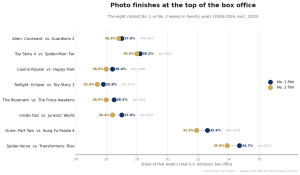
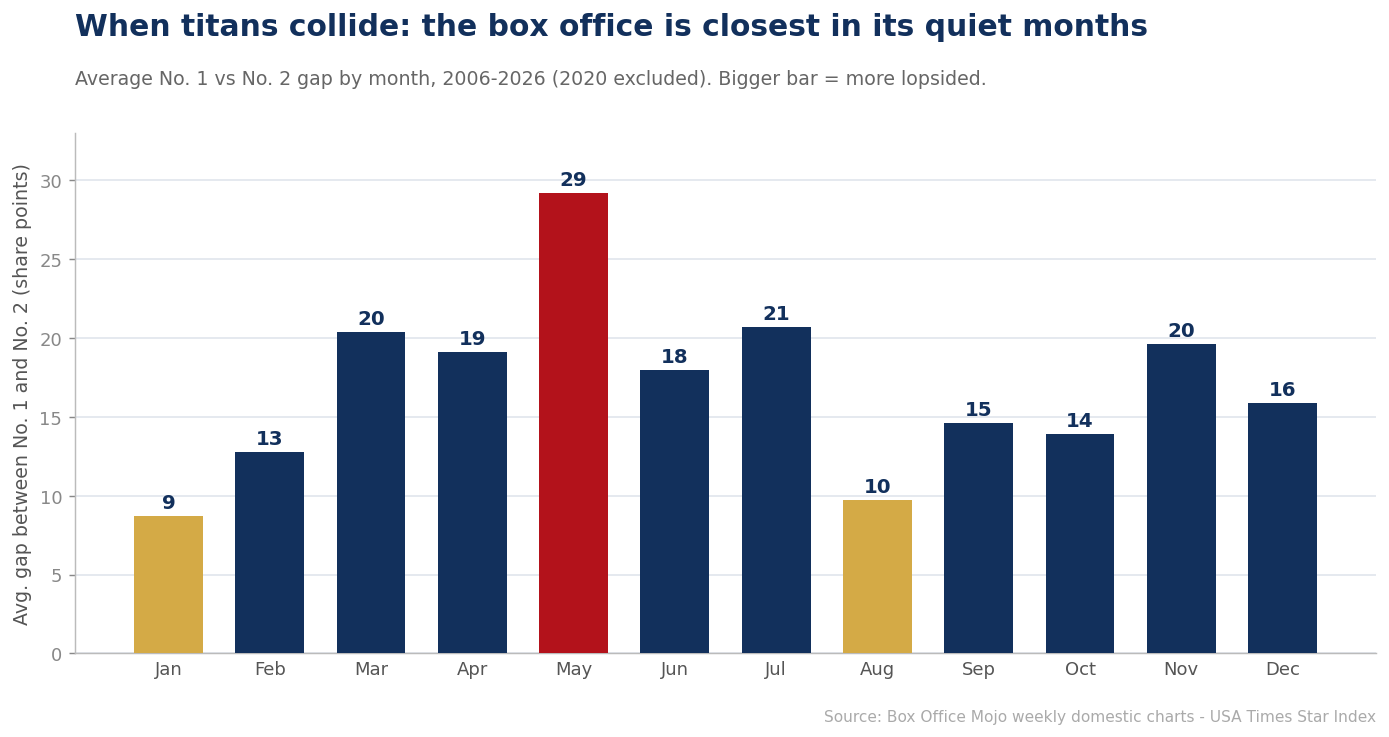
When is the U.S. box office actually a fight? The instinct is to say summer — all those tentpoles stacked on top of each other. The data says the opposite. We measured the gap between the No. 1 and No. 2 film every week for twenty years, then averaged it by month. The most lopsided month, by far, is May: the No. 1 film beats No. 2 by an average of 29 share points. The closest months are the quiet ones — January (a 9-point gap) and August (10).
The giants don’t compete — they clear the room
The pattern makes sense once you see it. When a true event film opens — Avengers in late April, a Pixar or a Star Wars in the summer corridor, a Thanksgiving juggernaut in November — it doesn’t so much beat the competition as vaporize it. Those months (May, July, March, November) post the widest gaps precisely because one film is taking 60–90% of the market and everything else is fighting over scraps. The blockbuster season is the least competitive time at the top of the chart.
The real contests happen in the off-season. January, February and August — the so-called dump months — are when no single film is big enough to run away, so two mid-sized releases end up separated by a point or two. If you want to see an actual photo finish at the box office, don’t look at the Fourth of July. Look at a cold weekend in January.
Why it matters for release strategy
For a studio, the chart is a map of where oxygen exists. Drop a modest film into May and it will likely be buried under a giant; drop the same film into late January and it can plausibly win a weekend outright. That is why counter-programming clusters in the gaps — and why the “quiet” months quietly mint a surprising number of one-week champions.
Related from the USA Times Data Desk
- The Perpetual Runner-Up: Twenty Years of No. 2 at the Box Office
- The Box-Office Calendar: The Months Movies Take Over
- Box-office coverage index