Dominating the box office and making money are not the same question. A film can own a week and still lose its studio a fortune; another can barely scrape into the rankings and return fifty times its cost. So we asked a simple thing of the USA Times Star Index: across twenty years, does climbing the tiers — from a one-week Mini-geuse to a market-swallowing Geuse — actually pay?
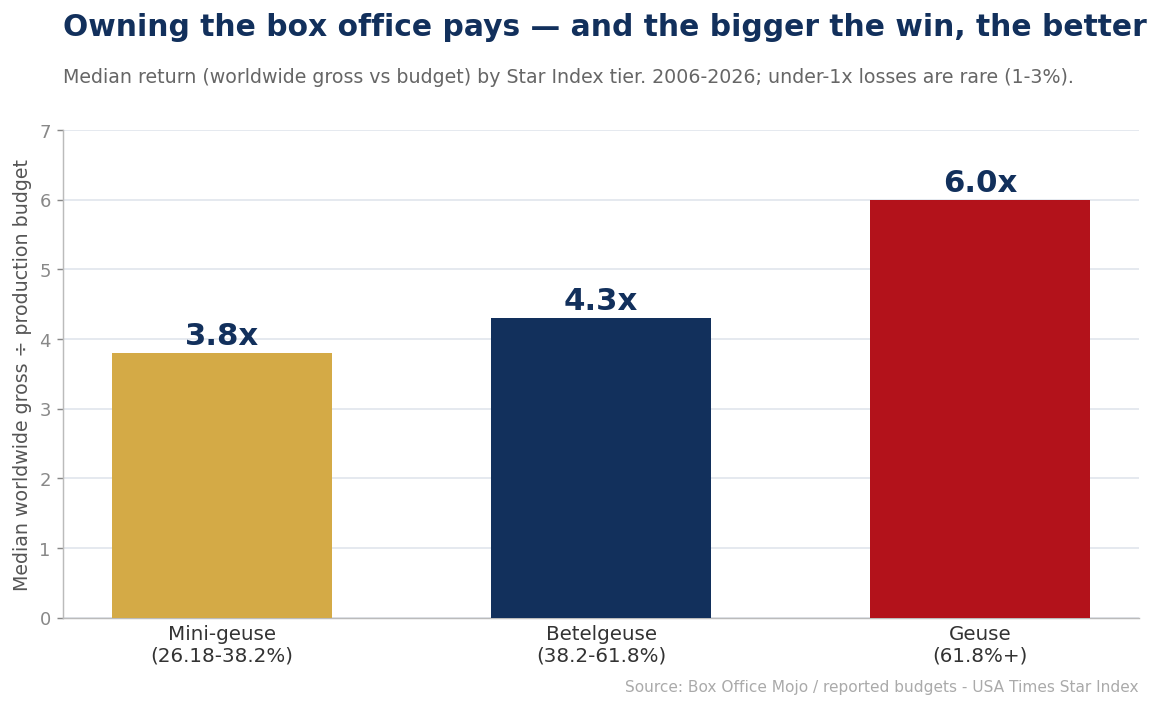
The short answer: yes, and cleanly. The median film’s worldwide gross runs 3.8× its production budget at the Mini-geuse tier, 4.3× at Betelgeuse, and 6.0× at Geuse. The bigger the win, the better the return — and outright losses are vanishingly rare at every level (just 1–3% of qualifying films returned less than their budget).
But the single most profitable films aren’t the biggest
Here is the twist. While the median return rises with the tier, the most efficient films in the entire index are cheap originals that never reached the top tier at all. Micro-budget horror dominates the leaderboard: Paranormal Activity 2 turned $3M into $177M — a 59× return — and Get Out turned $5M into $260M. The highest-grossing Geuses make more money in absolute terms, but on a per-dollar basis, nothing beats a $5M scare that catches fire.
| Film | Tier | Budget | Worldwide | Return |
|---|---|---|---|---|
| Paranormal Activity 2 | Mini-geuse | $3M | $177M | 59× |
| Get Out | Mini-geuse | $5M | $260M | 52× |
| Paranormal Activity 3 | Betelgeuse | $5M | $207M | 41× |
| Demon Slayer: Mugen Train | Betelgeuse | $20M | $803M | 40× |
| Split | Mini-geuse | $9M | $279M | 31× |
What it means
Two truths sit side by side. If you want the surest strong return, make the biggest film you can — Geuses almost never lose and typically sextuple their budget. If you want the highest return, make something tiny and terrifying and pray it becomes a phenomenon. The studios chasing tentpoles and the ones chasing $5M horror are, in their own ways, both reading this chart correctly. (A caveat: these figures exclude marketing, which is largest for the biggest films — so the real profit gap between a lean horror hit and a $200M tentpole is wider than the multiples alone suggest.)
Related from the USA Times Data Desk
- The Efficiency Champions: How Cheap Horror Owns the Box Office
- The Billion-Dollar Club, Ranked
- The Star Index methodology