Every box-office story is told from the top. The weekend winner gets the headline, the victory-lap tweet, the line in the studio’s annual report. Almost nobody writes down who came second. But second place has its own twenty-year history — a graveyard of great films that opened in the wrong week, and a handful of blockbusters so dominant they never let anyone near them. We logged the No. 2 film for all 1,026 weeks of the USA Times Star Index outside the pandemic year of 2020. Here is what the runner-up spot reveals.
Half of all runner-ups never win
Across those 1,026 weeks, 816 different films have taken second place at the U.S. box office. Barely half of them — 406 — never once stood at No. 1 in any week of their entire run. For comparison, only 665 distinct films ever reached No. 1 at all. Second place, it turns out, is where most of the industry lives: close enough to the crown to see it, never close enough to wear it.
The reason is timing, not quality. A film can open to a huge number and still lose its week — because something bigger opened the same Friday. The runner-up column is a record of collisions.
The perpetual bridesmaids
The clearest example is the summer of 2023. Oppenheimer spent four separate weeks at No. 2 and never led a single one — because Barbie sat immovably above it the entire time. Christopher Nolan’s film grossed nearly a billion dollars worldwide and won Best Picture; in the weekly U.S. ledger, it is a four-time runner-up with a crown count of zero. Barbenheimer was, for the Star Index, a story about one film blocking another for a month.
It is not alone. These are among the most recognizable films that reached No. 2 — some of them repeatedly — without ever topping a single week:
| Film | Weeks at No. 2 | Peak weekly share |
|---|---|---|
| A Star Is Born (2018) | 4 | 26.1% |
| Oppenheimer (2023) | 4 | 26.0% |
| Sing 2 (2021) | 4 | 19.6% |
| Puss in Boots: The Last Wish (2022) | 4 | 17.1% |
| Nobody (2021) | 3 | 21.3% |
| Sherlock Holmes (2009) | 3 | 20.2% |
| Elemental (2023) | 3 | 19.0% |
| Kingsman: The Secret Service (2015) | 3 | 17.0% |
Notice the pattern: family and animated titles dominate the list. Films like Sing 2 and Puss in Boots: The Last Wish have long, gentle legs — they hold the No. 2 spot for weeks while the No. 1 slot churns through louder openings above them. A great runner-up isn’t a flop. It’s a film that refused to fall off, just never got a clear Friday of its own.
When No. 1 laps the whole field
Most weeks aren’t close at all. The average weekly winner takes 32.6% of all domestic box office; the average runner-up takes just 15.7%. In more than a third of all weeks — 38% of them — the No. 1 film grossed at least twice as much as No. 2. When a true Geuse opens, second place becomes a rounding error:
| Week | No. 1 film (share) | No. 2 film (share) |
|---|---|---|
| Apr 2019 | Avengers: Endgame — 88% | Captain Marvel — 2% |
| Nov 2022 | Black Panther: Wakanda Forever — 86% | Black Adam — 4% |
| Dec 2021 | Spider-Man: No Way Home — 86% | Sing 2 — 3% |
| Dec 2022 | Avatar: The Way of Water — 84% | Black Panther: Wakanda Forever — 4% |
| May 2022 | Doctor Strange: Multiverse of Madness — 83% | The Bad Guys — 4% |
| Apr 2018 | Avengers: Infinity War — 81% | A Quiet Place — 4% |
Endgame’s opening week is the most lopsided in the entire twenty-year record: it took 88 cents of every box-office dollar in America, leaving everything else — combined — to fight over the rest.
Photo finishes
At the other extreme are the weeks decided by a whisker. The tightest of all came in May 2017, when Alien: Covenant edged Guardians of the Galaxy Vol. 2 by one-tenth of a percentage point of the market. A month later, Toy Story 4 beat Spider-Man: Far From Home by two-tenths. These are the weeks where the crown could have gone either way — and where the runner-up has every right to feel robbed.
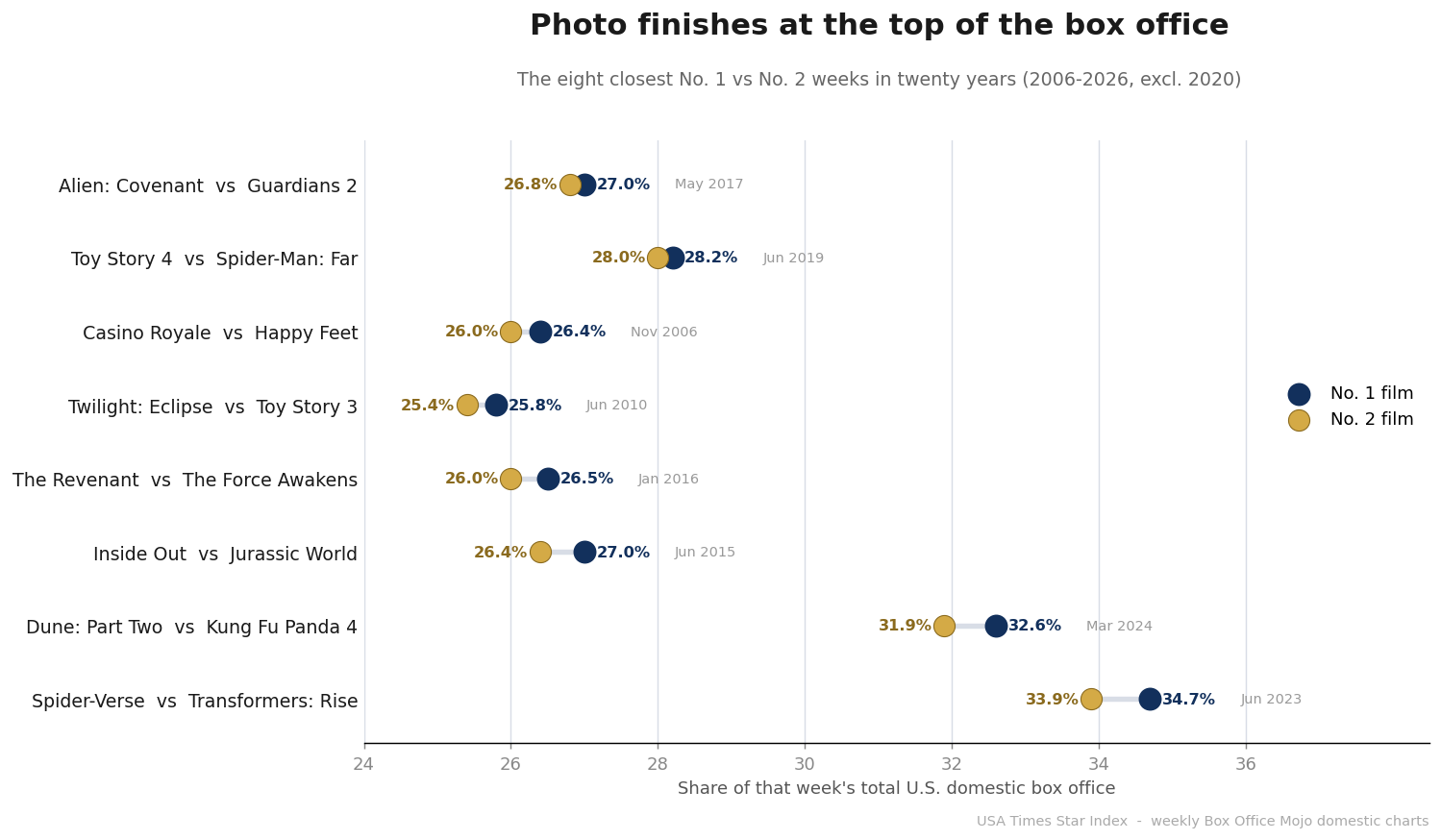
Two of the eight closest finishes happened in the last three years — Dune: Part Two over Kung Fu Panda 4 in March 2024, and Spider-Man: Across the Spider-Verse over Transformers: Rise of the Beasts in June 2023 — a sign of how crowded the modern release calendar has become at the very top.
The rarest runner-up of all
There is one thing a No. 2 film almost never does: post a share big enough to have won a normal week. In our tiers, a film needs 38.2% of the market to reach Betelgeuse status. In twenty years outside 2020, the runner-up cleared that bar exactly once. In April 2021, Mortal Kombat took 38.4% of the week — a Betelgeuse-grade number — and still finished second, because Demon Slayer: Mugen Train took 46%. That collision is the only Betelgeuse-Betelgeuse week the Star Index has ever recorded: two films, both strong enough to headline any other weekend, forced to share the same one. The runner-up that week wasn’t weak. It was simply unlucky about the calendar — the story of second place, in a single data point.
How we measured it
Each film’s weekly share is its gross as a percentage of that week’s total U.S. domestic box office, from Box Office Mojo’s weekly charts. We recorded the No. 1 and No. 2 film for every ISO week from 2006 through 2026 and excluded 2020, whose pandemic-shrunken weeks produce distorted shares that fail the Star Index qualification floor. “Weeks at No. 2” counts full weeks, not weekends. Figures are current as of publication and will shift slightly as 2026 weeks close.
Related from the USA Times Data Desk
- The Efficiency Champions: How Cheap Horror Owns the Box Office
- The Betelgeuse-Betelgeuse Week Has Happened Once in Twenty Years
- What Is a Star Movie? The USA Times Definition
- Box-office coverage index · the Star Index methodology