New York is one of the last cities on earth where the where of seeing a film is a genuine decision. On any given night you can catch a new release in the largest IMAX in the Northeast, a restored 1970s print in a West Village basement, a foreign premiere on the Lower East Side, or a first-run blockbuster with dinner at your seat downtown. The city’s screens are not interchangeable. Each is built for a different kind of film and a different kind of evening — and knowing which is which is the difference between a night out and a great one.
The format temple: AMC Lincoln Square
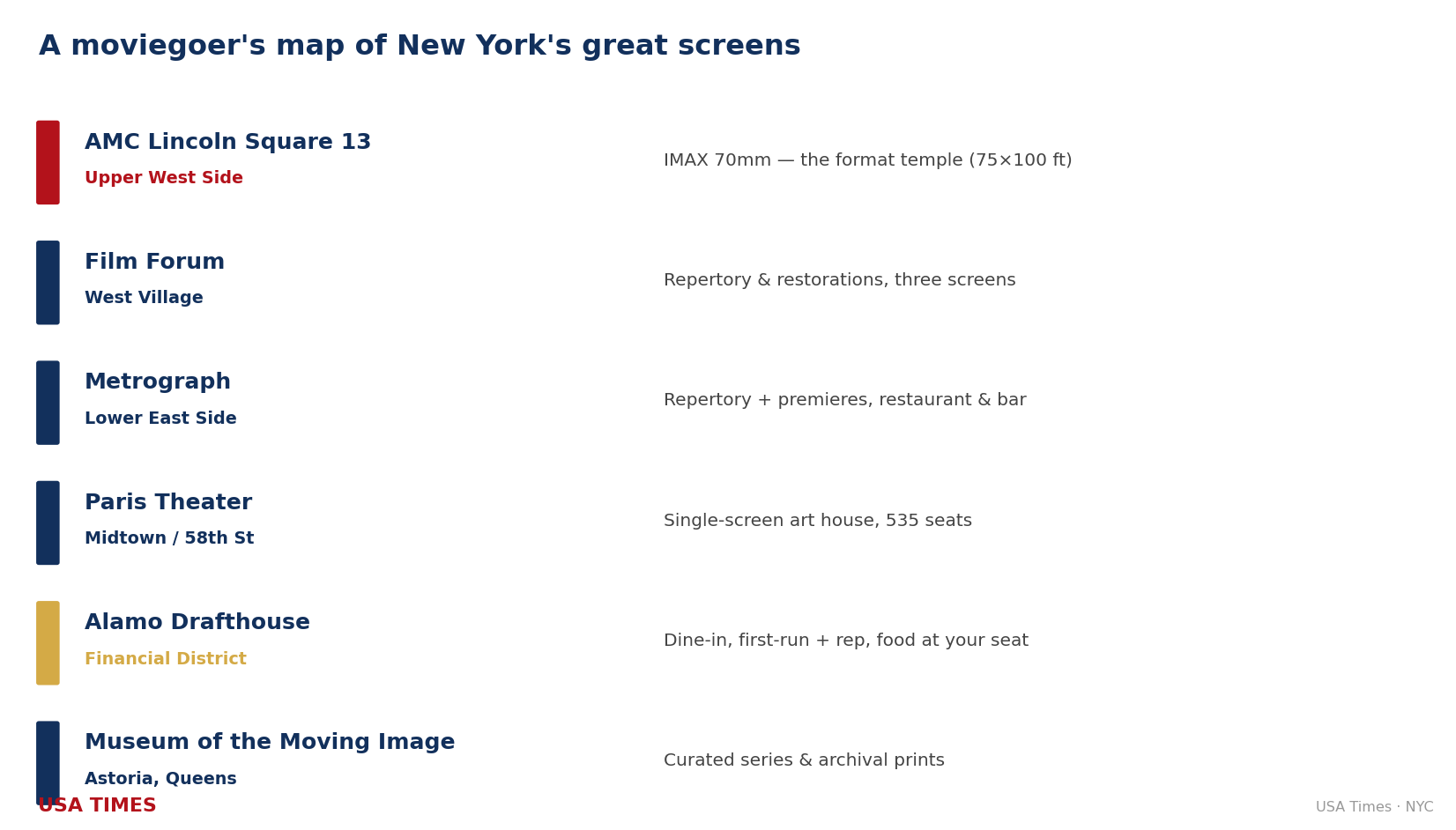
On the Upper West Side sits the reason cinephiles fly to New York: the IMAX at AMC Lincoln Square 13, a screen roughly 75 feet tall and 100 feet wide, the largest in the Northeast and one of the few in the country that runs true 70mm IMAX film. When a director shoots for the full 1.43 frame — Nolan, most famously — this is where the image exists at its intended size. It is a pilgrimage screen, and it behaves like one: engagements sell out weeks ahead, the good center seats go first, and the crowd is there for the format as much as the film. This is the one screen in the city genuinely worth planning an entire evening around.
The repertory houses: Film Forum, Metrograph, Paris
For the films the multiplex forgot, New York’s art houses are unmatched. Film Forum, in the West Village, is the city’s great repertory institution — restorations, retrospectives, and the kind of programming that treats film history as a living thing. Metrograph, on Ludlow Street on the Lower East Side, pairs sharp repertory and premieres with a restaurant and bar, so the screening and the evening around it happen under one roof. And the Paris Theater, a single-screen 535-seat house near the south end of Central Park, is the city’s most elegant room for a prestige release — a survivor from an era when a movie theater was meant to feel like an occasion in itself. None of these needs a giant screen to justify the trip; the value is the print, the programming, and the room.
Batmandir · Guest Passes Step inside for a day. Guest passes from $161/day — brought in by a member. See guest passes →The dine-in: Alamo Drafthouse
Downtown, in the Financial District, the Alamo Drafthouse folds dinner into the movie itself — food and drink brought to your seat, a strict no-talking, no-phones policy, and a mix of first-run films and curated repertory. It is the answer to the “dinner and a movie” problem, which is that the dinner and the movie are usually in two different places with a nervous dash between them. Here they are the same event, which makes it one of the easiest great nights in the city to actually pull off.
The getting-there problem
Here is what every one of these rooms has in common: none of them is easy to park near, and several are genuinely difficult to reach at showtime. Lincoln Square empties Broadway’s theater crowd onto the same blocks; the Lower East Side and West Village were laid out before the automobile and have the parking to prove it; the Financial District goes from empty to gridlocked the moment a game or a market event lets out. For a spontaneous multiplex trip, none of this matters. For a sold-out 70mm engagement you booked three weeks ago, the getting-there is the whole gamble — miss the trailers and the ritual is broken before the film begins.
This is why serious New York moviegoers treat the logistics as part of the plan rather than an afterthought. The move is to be dropped at the door with time to spare, so the pre-film drink is unhurried and the good seats are still there, and to be collected at the curb when the credits roll, so a film that moved you isn’t immediately undone by a subway transfer or a hunt for the car. In a city this dense, removing the transit friction is not an indulgence; it is the difference between arriving in the right frame of mind and arriving frazzled. The film is fixed the moment the lights drop. Everything before and after it is yours to design.
Beyond Manhattan
The island gets the headlines, but some of the city’s best film experiences are a bridge away. The Museum of the Moving Image in Astoria programs archival prints and thematic series with a curator’s rigor, in a setting that treats film as an art form worth a museum’s care. Brooklyn’s repertory and dine-in screens have quietly become destinations in their own right, drawing audiences who once would have defaulted to Manhattan. The lesson for anyone building a movie night is not to assume the best version of a given film is playing at the nearest multiplex. In New York, the right screen for a particular film might be in another borough entirely — and the trip is part of what makes the night feel deliberate rather than incidental.
That abundance is the city’s real gift to moviegoers, and also its one demand: with this many great rooms, the lazy choice — whatever is closest and soonest — is almost never the best one. New York asks you to choose, and rewards you enormously for choosing well. A little planning turns a film you could have streamed into a night you’ll bring up for years.
Building the night by neighborhood
The city rewards planning the evening around the screen, not the other way around. A 70mm night at Lincoln Square pairs naturally with an early dinner on the Upper West Side and a walk through the park if the weather holds. A Metrograph screening builds its own evening in with the restaurant upstairs. A Paris Theater premiere wants a proper Midtown dinner to match the room’s formality; an Alamo night downtown collapses dinner and film into one. Match the meal and the timing to the screen, handle the arrival and the ride home so they never intrude, and New York offers something almost no other city can: not just great films, but a dozen distinct, deliberate ways to see them — each one an evening in its own right.