The box office keeps a calendar, but great movies do not. A blockbuster that opens in mid-December is still selling tickets in mid-January, its run straddling the turn of the year like a runner crossing a painted line mid-stride. In the USA Times Star Index — which grades the #1 film each week by its share of the entire domestic box office — these cross-year films create a small, revealing wrinkle: a single movie appears in two different years’ ledgers, and almost always with a smaller crown the second time.
Sixteen films that owned two years at once
Since 2006, sixteen films have led the domestic box office in both the last weeks of one year and the first weeks of the next. Some were quiet holdovers that never reached star status in either stretch — Night at the Museum, Marley & Me, Mufasa. But the memorable ones are the giants, and they share a single trait: as they cross into January, their grip on the market loosens by exactly one status band, every single time.
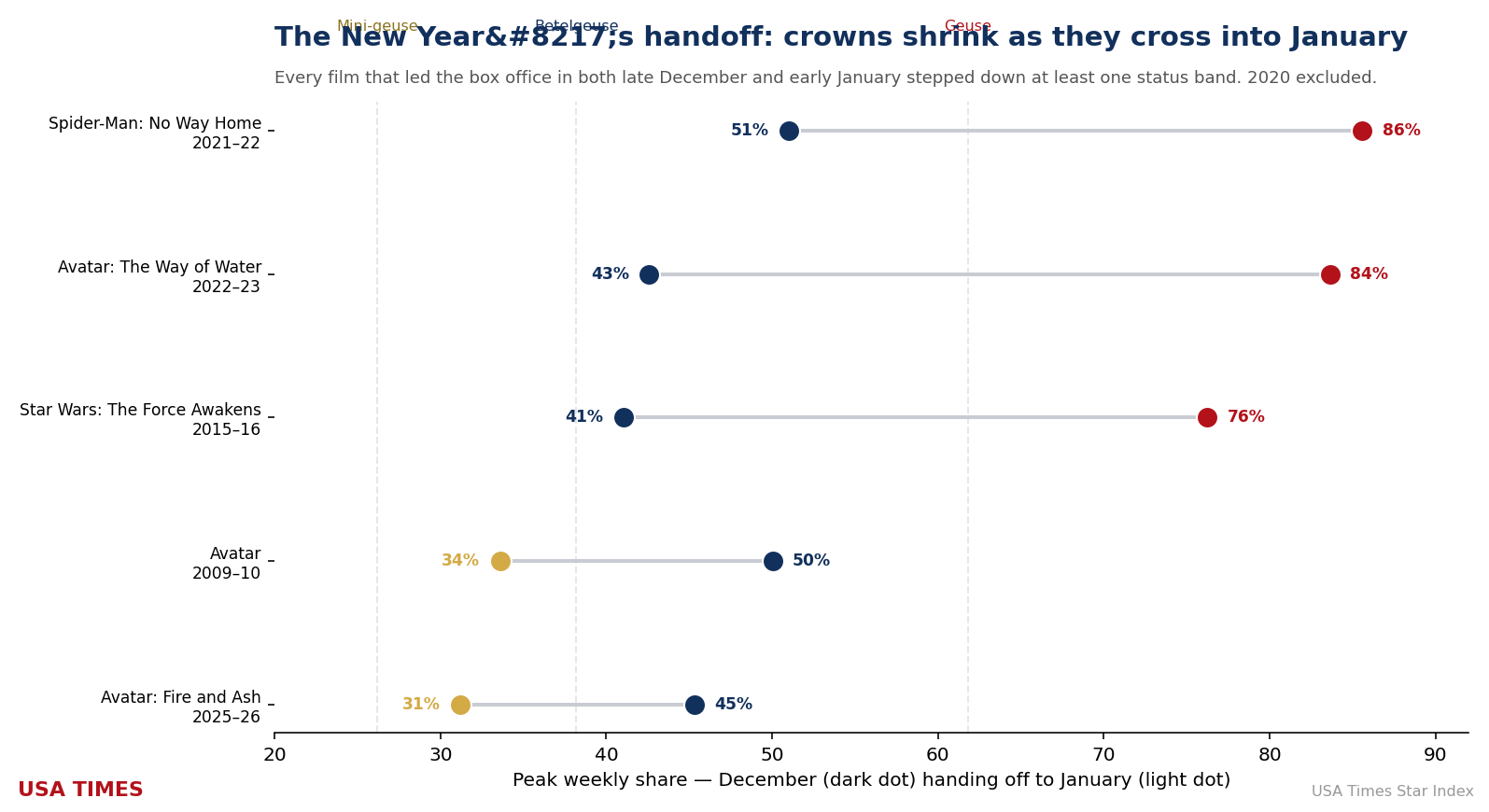
The crown always shrinks
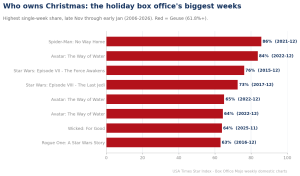
The pattern is remarkably clean. Star Wars: The Force Awakens owned 76.3% of its December 2015 week — a towering Geuse — then handed itself off to January 2016 at 41.0%, a Betelgeuse. Spider-Man: No Way Home went from an 85.6% Geuse in December 2021 to a 51.0% Betelgeuse in January 2022. Avatar: The Way of Water did the same, 83.7% to 42.6%. Even the original Avatar, back in 2009–10, slipped from a 50.0% Betelgeuse to a 33.6% Mini-geuse. And this past turn of the year, Avatar: Fire and Ash carried a 45.3% Betelgeuse opening in December 2025 into a lone 31.2% Mini-geuse week in January 2026 before falling out of star status entirely.
Batmandir · Guest Passes Step inside for a day. Guest passes from $161/day — brought in by a member. See guest passes →Not one of these films crossed the New Year without losing altitude. The reason is partly the calendar and partly the movie. The holiday corridor — the two weeks bracketing Christmas — is the single most concentrated stretch of the moviegoing year, when schools are out, families are off, and a tentpole can soak up an enormous share of a swollen market. January is the hangover: total spending collapses, but so does a holdover’s share, because the audience that turned out in the first frenzied weeks has largely already gone. What looks like a film “holding” #1 into January is really a film descending gracefully from a peak it will never touch again.
Why the index counts it twice
A reasonable reader might ask whether a cross-year film should count once or twice. The Star Index counts each calendar year on its own terms: a film’s December weeks belong to the year they occurred, and its January weeks to the next. So The Way of Water is, correctly, a three-week Geuse in the 2022 ledger and a Betelgeuse-plus-a-week in the 2023 ledger — two distinct entries describing the same run seen through two annual windows. It is the honest way to keep a weekly index: a week belongs to its own year, and a film that spans the boundary simply shows up on both sides of it, a little smaller each time.
This is also why the December and January charts on our year-by-year pages sometimes seem to disagree about a film’s status. They are not in conflict; they are describing different weeks. A movie can be a red Geuse bar in one year’s chart and a navy Betelgeuse bar in the next — the same title, the same run, caught at two different altitudes as it glides down from the holiday peak.
What it means for the December gamble
For studios, the handoff reframes the appeal of a late-December launch. Opening into the holiday corridor buys a film the largest possible peak — the Geuses in our data are disproportionately December releases — but that peak is borrowed against a steep January decline. A film that opens in, say, early November builds its total over a longer, gentler curve; a Christmas opener spikes and fades. Both strategies can produce a huge lifetime gross, but they produce very different shapes, and the Star Index, which measures concentration rather than accumulation, is unusually good at showing the difference.
So when the next December titan tops the chart on New Year’s week, watch what it does in the second week of January. If the last twenty years are any guide, it will still be #1 — and it will already be one full band smaller than the film that ruled a fortnight before. The crown crosses the year. It just never crosses it at full size.
The films that didn’t just shrink — they vanished
If the giants merely step down a band, a second group crosses the New Year and disappears from star status altogether. Frozen led the final week of 2013 as a Mini-geuse and was gone by mid-January 2014. The Hobbit: The Battle of the Five Armies, Aquaman, and Wonka all did the same — top of the box office at the turn of the year, then below the 26.18% line within a week or two, their crowns dissolving as the January field refilled with new releases. These are the films whose December strength was real but shallow: enough to lead a holiday week, not enough to survive the market’s reset. The handoff, for them, was less a graceful descent than a cliff.
Taken together, the two groups sketch the anatomy of a holiday hit. The truly enormous films — the Force Awakenses and No Way Homes — decline by a single band and keep leading for weeks, their runs long enough to headline two separate years of the index. The merely large ones lead the turn of the year and then evaporate. Either way, the direction is the same: down. In two decades, the box office has never once produced a film that grew stronger as it crossed from December into January. The New Year is, for a movie, always a small demotion — the moment the market stops rewarding the novelty of an opening and starts asking what a film can do on its own, in the cold, against everything new. Almost nothing does it at full height.
Method: shares are each film’s gross as a percentage of the entire week’s domestic box office, from Box Office Mojo weekly charts, 2006–2026, with 2020 excluded as a pandemic anomaly. “Cross-year” films are those that held #1 in both the final weeks of one year and the opening weeks of the next.