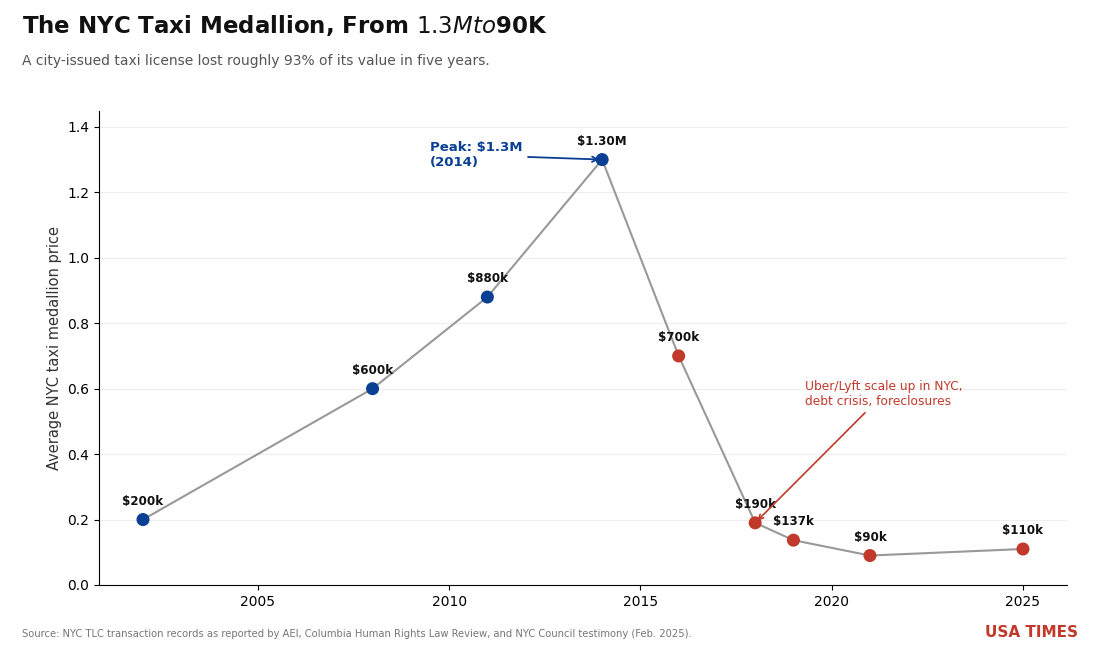
A New York City taxi medallion — the metal shield bolted to a yellow cab’s hood that makes it legal to pick up street hails — is just a license. It doesn’t include a car, a driver, or a business. In 2002 that license cost about $200,000. By 2014 it cost $1.3 million. By 2019 it was selling at auction for around $137,000. Today it’s worth roughly $90,000 to $115,000. The asset lost about 93% of its value in five years, and the debt taken out to buy it at the top didn’t shrink along with it.
Average NYC Taxi Medallion Price, 2002–2025
Hover any bar for the year and context.
Batmandir · The Circle Full access to theatres, museums & exhibitions. S2 · ongoing membership, without a Founder’s seat. Explore membership →How a taxi license became a $1.3 million asset
NYC caps the number of yellow-cab medallions in circulation, a supply restriction dating back to 1937. For decades that made a medallion a scarce, steadily appreciating asset — from roughly $200,000 in 2002, it more than doubled to over $600,000 by 2008, climbed further through the early 2010s, and peaked at about $1.3 million in 2014. Banks treated medallions as reliable collateral and lent freely against them; drivers, immigrant families in particular, borrowed heavily on the promise that a medallion would appreciate the way it always had, or at minimum hold its value as a retirement asset.
The collapse, once it started, didn’t slow down
Uber launched in New York in 2011 and scaled aggressively over the following several years, followed by Lyft; by the mid-2010s, app-based for-hire vehicles were competing directly with yellow cabs for exactly the trips medallion owners had assumed were protected by the supply cap. The cap restricted how many medallions could exist — it did nothing to restrict how many Uber and Lyft cars could enter the market. Medallion values, which had taken over a decade to climb from $200,000 to $1.3 million, gave essentially all of that back in about five years: down to roughly $190,000 by 2018, and to $136,000–$138,000 at auction in 2019.
The debt attached to those medallions didn’t collapse with the asset price. Loans taken out against a $1 million-plus medallion, often for $500,000 to $600,000 or more, stayed at their original balance while the collateral securing them became worth a fraction of that. At least 1,677 medallion loans went into foreclosure from 2018 onward. The gap between what owners owed and what their medallion could actually be sold for became the defining fact of the crisis — not the falling price alone, but the fixed debt sitting on top of a collapsing asset.
Why this became more than a market story
The medallion crash didn’t stay confined to balance sheets. Many owners were immigrant drivers who had put decades of savings and, in many cases, their retirement plan into a medallion on the understanding — accurate for most of the previous 80 years — that the city’s supply cap made it a safe, appreciating asset. Investigative reporting on the crisis — most notably a New York Times investigation by Brian Rosenthal, published in 2019 and awarded the 2020 Pulitzer Prize for Investigative Reporting — documented how industry lenders had systematically inflated medallion prices and steered immigrant buyers into loans they could never realistically repay, going back well before ride-hailing existed as competition. That reporting tied the debt crisis to nearly a thousand bankruptcies and several suicides among medallion owners, and its findings prompted criminal investigations by federal and state prosecutors. That reporting is a significant part of why City Hall treated the eventual relief program as a humanitarian response, not just an economic-policy fix — the $65 million wasn’t packaged as a bailout for an asset class, it was packaged as debt relief for a specific, identifiable group of working owner-drivers.
The city’s response, several years late
New York didn’t roll out a structured response until March 2021 — roughly seven years after the peak and three years into the worst of the foreclosure wave — with the Taxi Medallion Relief Program and an associated Loan Guaranty Program. The city put up $65 million in grants, offering eligible owners help restructuring their loans: a $20,000 payment to reduce principal, plus up to $9,000 in ongoing monthly debt-relief payments, along with free legal representation to negotiate directly with lenders. By late 2021, the city reported the program had crossed $20 million in debt forgiveness, with roughly 1,000 owners in the relief pipeline.
The relief program helped, but it didn’t fully close the gap for everyone. Reporting from 2024 found hundreds of drivers still carrying debt after some lenders declined to participate fully in the city’s restructuring deal, leaving a subset of owners negotiating loan terms without the leverage the program was designed to give them.
Where the value sits now
Medallion values bottomed out somewhere around $90,000 in the early 2020s and have shown modest signs of recovery since — recent tracking puts the current range around $90,000 to $115,000, still roughly 91-93% below the 2014 peak, with no realistic scenario in which they return to seven figures. For an owner who financed a medallion purchase near the top of the market, the math is now permanent: the collateral is worth a small fraction of what was borrowed against it, and no relief program fully erases a debt that was underwritten against a price that, in hindsight, was never going to hold.
What we did
We compiled medallion price figures across multiple independent points in time — 2002, 2008, 2014, 2018, 2019, and current 2025 figures — cross-referencing reporting from the American Enterprise Institute’s chart series on medallion prices, Columbia Human Rights Law Review’s analysis of the debt crisis, and New York City Council testimony from February 2025 on current medallion values and TLC’s role in the market. We separately verified the debt-relief program’s terms and dollar figures directly against the NYC Mayor’s Office’s own press releases from 2021, rather than relying on secondary summaries of the program. The details of Brian Rosenthal’s investigative work and its 2020 Pulitzer Prize for Investigative Reporting were confirmed directly against the Pulitzer Board’s own winner citation, not secondhand reporting about the award.