On a random Tuesday night in New York, you can find a line around the block for a movie that came out forty years ago. A restored print at Film Forum, a midnight cult screening at the Metrograph, a 70mm revival that sold out in minutes — the city’s repertory houses, long treated as a niche for graying cinephiles, are suddenly full of people in their twenties. In an age when almost every film ever made is a click away at home, New Yorkers are paying to leave the house and watch old movies in a crowd. It is one of the more surprising cultural reversals of the streaming era, and it is worth understanding why.
The paradox of infinite access
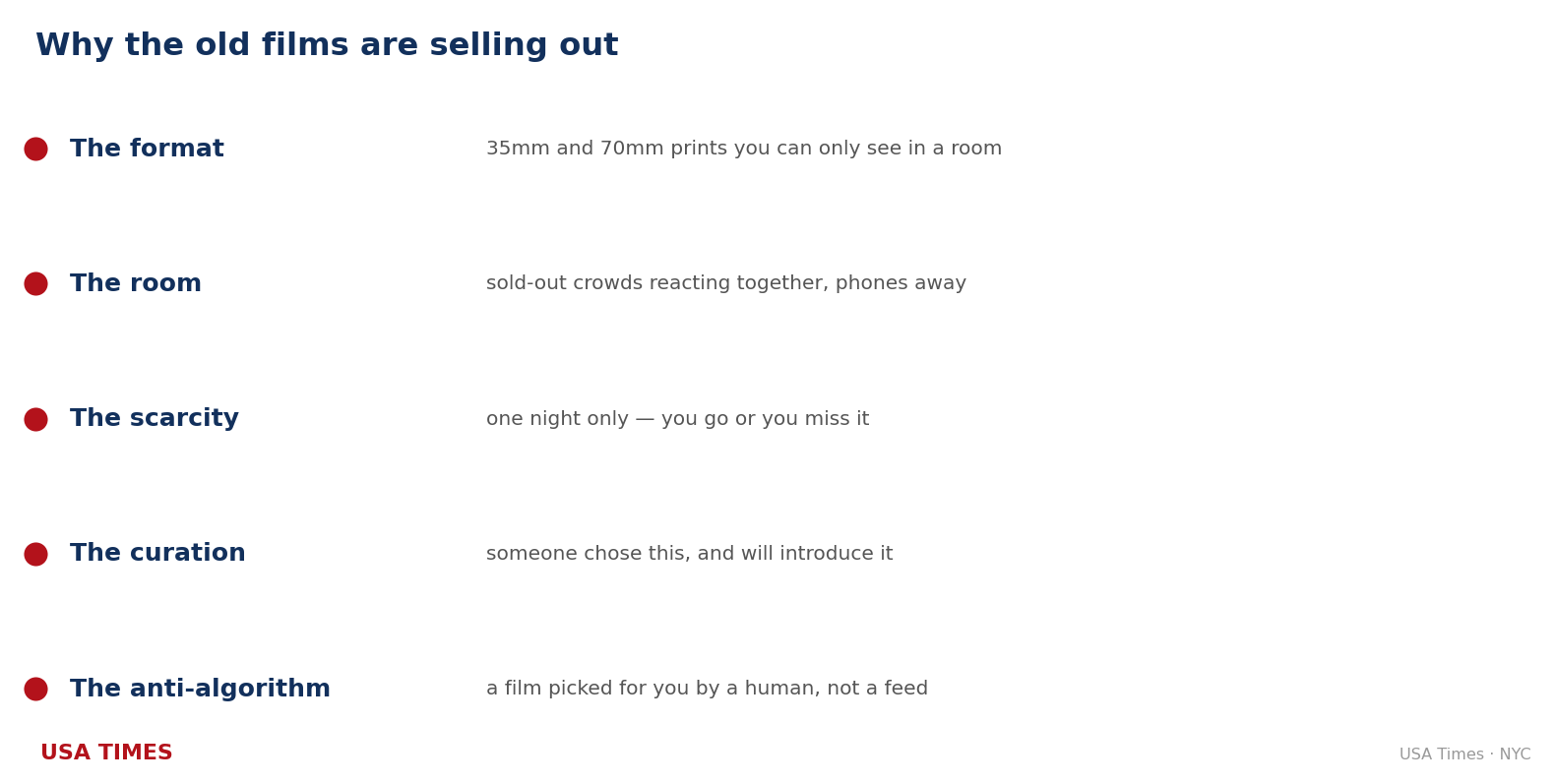
The obvious question is why anyone would pay for a ticket to a film they could stream in seconds. The answer is that infinite access created its own problem. When everything is available all the time, nothing feels like an event, and the sheer size of the catalog becomes paralyzing rather than liberating — a thousand films in a grid, none of them chosen, all of them equally optional. A repertory screening solves both problems at once. It is available for exactly one night, which restores the urgency that streaming destroyed, and it was selected — someone with taste decided this film, in this print, deserved a room tonight. In a media landscape drowning in choice, being told what to watch, and being given a single chance to watch it, turns out to be a relief rather than a constraint.
The room is the product
What the repertory house sells is not the film — the film is free at home — but the room. Watching a comedy in a packed theater where four hundred people laugh at the same instant is a fundamentally different experience from watching it alone on a laptop, and audiences have rediscovered that the difference is the whole point. A horror film with a crowd that gasps together, a beloved classic where the audience applauds the opening title, a cult movie where quoting along is part of the ritual: these are communal experiences that cannot be downloaded. The younger audiences filling these theaters grew up watching everything alone on screens. The novelty, for them, is other people — the shared, phones-away, undivided attention of a room that came out on purpose.
Batmandir · Guest Passes Step inside for a day. Guest passes from $161/day — brought in by a member. See guest passes →The format is the pilgrimage
Then there is the physical print. A film shown on actual 35mm or 70mm has a texture — grain, warmth, the faint flicker of light through celluloid — that a pristine digital stream deliberately smooths away. For a generation raised entirely on digital, seeing a real film print is genuinely new, and increasingly it is a draw in its own right. Repertory houses have leaned into this hard, advertising the format as prominently as the title, because a “35mm print” promises something the couch categorically cannot: not a better story, but a different, older, physical way of seeing it. The screening becomes a small pilgrimage, and the print is the relic you traveled to see.
A rebellion against the feed
Underneath all of this runs a quieter motive: exhaustion with the algorithm. Streaming services decide what you see through opaque recommendation engines optimized to keep you subscribed, and the result is a strange flattening — a feed that knows your habits and narrows them, serving more of what you already watched. A repertory calendar is the opposite. It is curated by a human being with a point of view, organized around a director, a theme, a moment in film history, and it constantly pushes audiences toward films they would never have chosen for themselves. For a generation that senses it is being programmed by its feeds, buying a ticket to a curator’s idea of what matters is a small act of rebellion — a way of putting taste back in human hands.
Why New York, specifically
No city is better built for this revival than New York. It has the density — enough film-obsessed people within a subway ride to fill a 400-seat house for an obscure double bill on a weeknight. It has the institutions — Film Forum, the Metrograph, the Paris, Film at Lincoln Center, the Museum of the Moving Image — each with its own programming personality and its own devoted crowd. And it has the walkable, going-out culture that turns a screening into an evening: dinner nearby, the film, a drink after to argue about it. The repertory renaissance could only happen at scale in a place where enough people live close enough to make a Tuesday-night revival a viable business, and where leaving the house for a movie is already part of how the city lives.
The economics quietly work
There is a business logic beneath the cultural one. A repertory house does not pay to produce anything — the films already exist — and the licensing cost of an older title is a fraction of the rental on a new release. What the theater sells is the experience of the room and the intelligence of the programming, both of which travel on word of mouth and social media rather than expensive marketing. A single striking calendar — a director’s complete works, a themed month, a restored classic in a rare format — can fill seats for weeks on almost no advertising budget, because the audience does the promotion. In an exhibition landscape where first-run theaters fight over the same handful of tentpoles and shrinking margins, the repertory model has quietly become one of the more resilient ways to run a cinema: low cost, loyal audience, and a product no streaming service can undercut because the product is not the film but the gathering.
The lesson reaches past cinema. In a culture of infinite, frictionless, algorithmically-served content, the things gaining value are the opposite: the scarce, the curated, the communal, the physical, the one-night-only. The repertory house offers all five at once, which is why a forty-year-old film can sell out a New York theater faster than half of what opened this weekend. The movies didn’t lose to streaming. A certain way of watching them did — and it is coming back, one sold-out revival at a time.