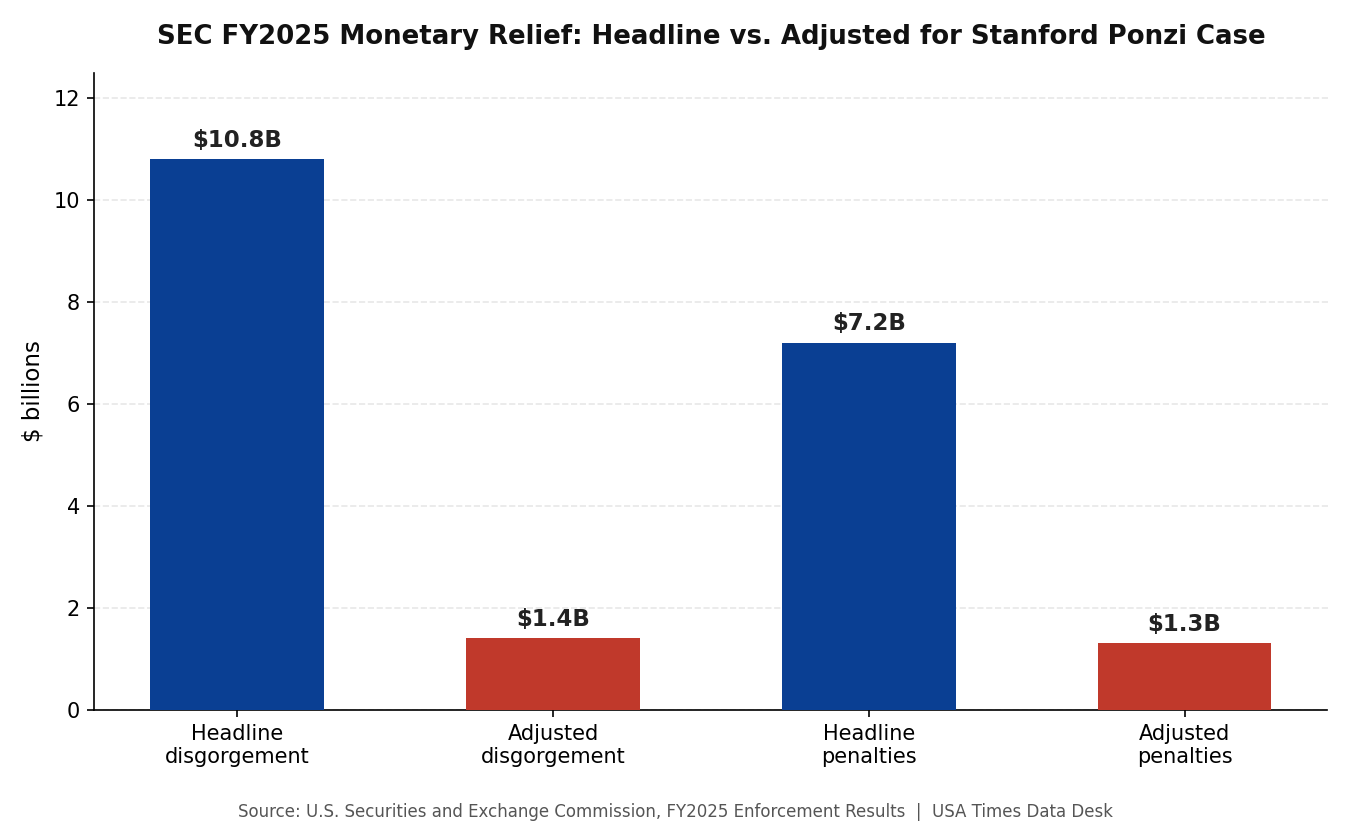
The Securities and Exchange Commission’s fiscal year 2025 enforcement results, released April 7, 2026, report $17.9 billion in total monetary relief — $10.8 billion in disgorgement and prejudgment interest, plus $7.2 billion in civil penalties. It’s the kind of number that would normally read as a record-setting year for the agency. It isn’t, and the SEC’s own release explains why in unusually direct terms.
Buried in the “Supporting Detail” section, the SEC discloses that a large share of that $17.9 billion comes from two sources that inflate the headline figure without reflecting new FY2025 enforcement activity: amounts “deemed satisfied” by restitution or forfeiture orders in separate criminal cases, and the judgment against Robert Allen Stanford and co-defendants in the agency’s long-running litigation over Stanford’s $8 billion Ponzi scheme — a case that originated in 2009. After excluding both, the SEC reports the real FY2025 total was $1.4 billion in disgorgement and prejudgment interest plus $1.3 billion in civil penalties — $2.7 billion combined, roughly 85% below the headline number.
A Commission that says it’s deliberately doing less, not more
The SEC filed 456 enforcement actions in FY2025 — 303 standalone actions plus 69 “follow-on” administrative proceedings barring individuals from securities-industry roles based on prior criminal or civil orders — down from what the agency describes as an “unprecedented rush” of case filings under the prior Commission ahead of the presidential inauguration. SEC Chairman Paul Atkins framed the shift explicitly in the release: “We have redirected resources toward the types of misconduct that inflict the greatest harm—particularly fraud, market manipulation, and abuses of trust—and away from approaches that prioritized volume and record-setting penalties over true investor protection.”
Batmandir · The Circle Full access to theatres, museums & exhibitions. S2 · ongoing membership, without a Founder’s seat. Explore membership →The release goes further, retroactively criticizing enforcement choices from the prior Commission: since fiscal year 2022, it says, the agency brought 95 actions and $2.3 billion in penalties over firms’ failure to preserve “off-channel communications” (personal texts and messaging apps used for business), plus 13 cases involving crypto-firm registration and the regulatory “definition of a dealer” — cases the current Commission says “identified no direct investor harm” and represented “a bias for volume of cases brought versus matters of investor protection.”
Seven crypto cases got dismissed outright
The clearest evidence of the enforcement pullback: starting in February 2025, the Commission dismissed seven of its own pending crypto enforcement actions, brought by the prior Commission, against Coinbase, Cumberland DRW, Consensys, Kraken (Payward), Dragonchain, an individual defendant named Balina, and Binance Holdings. In their place, the SEC stood up a Crypto Task Force and, in February 2025, a Cyber and Emerging Technologies Unit aimed at fraud involving blockchain technology, AI, account takeovers, and cybersecurity — a shift from case volume toward what the agency frames as more targeted fraud enforcement.
Individual accountability rose even as total cases fell
One metric moved in the opposite direction from overall case volume: roughly two-thirds of the SEC’s standalone actions in FY2025 charged at least one individual — a 27% year-over-year increase — and the SEC says nearly nine in 10 standalone actions filed specifically under Acting Chairman Mark Uyeda and Chairman Atkins (the current leadership) involved individual charges. The Commission also barred 119 individuals from serving as officers or directors of public companies during the year. Commissioner Uyeda’s own statement in the release ties this directly to strategy: enforcement, he said, should be “guided by investor protection above all” rather than used “as a tool for policymaking.”
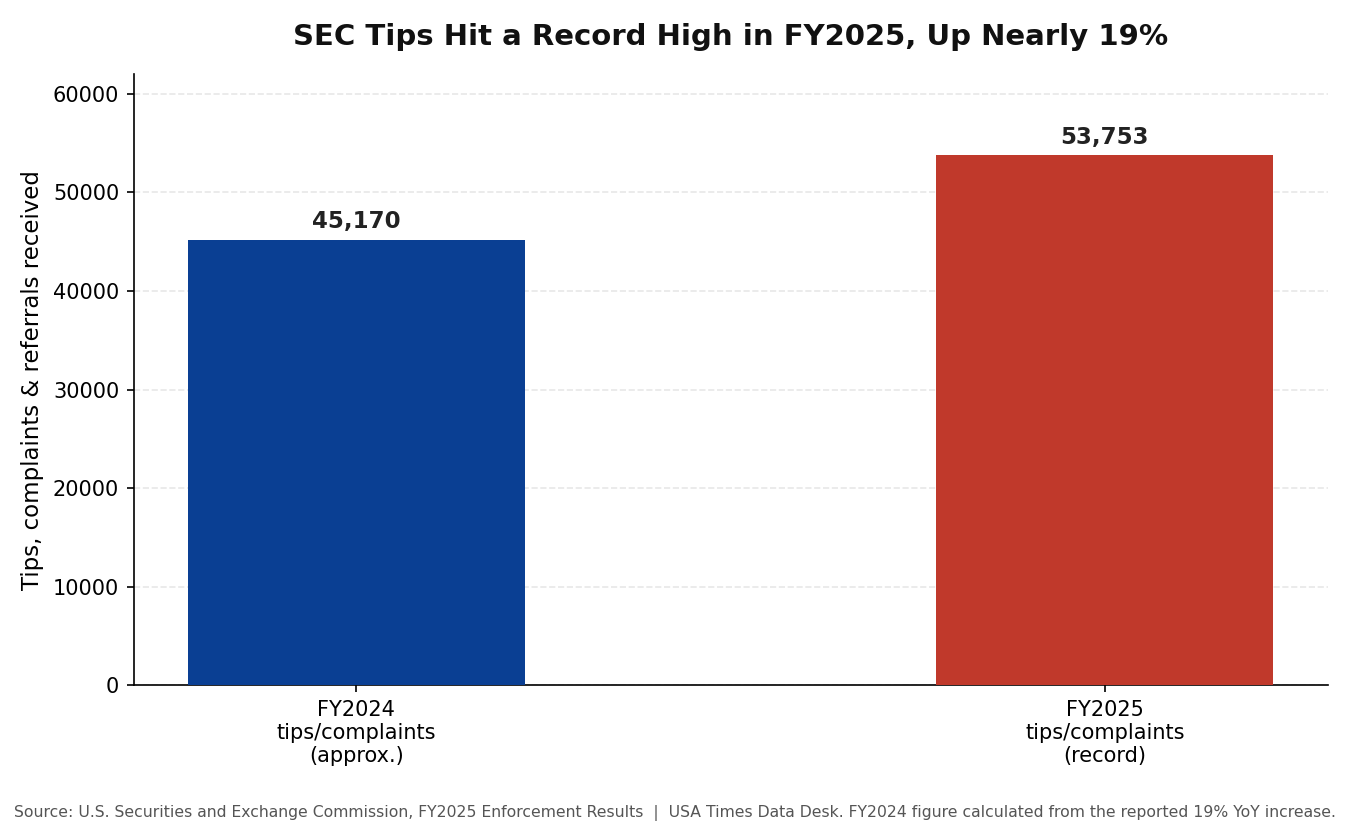
The agency also reported a record 53,753 tips, complaints, and referrals in FY2025 — up nearly 19% from the prior year — even as the number of enforcement actions filed in response fell. That combination, more tips coming in against fewer total cases filed, is consistent with the SEC’s own stated strategy of being more selective about which matters it pursues to conclusion, rather than a sign that misconduct reports themselves went unaddressed: the release notes separately that 1,095 investigated matters were closed without charges, some after companies remediated the underlying practices on their own.
What actually reached investors
Of the enforcement activity that did conclude, the SEC returned approximately $262 million directly to harmed investors in FY2025 and paid roughly $60 million to 48 individual whistleblowers — an average of about $1.25 million per award, reflecting the SEC’s whistleblower program’s design to pay a percentage of the monetary sanctions collected in cases that whistleblower tips helped bring. Notable cases the SEC highlighted include a $400 million Ponzi scheme run through Paramount Management Group and Prestige Investment Group that defrauded roughly 2,700 investors, a $140 million Ponzi scheme at First Liberty Building & Loan, and a $60 million fraud at Nightingale Properties that misappropriated more than $52 million from about 700 retail investors.
Three trial wins the SEC highlighted
The release also touts specific litigation victories from FY2025. In SEC v. Gallagher, a nine-day jury trial in September 2025 found defendant Steven Gallagher liable for securities fraud after he used his Twitter account between December 2019 and October 2021 to promote more than 30 microcap stocks he already held, then quietly sold his position while continuing to recommend followers buy in — a pattern that produced more than $2.6 million in illicit trading profits. In SEC v. Minuskin, a five-day trial in June 2025 ended with the jury returning a verdict against defendant Thomas Casey after less than two hours of deliberation, finding he had defrauded more than 200 retirees out of over $10 million through a scheme called “Golden Genesis” that falsely promised guaranteed returns from a human-plasma blood bank venture. And in SEC v. Cutter Financial Group, an April 2025 jury trial found a Massachusetts investment adviser liable for recommending insurance products to clients without adequately disclosing the upfront commissions he earned from the sales.
What we did
All figures in this piece — the total and adjusted monetary relief numbers, the case counts, the tips and complaints data, the whistleblower award totals, the individual-accountability statistics, the crypto case dismissals, and the specific case examples — come directly from the SEC’s “SEC Announces Enforcement Results for Fiscal Year 2025” press release (release number 2026-34), published April 7, 2026, and read directly from sec.gov, along with the linked litigation releases it cites for individual case examples. The FY2024 tips/complaints figure shown in our second chart is calculated by us from the SEC’s own reported statistic that FY2025’s 53,753 figure represented “nearly 19 percent more” than the prior year — SEC did not publish the FY2024 raw number directly in this release, so our FY2024 bar is a derived estimate (53,753 ÷ 1.19 ≈ 45,170), not a directly reported SEC figure.