Being the number-one movie in America sounds like a title you hold. In practice, it is a title you rent — usually for exactly seven days. Track every film that has topped a weekly U.S. box-office chart since 2006, and a brutal pattern emerges: the overwhelming majority reign for a single week and are gone. The #1 spot is not a throne. It is a turnstile.
The survival curve
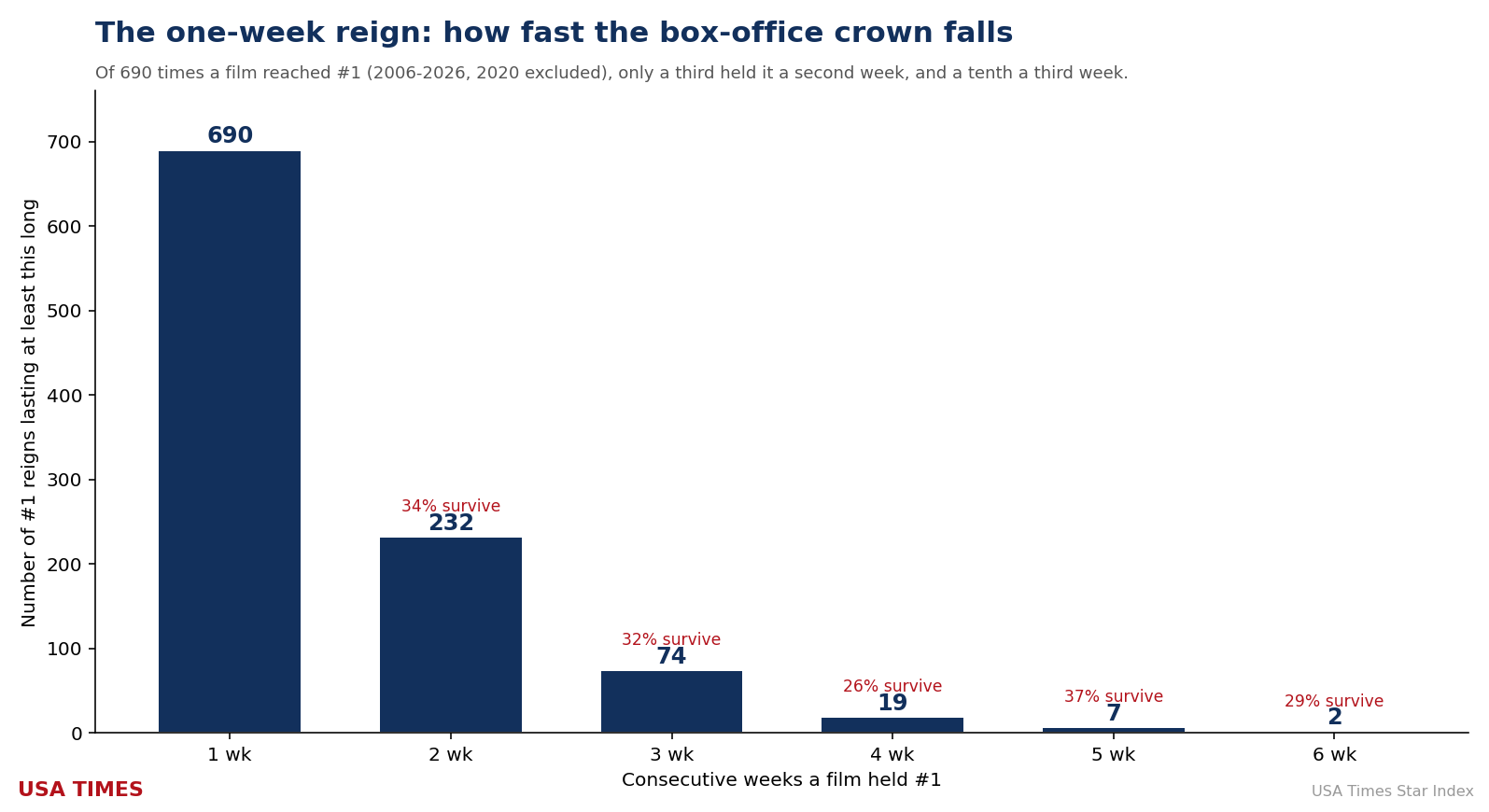
Since 2006, excluding the pandemic-scrambled 2020, films have reached #1 exactly 690 times. Of those reigns, only 232 — about a third — survived into a second consecutive week. Just 74 made it to a third week, 19 to a fourth, 7 to a fifth, and a mere 2 held the top spot for six straight weeks. Each rung of the ladder keeps roughly a third of the films on the one below it. That is the mathematical signature of a half-life: a steady, punishing decay in which the crown is far more likely to change hands than to stay put.
Even when it holds, it shrinks
Surviving a second week is no guarantee of strength. Among the 232 films that did hold #1 for a second week, their share of the total box office fell by an average of 27% from the first week to the second. A film commanding 40% of the market on its opening week is typically down near 29% by the next — still first, but visibly loosening its grip. Domination decays even when it doesn’t collapse. The films that stay on top are not holding steady; they are descending slowly enough to keep everyone else behind them, which is a very different thing from holding their ground.
Batmandir · Guest Passes Step inside for a day. Guest passes from $161/day — brought in by a member. See guest passes →Why the crown falls so fast
The modern box office is engineered for exactly this. A blockbuster now front-loads its audience with saturation marketing and a maximum opening: the studio wants the biggest possible first weekend, both for the headline and because early momentum drives everything downstream. But a front-loaded opening is, by definition, borrowed against the future — the audience that would have trickled in over a month instead arrives all at once, leaving fewer people to see it in week two. Add a new wide release every single Friday, each with its own opening-weekend spike, and the incumbent is dethroned not because it faltered but because the calendar simply hands the crown to whatever opened this week. The system produces a new king almost every seven days by design.
The rare long reigns
Which is what makes the exceptions extraordinary. The two films that held #1 for six straight weeks did something the structure of the modern box office actively resists: they kept beating every new opener, week after week, for a month and a half. A long reign is not merely a big film; it is a film with such durable word of mouth and such broad appeal that it out-earns a fresh competitor five and six weekends running. In an era built to crown someone new every Friday, holding the top for a month is a rarer feat than a single enormous opening — and a far better measure of a film that genuinely captured the culture rather than merely arriving loudly.
What the turnstile means
For studios, the one-week reign reframes what “#1” is worth. Topping the chart for a single week is common enough to be nearly meaningless as a mark of quality — two-thirds of all #1 films do exactly that and vanish. The achievements that actually separate films are the ones the turnstile makes hard: holding the top for multiple weeks, or taking such an enormous share in that one week that the number itself is historic. A film chasing the former needs staying power; a film chasing the latter needs overwhelming scale. What no longer means much is simply getting there, because in a market that reshuffles every Friday, almost everything gets there eventually, and almost nothing stays.
So the next time a film is crowned the number-one movie in America, note the date — and check back in seven days. The odds are two to one that it will already be gone, dethroned not by a better film but by the relentless mechanics of a box office that manufactures a new champion every week and lets almost none of them keep the title. The crown is real. It is just never yours for long.
It wasn’t always this way
The revolving door is partly a modern invention. In earlier decades, a genuine hit could sit at #1 for a month or more simply because the release calendar was thinner and word of mouth had time to build — a film could grow week over week as audiences told their friends, rather than peak on Friday and decline from there. The saturation-release model changed that. When a studio opens a tentpole on 4,000 screens with a nine-figure marketing spend, it compresses a film’s entire theatrical life into its first weekend; there is no slow build left to sustain a long reign, only a tall spike and a fast fade. The one-week reign, in other words, is not a sign that films got worse. It is a sign that the way films are sold changed, trading the long, durable run for the enormous, disposable opening.
That trade has consequences beyond the chart. A film that lives or dies on a single weekend leaves no room for the surprise hit that finds its audience slowly, the modest opener that becomes a phenomenon by week four. Those stories still happen — they are exactly the rare multi-week reigns in our data — but the system is now tuned against them. The box office rewards the loudest arrival, not the longest stay, and the survival curve is the receipt: a steep, unforgiving slope on which almost every crown, however large, is already sliding off by the second week.
Method: a “reign” is a run of consecutive weeks a single film held #1 on the weekly U.S. domestic chart, from Box Office Mojo via the USA Times Star Index, 2006–2026, with 2020 excluded as a pandemic anomaly.