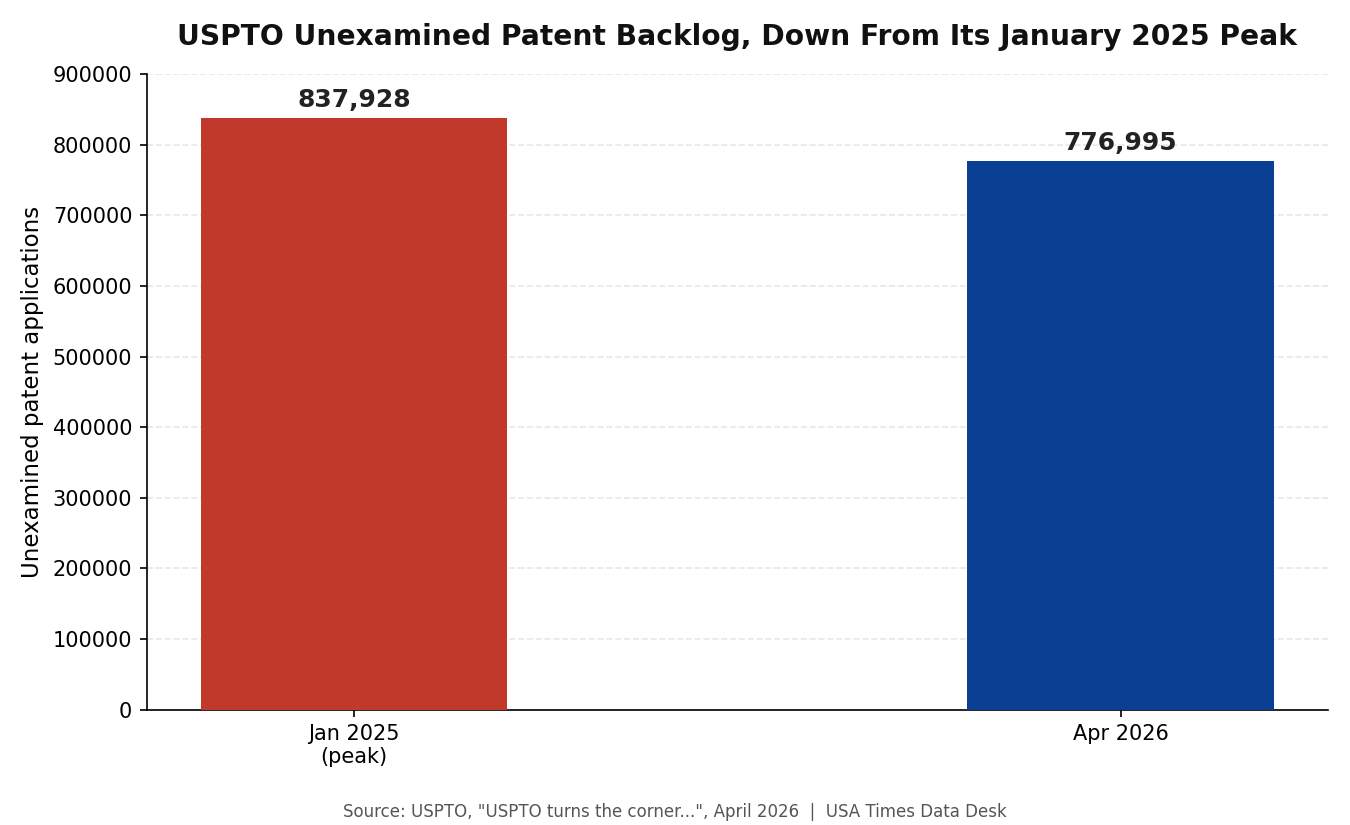
The U.S. Patent and Trademark Office’s backlog of unexamined patent applications fell to 776,995 as of April 6, 2026 — down from a peak of 837,928 in January 2025, according to a USPTO announcement. That’s a 7.3% reduction from the peak, and the agency says it’s the lowest the backlog has been in two years. The more significant number underneath it: for the first time in nearly a decade, the USPTO’s cumulative output of first office actions within a fiscal year has exceeded the number of new applications filed in that same year — meaning examiners are now working through applications faster than new ones are arriving, rather than merely slowing the rate at which the pile grows.
That distinction matters. A backlog can shrink temporarily just because filings dip for unrelated reasons. What USPTO Director John Squires is describing is different: output overtaking input on a sustained basis, which is the only way a backlog actually reverses course rather than just growing more slowly.
A concrete dollar figure attached to pendency
Squires attached an unusually specific economic claim to the announcement: USPTO’s own internal studies, he said, show that even a one-week reduction in patent pendency increases a U.S. company’s value by approximately $35,000 on average. That figure — if it holds up as a general rule across the agency’s full applicant pool — implies the roughly two-year reduction in the worst-case pendency backlog described in this release could be worth a meaningful sum in aggregate company value across the thousands of applicants whose wait times shortened, though USPTO’s release doesn’t provide a total aggregate estimate.
Batmandir · Founders A numbered seat at the table. S3 · The Founders Club — 161 seats per location. By invitation. Explore membership →The agency is also targeting its oldest cases specifically. USPTO says it’s closing in on an early win against its fiscal-year goal of virtually eliminating the inventory of unexamined applications that would otherwise sit for more than 36 months — the longest-waiting, most costly-to-applicants segment of the backlog, and traditionally the hardest to clear because those applications tend to involve the most complex or contested claims.
The post-grant side has been improving for longer
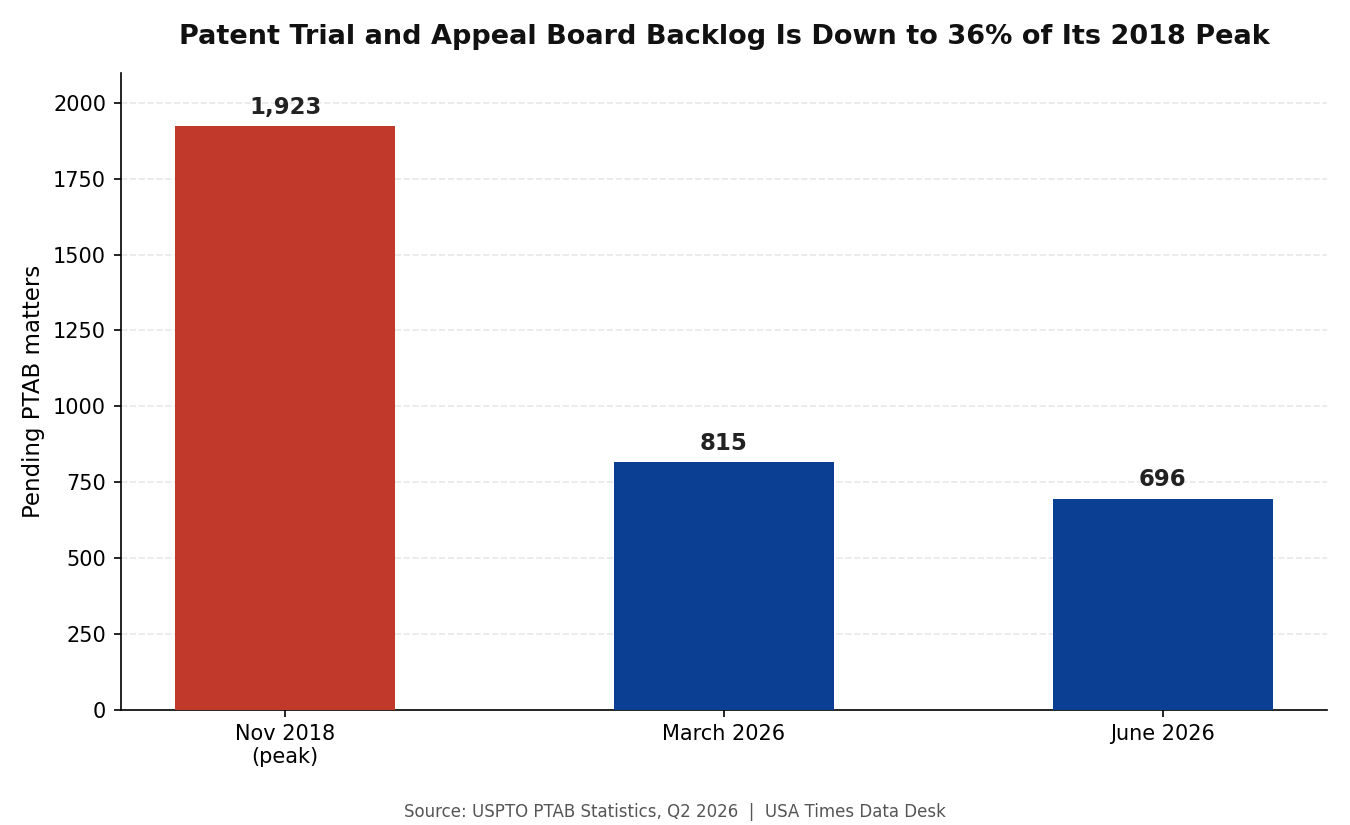
While the unexamined-application backlog only recently turned a corner, the Patent Trial and Appeal Board’s backlog of post-grant validity challenges has been shrinking for years. Pending PTAB matters fell to 696 at the end of June 2026 — just 36.2% of the November 2018 peak of 1,923, and down from roughly 815 as recently as March 2026. That’s a multi-year decline that predates and runs alongside the newer unexamined-application improvement, suggesting the agency’s post-grant process has had more time to work through its own backlog than the front-end examination pipeline has.
How companies are challenging patents is also shifting
The type of post-grant challenge companies are filing has changed meaningfully. Inter partes review (IPR) petitions — the more adversarial, trial-like proceeding companies use to challenge a rival’s patent validity before PTAB — fell to an all-time quarterly low of 57 in the second quarter of 2026. At the same time, ex parte reexamination requests, a narrower, examiner-driven process, hit an all-time quarterly high of 336 in the same quarter. Reexaminations now make up roughly three-quarters of all post-grant validity filings, a striking reversal from the era when IPR was the dominant tool companies reached for to challenge a competitor’s patent.
That shift likely reflects, at least in part, procedural and cost differences between the two mechanisms — IPR petitions require a formal adversarial filing and higher fees, while reexamination requests are comparatively cheaper and don’t require the same trial-like structure — though USPTO’s own release and PTAB statistics don’t attribute a specific cause to companies’ shifting preference between the two.
AI tools and new hires are part of the agency’s own explanation
USPTO credits the turnaround partly to internal changes: the agency says it is “steadily releasing robust AI tools to assist our examiners” and is roughly halfway to its hiring goal for new patent examiners. Squires also noted the office simultaneously “welcomed more new applications” under newer examination guidance he referenced as the “Desjardins precedent” and a new eligibility disclosure submission program — meaning the backlog reduction happened even as the agency says it opened the door to more filings under revised guidance, not by simply discouraging new applications.
Why patent pendency is an economic number, not just a bureaucratic one
A pending, unexamined patent application sits in legal limbo: the inventor can’t fully enforce rights against a competitor who copies the invention, and can’t always use the pending application as leverage in licensing or fundraising conversations the way an issued patent allows. For a small company, that limbo period can matter enormously — investors weighing whether to fund a startup often discount the value of intellectual property that hasn’t cleared examination, since a rejected or narrowed claim can materially change what the company actually owns. A backlog measured in the hundreds of thousands of applications, even one moving in the right direction, still means a large number of companies and individual inventors are currently sitting in that uncertain position, some for multiple years.
That’s also the lens through which to read USPTO’s emphasis on its 36-month-plus inventory specifically. Applications waiting that long tend to be the ones with the most complicated prosecution histories — multiple rounds of office actions, contested claims, or technically dense subject matter — meaning they’re disproportionately likely to belong to companies for whom the wait has already been long and costly by the time this initiative reaches them.
What we did
The unexamined-application backlog figures, the first-office-action milestone, the 36-month-pendency goal, the $35,000-per-week pendency value figure, and the quoted statements from USPTO Director John Squires all come directly from the USPTO’s April 10, 2026 press release “USPTO turns the corner on unexamined patent application backlog reduction,” read directly from uspto.gov. The PTAB pending-matter figures, the IPR petition count, and the ex parte reexamination figures come from USPTO’s own published PTAB statistics for the second quarter of 2026, cited via a legal-industry secondary summary of that USPTO data (Harness IP’s Q2 2026 post-grant challenges update) rather than fetched directly from USPTO’s PTAB statistics page; we did not independently verify those specific PTAB figures against the USPTO’s raw dataset before publication. The $35,000 pendency-value figure is characterized by USPTO itself as coming from the agency’s “studies,” which the press release does not name, cite, or link directly.