On the night of Thursday, July 24, this newsroom filed a trademark application with the United States Patent and Trademark Office — a design mark, our four-star logo, serial number 50013007. The government’s confirmation landed a few hours later, from an address ending in @uspto.gov. So did something else: a routine USPTO notice headed “Be aware of scammers.”
We didn’t have to wait long to see why. About 58 hours after our filing hit the public record, the scammers arrived — first by email, then by text, both citing our real serial number, both demanding we get on the phone, both warning that our application was about to be “abandoned.” None of it was real. All of it is a scam the USPTO and intellectual-property lawyers are warning about right now. Here is exactly how it works, using our own messages as the evidence.
The email: an “appointment” we never made
At 9:02 on Monday morning, an email arrived with the sender name “USPTO.” Its actual address was teas@office-160.com — not a government domain. The subject: “U.S Trademark Application Verification – Logo.” Inside was an “OFFICIAL NOTICE OF TRADEMARK VERIFICATION APPOINTMENT,” our serial number, and the name of a supposed examining attorney, “Elijah Jackson,” who wanted us on a call at 10:00 a.m. Pacific that same day. Miss it, the message warned, and the application “may be deemed abandoned.”
Batmandir · The Circle Full access to theatres, museums & exhibitions. S2 · ongoing membership, without a Founder’s seat. Explore membership →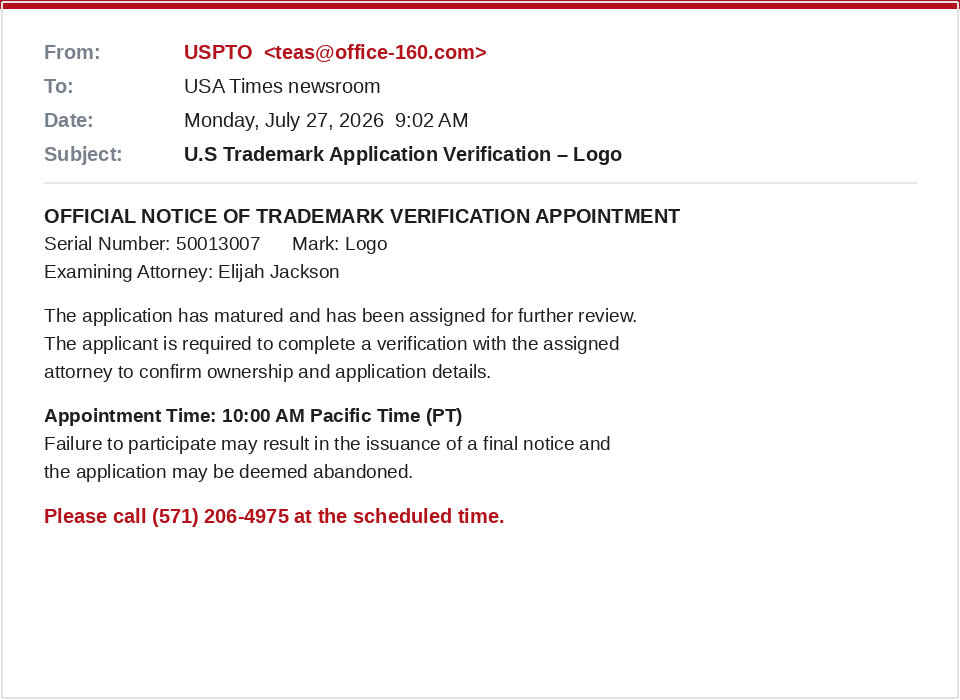
In a detail that would be funny if it weren’t the whole trick, the email even contained a disclaimer noting that the USPTO “will never request payments or sensitive information via phone.” That is true. It is also exactly why an email pushing you toward a phone call should stop you cold.
The text: the same story, a different number
Later that morning came the text — from a 571 number, again opening with “FROM: USPTO,” again quoting serial 50013007 and our name, this time citing “classification deficiencies” and an “APPOINTMENT NO.: 7610.” Respond immediately, it said, “otherwise your application will be ABANDONED. If abandoned, the other applicant wins registration, and you lose all rights.” Then a number to call.
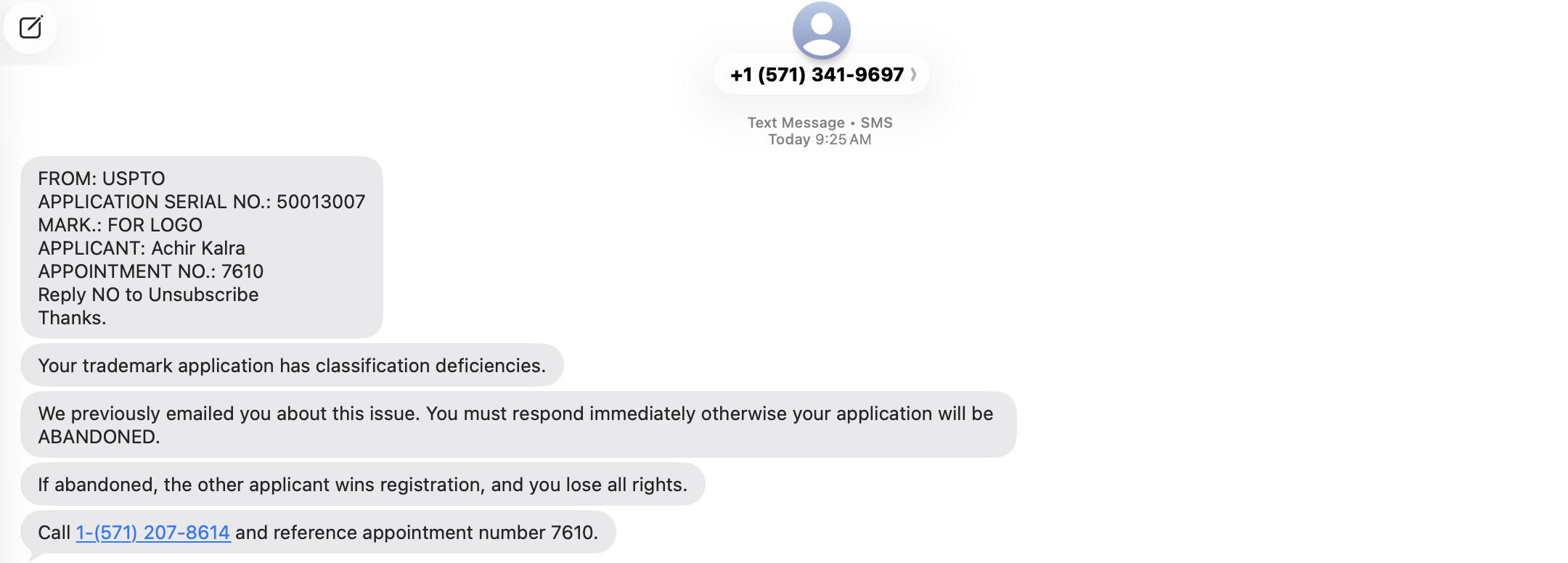
Two channels, one target, one filing — coordinated within a single business day. We could not determine who operates the office-160.com domain or the 571 numbers, and we are not naming any real person as responsible; “Elijah Jackson” appears to be an invention. We are publishing the callback numbers the messages told us to dial — (571) 206-4975 and 1-(571) 207-8614 — for one reason: so you do not call them — and we are doing the same with the third number, (804) 604-3927, so you do not reply to it either.
A third message, a new number, a different hook
On July 28 — a day after the email and the first text — a third message arrived, again by SMS, from yet another number: (804) 604-3927. This one didn’t ask us to call. It asked us to reply.
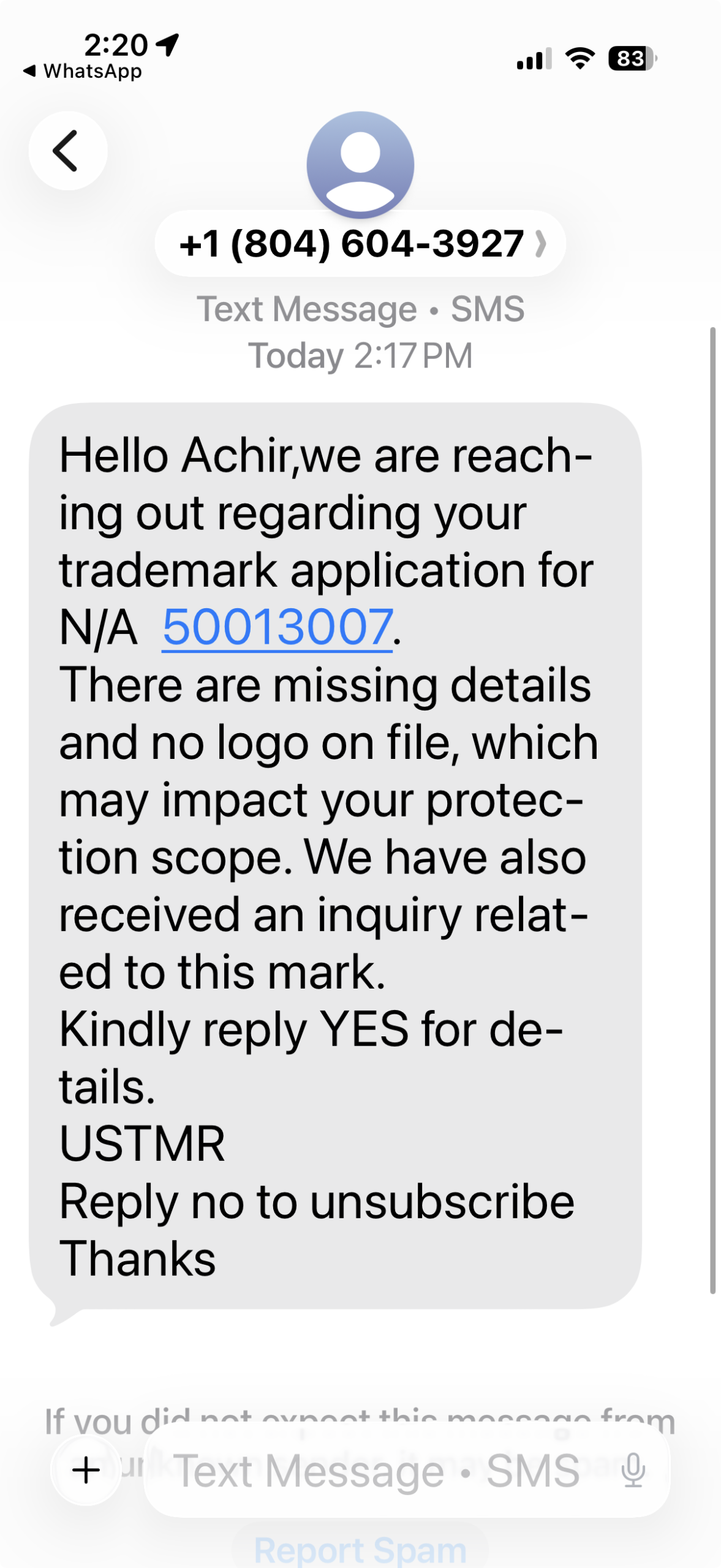
The template is sloppier here, and the sloppiness is itself a tell. It cites our real, public serial number, 50013007 — but the field meant to name our mark is blank: “your trademark application for N/A 50013007.” That’s a mail-merge failure, not a personal review of our file; it’s what happens when an automated list dumps public USPTO filing data into a template and a field doesn’t populate. It signs off as “USTMR,” an invented abbreviation with no connection to the actual agency, and it asks us to reply “YES” — or, failing that, “NO to unsubscribe.” Either reply does the same thing for whoever sent it: it confirms a real person reads this number, which is worth something to resell into the next round of messages whether or not anyone ever calls back.
Why none of it is real
Every claim in these messages collapses against how the trademark office actually works.
| What the message claimed | What the USPTO actually does |
|---|---|
| Sender is “USPTO” — from teas@office-160.com and a 571 text number | Official USPTO email comes only from @uspto.gov addresses. It doesn’t run these text campaigns. |
| A “verification appointment” — call the attorney at a set time | The USPTO does not schedule appointments or require you to phone an examiner to “verify” anything. |
| Respond “immediately” / within hours or be abandoned | Real deadlines arrive in writing and typically give you three months (often extendable) — not the same morning. |
| Your “assigned examining attorney” — three days after filing | New applications aren’t assigned an examining attorney for months. On day three, there is no assigned attorney to call. |
| “The other applicant wins registration, you lose all rights” | Any actual issue is posted to your USPTO account and to the public TSDR record. Rights aren’t a race you lose by missing a phone call. |
| Call this number (and, in other versions, pay a fee) | The USPTO never asks you to call a number from an unsolicited message, and never takes fees or personal information by phone, email, or text. Fees are paid only through its official electronic system. |
Why filers get hit within days
The moment you file, your application becomes public record. Your name, mailing address, the mark, and the serial number all post to the USPTO’s Trademark Status and Document Retrieval database, where anyone — including scammers running automated scrapers — can pull them the same day. That’s how a stranger knew our serial number, our name, and that we’d just filed a logo. The specificity is the weapon: it makes a generic threat feel personally addressed.
Our experience is not unusual; it’s the current wave. Law firms began issuing client alerts this year about this precise “verification appointment” variant, and one documented case describes a filer phoned within minutes of submitting and told her $700 filing needed an extra $4,000 for “Global Authority.” The USPTO’s own list of common scams catalogs the cousins: bogus $895-a-year “monitoring” invoices, fake “international registry” fees, and impostor examiner emails — all trading on the same public data and the same fear of losing your mark.
What to do if it happens to you
- Don’t call, don’t reply, don’t pay. Replying — even “NO to unsubscribe” — just confirms your number is live and answered.
- Check the real record. Look up your serial number yourself at tsdr.uspto.gov. Any genuine action from the office appears there and in your USPTO.gov account.
- Report it. The USPTO asks you to forward these to TMScams@uspto.gov with the original message attached. We’re reporting ours. You can also file with the FTC at reportfraud.ftc.gov and, for online fraud, the FBI’s IC3.
- Trust the domain, not the logo. If an email isn’t from @uspto.gov, it isn’t the USPTO — no matter how official the letterhead looks.
We got these messages because we did something ordinary and public: we protected our own mark. The people behind them are betting that a first-time filer, rattled by the word “abandoned,” will call before they think. Don’t. The trademark office will never rush you onto a phone — and the surest sign something is a scam is that it’s trying to.
Sourcing: This account is based on the confirmation and warning emails USA Times received from @uspto.gov on July 25, 2026, and on the fraudulent email (from teas@office-160.com) and first text message received July 27, 2026, and a second, differently-worded text from (804) 604-3927 received July 28, 2026, all preserved by the newsroom. Guidance on legitimate USPTO practice is drawn from the USPTO’s pages on recognizing common scams and what to do if you’ve been scammed, its solicitation warnings, and 2026 client alerts from intellectual-property firms. We could not independently identify the operators of the domain or phone numbers involved and make no allegation against any identifiable individual.