Read in: English · Español
A New York City report found that Uber Eats and DoorDash quietly redesigned their apps to make tipping harder — and that delivery workers lost more than half a billion dollars in tips as a result. It is the worker-side mirror of the delivery-app economics USA Times has been documenting from the consumer side, one receipt at a time.
When you order delivery in New York, three parties are splitting your money: the restaurant, the app, and the person who actually carries the food to your door. A report from the New York City Department of Consumer and Worker Protection put a number on how much of that money stopped reaching the last of those three — and on how, the city says, it was engineered to stop.
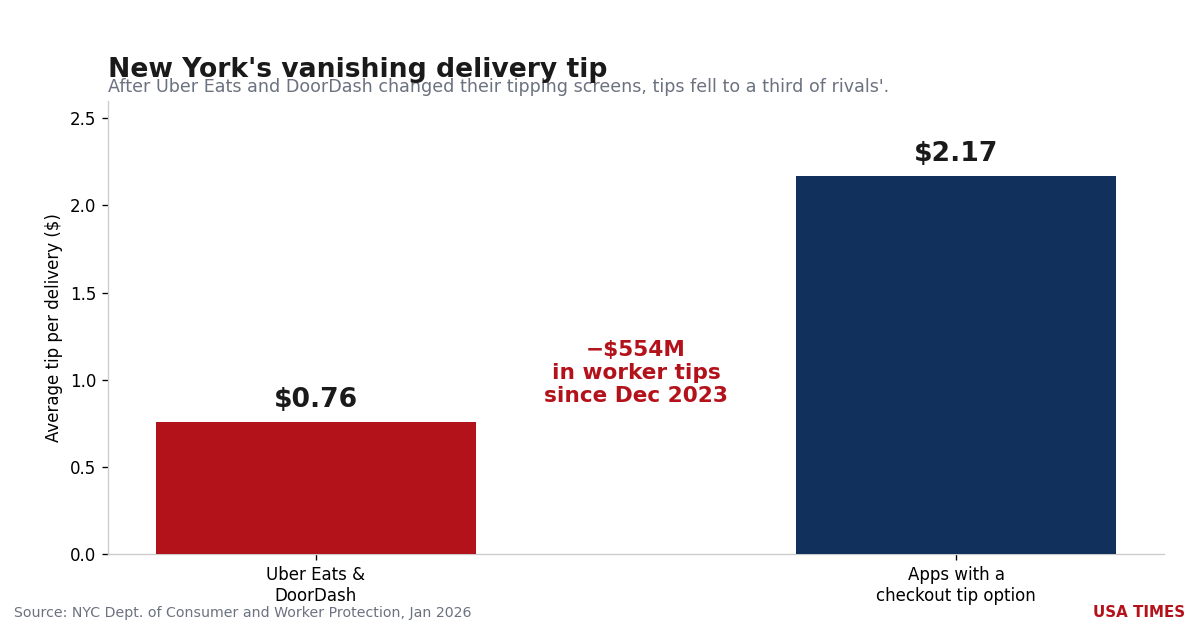
Batmandir · Founders A numbered seat at the table. S3 · The Founders Club — 161 seats per location. By invitation. Explore membership →In the report, released January 13, 2026, DCWP concluded that Uber Eats and DoorDash “engineered design tricks” in their interfaces that made it harder for customers to tip — and that tips fell by more than $554 million after the changes, even as tipping held steady on rival apps that left their checkout flows alone.
How the tip disappeared
The city’s numbers are blunt. The average tip on Uber Eats and DoorDash is now $0.76 per delivery. On restaurant delivery apps that still offer a tipping option at checkout, it is $2.17 — nearly three times as much. DCWP estimates the design changes cost the typical delivery worker roughly $5,800 a year. According to the report, tipping fell immediately after the two apps changed their interfaces at the end of 2023, and has continued to decline since.
The mechanism, the city says, was design: where and when the tip prompt appears, what the default is, and whether a customer is nudged to tip before or after the order. Rival platforms that kept a straightforward tip-at-checkout option did not see the same collapse — which, DCWP argues, is the tell. “When New Yorkers are given the option to tip delivery workers,” the report states, “they do.”
| New York delivery tips | Figure |
|---|---|
| Average tip — Uber Eats & DoorDash | $0.76 / delivery |
| Average tip — apps with a checkout tip option | $2.17 / delivery |
| Estimated loss per worker | ~$5,800 / year |
| Total tip loss since Dec 2023 | $554 million |
| Total worker pay gain since minimum-pay rule | $1.2 billion |
“Our report blows the whistle on a massive scheme by Uber and DoorDash to drive down worker pay by more than $550 million,” said DCWP Commissioner Samuel A.A. Levine. “If these companies do not follow new tipping laws going into effect later this month, they will face significant consequences.”
The backdrop: a living wage, then a fight over tips
The report lands on top of one of the most consequential labor experiments in the country. Since December 2023, DCWP has enforced a minimum pay rate for app delivery workers — the first of its kind at scale — which the city says has raised total pay to workers by $1.2 billion even as the industry kept growing. Worker advocates read the timing of the tipping changes, which arrived in the same window, as a direct response.
“This report confirms what deliveristas have lived for years: when workers won a living wage, the app companies retaliated by intentionally blocking access to tips to keep workers vulnerable and dependent,” said Ligia Gualla, executive director of the Worker’s Justice Project and co-founder of its Los Deliveristas Unidos campaign. “When deliveristas fight for dignified pay and dignified work, these companies do everything they can to undermine those gains.”
The report is also explicitly political: it was issued under Mayor Zohran Mamdani’s administration, and DCWP framed it as the opening of “a new era of enforcement and accountability” ahead of a tip-protection law taking effect in 2026.
The consumer side of the same ledger
USA Times’ own reporting has followed the other end of the transaction — what happens to the diner’s money. Across our Data Desk audit of New York restaurants, we found food marked up above the counter price on some apps, a stack of service and “regulatory response” fees added at checkout, and, in New York, a disclosure that the price was “set by an algorithm using your personal data.” In one live example, a $28.95 Katz’s pastrami sandwich reached $45.04 — a 56% premium by the time the fees cleared.
Put the two halves together and a single system comes into focus. The platform sits between the diner and the worker and adjusts what each side pays or keeps: on the consumer side, our audit found charges added on; on the worker side, the city found tips passed through less often. The restaurant, caught in the middle, frequently nets less on a delivery order than on a walk-in. Our restaurant-by-restaurant findings are documented across the series, including Prince Street Pizza, Di Fara, Louie & Ernie’s and L&B Spumoni Gardens.
What the companies say
Uber and DoorDash dispute the framing. The companies have said that tipping remains available on their apps, that interface changes are meant to improve the customer experience, and that New York’s own rules — the minimum-pay mandate and the commission cap — raised their costs and forced changes to how orders are priced and how workers are paid. Both companies have previously challenged New York’s delivery regulations in court. USA Times’ Data Desk requested comment from Uber and DoorDash for this piece and will update with any response.
There is a real tension worth naming. The same minimum-pay rule that advocates celebrate as a $1.2 billion raise is, from the platforms’ perspective, a mandated cost increase — and guaranteed pay can change how tipping is presented, because the base is now higher. The city’s charge is narrower than “the apps pay too little”: it is that the apps deliberately made a voluntary payment from customer to worker harder to make.
What’s next
DCWP tied the report to a new tip-protection law taking effect in 2026 and promised “aggressive enforcement,” including transparency requirements around pay and tipping. For delivery workers, the city points to nyc.gov/deliveryapps or 311 (say “delivery worker”) to check their rights. For diners, the practical takeaway is simpler: on some apps, the tip prompt is no longer where you expect it — and the worker only gets what you actively choose to give.
Sources: NYC Department of Consumer and Worker Protection, “DCWP Report Shows Uber and DoorDash Drove $550 Million in Delivery Worker Pay Losses” (January 13, 2026) and its underlying Delivery Worker Tipping Report; USA Times Data Desk pricing audit (2026).