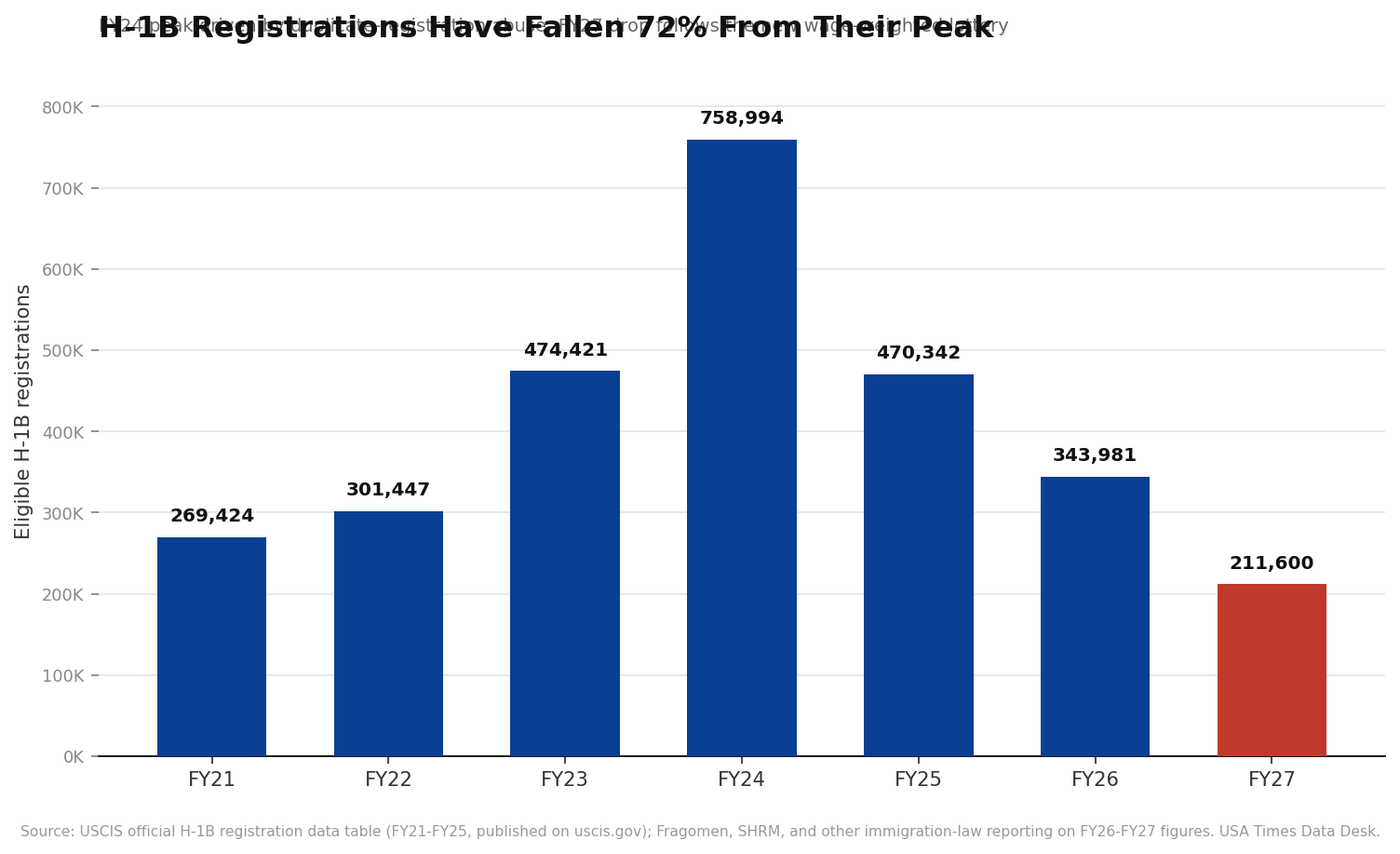
Two years ago, employers submitted 758,994 eligible registrations for the 85,000 H-1B visas available for fiscal year 2024 — a record, and one driven substantially by employers gaming the lottery with duplicate registrations for the same worker. This year, for fiscal year 2027, that number was roughly 211,600, according to immigration-law reporting on USCIS’s cap season. That’s a 72% decline from the 2024 peak, and the steepest single-year drop in the program’s recent history came specifically this year, following a policy change that fundamentally rewired how the lottery picks winners.
Eligible H-1B Registrations by Fiscal Year
Hover any bar for what changed that year.
Batmandir · Founders A numbered seat at the table. S3 · The Founders Club — 161 seats per location. By invitation. Explore membership →Two different reforms, two different kinds of decline
The decline hasn’t happened in one straight line, and it hasn’t had one cause. According to USCIS’s own published registration data, eligible registrations ran at a relatively stable 269,000 to 301,000 in fiscal years 2021 and 2022, then jumped to 474,421 in FY 2023 and exploded to 758,994 in FY 2024 — a run-up USCIS itself attributes largely to employers and agents submitting multiple registrations per beneficiary to unfairly inflate that worker’s odds of selection. In FY 2024, 408,891 of the eligible registrations — more than half — were tied to beneficiaries who had multiple registrations submitted on their behalf, compared with just 28,125 in FY 2021.
USCIS’s fix for that specific problem was a “beneficiary-centric” selection rule, finalized in January 2024 and first applied to the FY 2025 cap season: instead of selecting individual registrations, the lottery selects unique beneficiaries, and every registration tied to a selected beneficiary becomes eligible regardless of how many were filed. That single change cut FY 2025’s eligible registrations to 470,342 — down 38.6% in one year — while the number of unique beneficiaries registered stayed nearly flat, at roughly 442,000 versus about 446,000 the year before. In other words, the FY 2024 number had been artificially inflated by duplicate filings; the FY 2025 number reflected something closer to the program’s actual size.
The newest change targets who wins, not how many enter
The FY 2027 season, which closed its initial registration period in March 2026, introduced a second and different kind of reform. The Department of Homeland Security replaced the historically random lottery with a weighted selection system that increases the odds of selection for registrations tied to higher prevailing wages, using the Department of Labor’s four-level Occupational Employment and Wage Statistics wage classification. According to reporting on the results, 71.5% of selected FY 2027 beneficiaries hold U.S. advanced degrees, up sharply from 57% in FY 2026, and only 17.7% of selected registrations fell into the lowest prevailing-wage category — down from a substantially higher share in prior years, when wage level had no bearing on selection odds at all.
The wage-weighting doesn’t fully explain the drop in total registrations on its own — a $215 H-1B registration fee introduced ahead of the FY 2026 season (versus $10 in prior years) had already cut that season’s eligible registrations to 343,981, a 26.9% decline from FY 2025’s 470,342 before the wage-weighted lottery existed at all. Layered together, the fee increase and the wage-weighted selection system appear to be doing different jobs: the fee raised the cost of registering speculatively for every possible candidate, while the wage-weighting changed which registrations are actually worth submitting in the first place, since a registration for a lower-wage position now has a meaningfully worse chance of selection than it did a year ago.
What this looks like for the 85,000 who do get in
The annual cap itself hasn’t changed — it remains 85,000 total, split between the congressionally mandated 65,000 regular cap and the 20,000 exemption reserved for holders of U.S. advanced degrees, and USCIS confirmed in its FY 2027 results that both were filled without needing a second lottery round, something that did happen in FY 2024 and FY 2025. What’s changed is the composition of who fills those 85,000 slots: a program that a decade ago selected essentially at random now systematically favors registrations for higher-paid, more credentialed positions, which shifts the H-1B population toward roles like specialized engineering, senior research, and advanced technical work and away from the lower-wage end of the “specialty occupation” category the visa was designed to cover.
Who the shrinking pool of winners actually is
The country-of-origin concentration in the H-1B program has stayed remarkably stable through all of this churn in registration volume and selection method. In USCIS’s own congressionally mandated characteristics report for FY 2024, 71% of approved H-1B petitions went to beneficiaries born in India, with China a distant second at about 12% — figures that held nearly steady into FY 2025, when India’s share came in around 70% and China’s held at roughly 12%, per subsequent reporting on that year’s approvals. Those two countries alone have accounted for roughly four in five approved H-1B workers across the recent fiscal years for which data exists, regardless of whether the total pool of registrations that year was 269,000 or 759,000. That stability matters for reading the wage-weighted lottery’s effects correctly: the shift toward higher-wage, more-credentialed selections isn’t reshaping which countries the program draws from — it’s reshaping which roles and salary tiers, within a beneficiary population whose national origins have stayed essentially fixed, actually make it through.
What we did
The FY 2021 through FY 2025 eligible-registration figures, the duplicate-registration breakdown, and the beneficiary-count figures all come directly from USCIS’s own published H-1B Electronic Registration Process page, which includes USCIS’s official year-by-year data table — we quoted those figures directly from the agency’s table rather than a secondary summary. For FY 2026 and FY 2027, we relied on immigration-law-firm reporting (Fragomen, SHRM, and others tracking the cap season in real time), because USCIS’s own alert on the FY 2027 selection process, published March 31, 2026, explicitly states that “the precise number of cap registrations submitted has not yet been disclosed” by the agency as of that date — a limitation we’re flagging directly rather than presenting the widely reported 211,600 figure as an official USCIS number. The 71.5%-advanced-degree and 17.7%-lowest-wage-tier figures for FY 2027 selections likewise come from immigration-law reporting on the wage-weighted lottery’s results, not a direct USCIS dataset, since USCIS has not published beneficiary-level wage-tier breakdowns for this cap season as of this article’s publication.