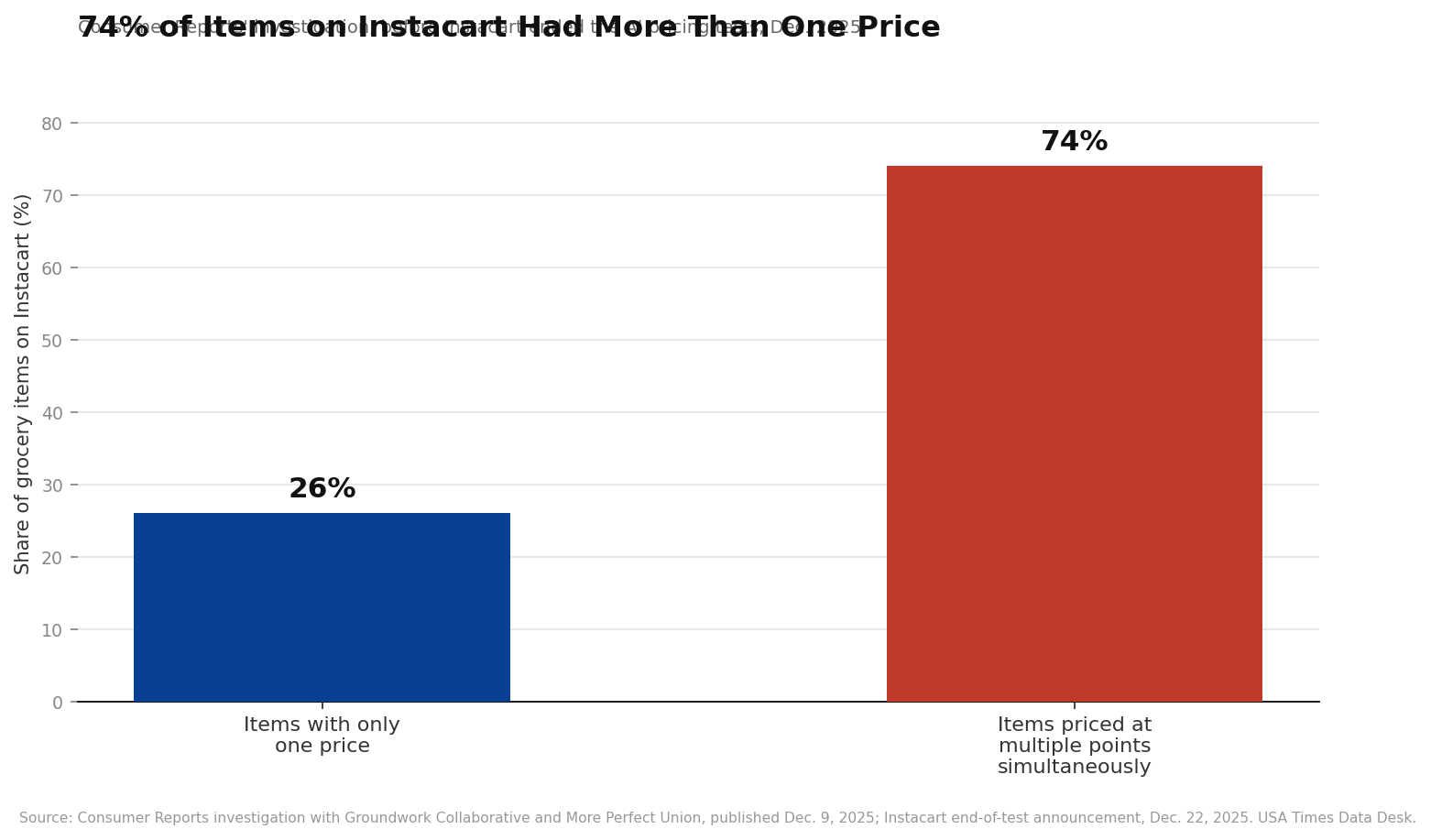
On December 9, 2025, Consumer Reports, Groundwork Collaborative, and More Perfect Union published a joint investigation into Instacart’s pricing: 74% of items checked were being offered at more than one price simultaneously, with some shoppers seeing prices up to 23% higher than others browsing the identical item at the identical store at the identical time. The average gap across the same grocery list was smaller — about 7% — but some individual items carried as many as five different prices for the same product on the same day. Thirteen days later, on December 22, Instacart announced it was ending the practice immediately.
13 Days: From Investigation to Reversal
Click through the timeline of Instacart’s pricing controversy.
Batmandir · Guest Passes Step inside for a day. Guest passes from $161/day — brought in by a member. See guest passes →What Instacart was actually running
The tool behind the pricing was Eversight, an AI-driven price-testing platform that let grocery retailers run randomized experiments on Instacart’s platform to gauge how shoppers would respond to different prices for the same item — the same basic logic as A/B testing a webpage, applied to grocery prices in real time. Instacart’s own December 22 statement characterized what happened plainly: “the tests we ran with a small number of retail partners…resulted in different prices for the same item at the same store,” and acknowledged that this “missed the mark for some customers.” The company drew a distinction it maintained afterward, saying it would continue to allow retailers to test discounts and promotions — which it called “industry standard practice” — while stopping the specific practice of testing different base prices for the same item.
Thirteen days from investigation to reversal
The speed of Instacart’s reversal reflected the speed at which political and regulatory pressure built. Within the two weeks after CR’s findings published, at least 12 members of Congress sent formal letters to Instacart or the FTC. Senate Minority Leader Chuck Schumer wrote directly to the FTC requesting an investigation. A group of seven Democratic senators, including Amy Klobuchar and Cory Booker, wrote to FTC Chairman Andrew Ferguson raising concerns the pricing practice could violate the FTC Act’s prohibition on “unfair or deceptive” commercial practices. On December 17, Reuters reported the FTC had opened an investigation into Instacart’s pricing technology specifically in response to the CR findings. One retail partner, Wegmans — more than 100 stores across 10 East Coast states — confirmed it had already stopped using Instacart’s pricing software on December 10, a day after the investigation published, referring to it internally as a “markup optimization pilot.”
A separate, unrelated $60 million settlement landed the same week
In a coincidence of timing, the FTC and Instacart reached a settlement on December 18 — six days before the pricing-test reversal — in a completely separate case alleging Instacart had advertised free delivery and then charged consumers anyway, and had failed to clearly disclose that a free trial would auto-enroll users into its paid Instacart+ subscription. Under that settlement, Instacart agreed to refund $60 million to affected customers and is barred from “making misrepresentations concerning the costs of delivery services and satisfaction guarantees.” The two cases aren’t legally connected, but their proximity meant Instacart absorbed two distinct consumer-pricing controversies — one about deceptive fees, one about algorithmic price discrimination — within the same ten-day window.
The legislative response is already broader than one company
On the day CR’s findings published, Sen. Ruben Gallego introduced the One Fair Price Act, federal legislation that would prohibit companies from using consumers’ personal data to set individualized prices; it has since picked up co-sponsors and been referred to the Senate Commerce Committee. Separately, New York’s Algorithmic Pricing Disclosure Act — which took effect in November 2025, independent of the Instacart controversy — requires companies to “clearly and conspicuously state when they are using consumers’ personal data to affect prices.” The New York Attorney General’s office sent Instacart a letter in January specifically citing that law and naming 14 retail and consumer-brand partners, including Coca-Cola, Costco, and Target, whose pricing arrangements with Instacart the office wanted documented. More than a dozen additional states have proposed similar algorithmic-pricing disclosure or ban legislation in 2026, and the Republican-led House Oversight Committee opened its own probe in March into AI-enabled pricing software more broadly, requesting records not just from Instacart but from Booking.com, Expedia, Lyft, and Uber as well.
Instacart wasn’t the first target — just the fastest to fold
The Instacart episode landed inside a federal inquiry that predates it by roughly a year. In 2024, the FTC used its Section 6(b) authority — which lets the agency compel information from companies without opening a formal investigation — to subpoena eight companies that build dynamic-pricing and algorithmic-targeting tools for retailers, seeking details on how those vendors obtain consumer data, how their pricing algorithms actually work, and what analysis they’ve done on the resulting impact on shoppers. The FTC’s initial public findings, released in January 2025, described data inputs as granular as a shopper’s precise location, browsing history, and even in-session behavior like mouse movements or which items get added to a cart and then abandoned — all of it potentially usable as an input into what price a given shopper sees. Instacart’s Eversight tool was one visible, consumer-facing example of the exact mechanism the FTC’s broader study had already been examining; it became the highest-profile casualty simply because it was the one a nonprofit investigation caught in the act with a specific, quantified consumer harm attached.
What we did
The core findings — 74% of items priced at multiple points, up to 23% higher for some shoppers, a 7% average gap, and up to five simultaneous prices for a single item — come from Consumer Reports’ original investigation with Groundwork Collaborative and More Perfect Union, published December 9, 2025. We read Consumer Reports’ own follow-up reporting on Instacart’s reversal directly, including the company’s full public statement and the specific dates and content of the Congressional letters, the FTC investigation report (via Reuters, as cited by CR), the unrelated $60 million settlement, and the state and federal legislative response, rather than relying on secondary aggregation of the story. We did not independently re-run Consumer Reports’ price-comparison methodology or verify its underlying price data ourselves, since that would require live access to Instacart’s platform at the specific dates and locations CR’s investigation covered; our reporting here describes and contextualizes their findings and the verified public response to them, and we’ve named the original investigators throughout rather than presenting their data as our own.