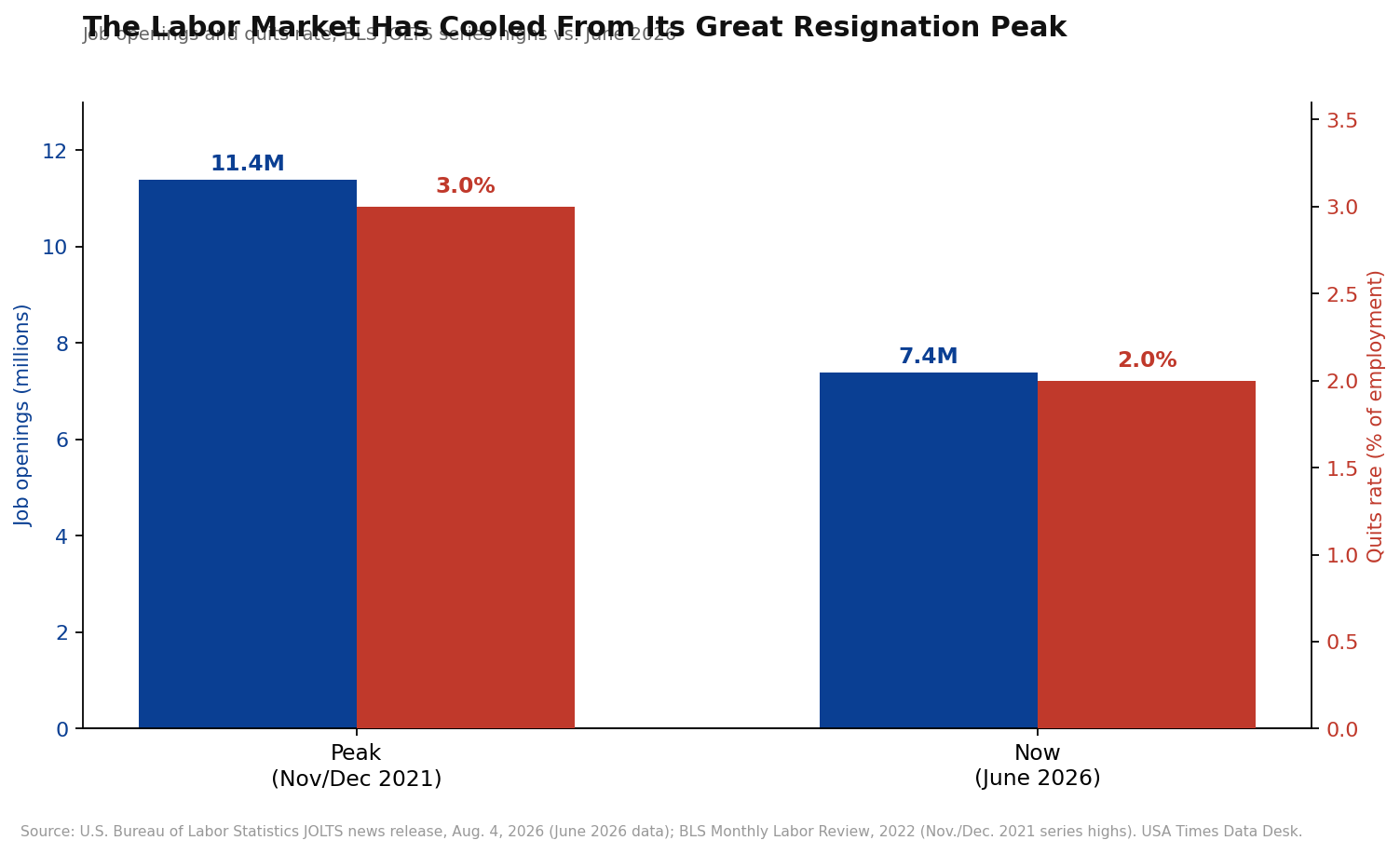
In November 2021, at the peak of what got called the Great Resignation, 3.0% of American workers quit their jobs in a single month — a record 4.5 million people, most of them confident enough in the job market to walk away from something without necessarily having a next thing lined up. According to the Bureau of Labor Statistics’ newest Job Openings and Labor Turnover Survey, released August 4, 2026, that quits rate now sits at 2.0% — and it’s been stuck there for two consecutive months. Job openings, which peaked at 11.4 million in December 2021, have fallen to 7.4 million. The layoffs rate, meanwhile, is also historically low, at 1.1%. Economists have a name for the resulting standstill: a “low-hire, low-fire” labor market, where employers aren’t cutting staff aggressively, but they aren’t hiring aggressively either, and workers aren’t quitting because there’s nowhere obviously better to go.
Labor Market Indicators, Peak vs. Now
Hover any bar for context. All figures from BLS JOLTS.
Batmandir · Guest Passes Step inside for a day. Guest passes from $161/day — brought in by a member. See guest passes →What the quits rate actually measures
BLS is explicit about why it tracks this specific number: quits are voluntary separations initiated by the employee, so the quits rate functions as “a measure of workers’ willingness or ability to leave jobs.” A high quits rate signals workers feel confident they can land something better, or at least something else, quickly — which is why 2021’s number became such a widely cited signal of worker leverage during the pandemic-era hiring crunch. A frozen, low quits rate signals the opposite: workers who might otherwise want to leave a job are choosing to sit tight, either because they don’t see better opportunities available or because they’re worried a job search right now would be harder than it used to be. Layoffs and discharges, tracked separately, are involuntary separations initiated by the employer — and the fact that both quits and layoffs are simultaneously low is what specifically defines “low-hire, low-fire” as distinct from either a booming or a contracting labor market. It isn’t a crisis by the numbers. It’s closer to paralysis: neither side of the employment relationship is moving much.
June’s report, industry by industry
Beneath the flat national numbers, BLS’s industry breakdown shows real movement in specific sectors, just not enough in any one direction to move the aggregate. Job openings rose in transportation, warehousing, and utilities (+97,000) and in federal government (+39,000) in June, while they fell in wholesale trade (-74,000), nondurable goods manufacturing (-55,000), and mining and logging (-9,000). Federal government hiring showed a small net decline in hires (-6,000) even as its job openings ticked up, and federal quits fell by 4,000 — a sector-specific pattern distinct from the private-sector aggregate, though BLS’s report doesn’t break out the specific cause. May’s initial figures were also revised in this release: job openings for May were revised down by 57,000 to 7.5 million, while hires, total separations, quits, and layoffs for that month were all revised upward, a reminder that JOLTS figures — based on survey responses collected over time from businesses and government agencies — get refined for a month or more after their initial release.
How far the reversal has actually gone
Doing the math on the reversal: the quits rate has fallen exactly one-third from its Great Resignation peak, from 3.0% to 2.0%. Job openings have fallen by roughly 35%, from 11.4 million to 7.4 million. Both declines happened gradually over nearly five years rather than as a single sharp correction — there was no equivalent “Great Resignation” news cycle marking the moment the labor market flipped from worker-favorable to this current standstill, which is part of why the shift has been less discussed in real time than the surge that preceded it. The Great Resignation itself wasn’t spread evenly across the economy either: leisure and hospitality peaked at a 6.4% quits rate in November 2021, more than double the national average that month, reflecting how concentrated the worker leverage of that period actually was in specific, often lower-wage, service-sector jobs — which raises the open question of whether the current low-quits environment is similarly concentrated in specific sectors rather than uniform, a breakdown BLS’s June release doesn’t isolate at the level of individual industries’ quits rates in the same way it does for openings.
Why a “boring” number gets this much attention
JOLTS data doesn’t just describe the labor market — it’s a direct input into how the Federal Reserve reads it. The ratio of job openings to unemployed workers, a figure derived directly from this release, is one of the metrics Fed officials have repeatedly cited in public remarks as evidence of whether the labor market is “cooling” in an orderly way or deteriorating faster than the broader economic data suggests. A frozen, historically low quits rate sitting alongside a frozen, historically low layoffs rate is, in that specific framework, closer to the Fed’s stated goal than either a red-hot or a rapidly weakening labor market would be — which is part of why “low-hire, low-fire” gets repeated as a phrase in financial commentary rather than treated as an alarming headline. That framing matters for how the same underlying numbers get used in very different political and economic arguments: the same 2.0% quits rate can be cited as evidence of a successfully engineered soft landing or as evidence that ordinary workers have lost the leverage they had in 2021, depending on who’s citing it and what point they’re making.
What we did
The June 2026 job openings, hires, quits, and layoffs figures, the industry-level movements, and the May revisions all come directly from BLS’s own JOLTS news release (USDL-26-1289), published August 4, 2026 — two days before this article’s publication — which we read in full rather than relying on secondary summaries. The November/December 2021 series-high figures (11.4 million job openings, 4.5 million quits, 3.0% quits rate) and the leisure-and-hospitality 6.4% sectoral peak come from BLS’s own 2022 Monthly Labor Review article on that period, cross-checked against contemporaneous news coverage of the same BLS data release from January 2022 for consistency. We calculated the percentage declines from peak (33% for the quits rate, roughly 35% for job openings) ourselves from those two BLS-sourced figures rather than citing someone else’s calculation of the same numbers.